
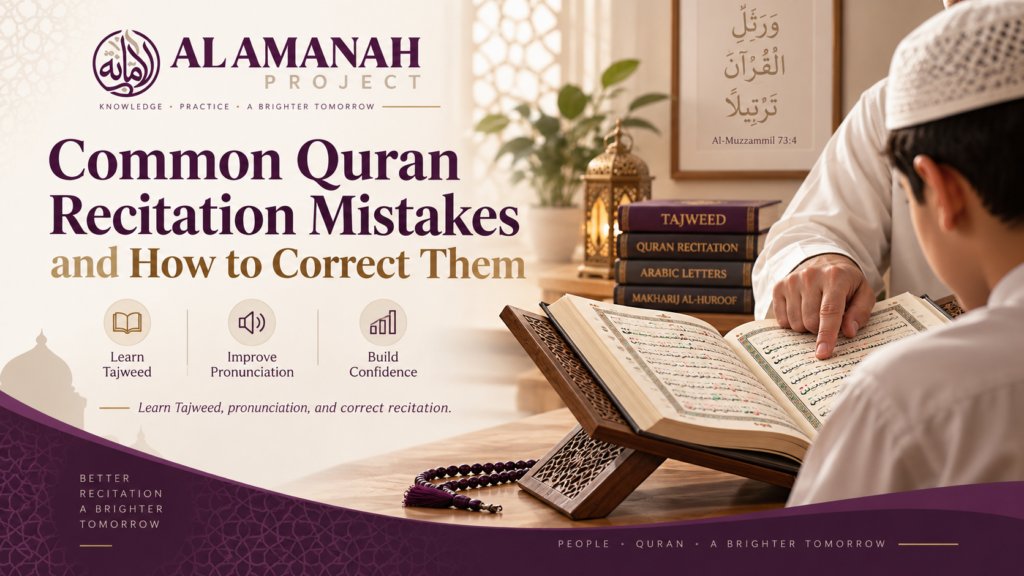
Common Quran Recitation Mistakes and How to Correct Them
Reading the Quran regularly is an important part of a Muslim’s relationship with the Book of Allah, but regular reading alone does not automatically guarantee accurate pronunciation. Many learners develop small habits in Quran Recitation that remain unnoticed for months or even years.
A reader may shorten a long vowel, pronounce one Arabic letter like another, stop at an unsuitable place, overlook a shaddah, or apply a Tajweed rule inconsistently. Some mistakes are immediately noticeable, while others are subtle enough that the reader may not recognize them without listening to a qualified teacher.
The encouraging part is that most Quran Recitation mistakes can be corrected through systematic learning, careful listening, repeated practice, and teacher feedback.
The objective should not be to become anxious about every sound. Instead, learners should gradually develop clearer articulation, greater awareness of Tajweed, and more confidence when reading.
Allah instructs believers to recite the Quran in a measured manner in Surah Al-Muzzammil 73:4. The verse is commonly understood as emphasizing careful, deliberate recitation rather than rushing through the words.
This guide explains the most common mistakes learners make, why they occur, and practical methods that can help improve Quran Recitation step by step.
Why Correct Quran Recitation Matters
Arabic is a precise language. Small differences in the pronunciation of letters, vowels, or grammatical endings can sometimes alter a word significantly.
For that reason, improving Quran Recitation involves more than developing a pleasant voice. Accuracy comes first.
A learner should work on:
- Correct Arabic letter pronunciation
- Makharij, or articulation points
- Characteristics of letters
- Short and long vowels
- Ghunnah
- Madd
- Qalqalah
- Noon sakin and tanween rules
- Meem sakin rules
- Shaddah
- Appropriate stopping and starting
- Smooth but measured reading
Tajweed developed as a systematic way of describing how Quranic sounds and recitation rules are transmitted. Discussions of Quranic studies also emphasize the importance of accurate oral transmission and reciting to another person rather than depending entirely on solitary reading.
A useful principle for learners is therefore:
Learn with your eyes, train with your ears, practise with your tongue, and verify with a teacher.
1. Pronouncing Similar Arabic Letters Incorrectly
One of the most widespread Quran Recitation mistakes is confusing letters that sound similar to beginners.
Common examples include:
- س and ص
- ت and ط
- د and ض
- ذ and ز
- ح and ه
- ك and ق
- ع and ا
- ث and س
- ظ and ز
To someone unfamiliar with Arabic phonetics, these sounds may appear almost interchangeable. They are not.
For example, ق is produced further back in the mouth than ك. Likewise, ح is not simply a stronger version of the English “h”; it has a distinct articulation from the throat.
How to correct this mistake
Do not practise difficult letters only inside long verses.
Isolate them first.
A useful exercise is:
Letter → vowel → word → Quranic phrase
For example, if ق is difficult:
- Practise ق by itself.
- Read قَ, قِ and قُ.
- Practise words containing ق.
- Read those words inside an ayah.
- Ask a teacher to check the sound.
Learners who still struggle with Arabic letters may benefit from rebuilding their foundation through the Al Amanah Project Noorani Qaida course, which focuses on Arabic letters, pronunciation, joining letters, and preparation for Quran reading. Explore the Noorani Qaida Course
2. Ignoring Makharij
Makharij refers to the articulation points from which Arabic letters are produced.
A reader may recognize every letter visually but still pronounce it incorrectly because the tongue, lips, throat, or mouth are positioned incorrectly.
This is why simply looking at the written Arabic alphabet is not sufficient for accurate Quran Recitation.
Letters originate from different areas associated with the throat, tongue, lips, nasal passage, and oral cavity.
A practical Makharij test
Choose one difficult letter.
Say it slowly while paying attention to:
- Where your tongue touches
- Whether your lips are involved
- How much air escapes
- Whether the sound comes from the throat
- Whether nasal resonance is present
Record yourself and compare the sound with reliable recitation.
The Quranic Arabic Corpus also provides phonetic representations of Arabic letters and vowels, helping learners distinguish sounds and understand long vowels, shaddah, hamzah, and other features of Quranic Arabic.
3. Reading Short Vowels as Long Vowels
Arabic distinguishes between short vowels and long vowels.
A beginner may unintentionally stretch:
َ fatha
ِ kasra
ُ dammah
Or they may do the opposite and shorten an actual long vowel.
This creates an important Quran Recitation problem because vowel length is part of correct pronunciation.
How to correct vowel-length mistakes
Practise with a simple beat.
For a normal short vowel, keep the sound brief.
For a basic madd, maintain the required extension according to the rule being applied.
Do not rely purely on intuition. Learn which letters create long vowels and then study the different categories of madd gradually.
Listening to slower reciters can also help. Quran.com provides multiple reciters and word-by-word audio, allowing learners to hear individual Quranic words clearly.
4. Missing or Weakening the Shaddah
A shaddah indicates that a consonant is effectively doubled.
Ignoring it can change how a Quranic word is pronounced.
Some learners see the shaddah but move across it too quickly, producing only a single consonant.
How to practise shaddah correctly
Rather than trying to “make the word louder,” think of the letter as receiving additional articulation time.
Break a difficult word into sound units and practise slowly.
Once the pronunciation becomes stable, return to natural reading speed.
Accurate Quran Recitation often improves faster when learners deliberately slow down during correction rather than repeating the same word incorrectly at full speed.
5. Incorrect Ghunnah
Ghunnah is the nasal sound associated particularly with noon and meem in specific Tajweed situations.
Two common mistakes occur:
- Removing the nasal quality almost completely
- Exaggerating the nasal sound for too long
Neither extreme produces balanced Quran Recitation.
How to improve Ghunnah
Practise words containing:
- نّ
- مّ
- Ikhfa
- Idgham with ghunnah
- Iqlab
Listen carefully to a teacher and observe how long the nasal sound is maintained.
An easy self-check is to place your fingers lightly near your nose while practising. You may notice resonance when ghunnah is properly produced, although physical sensation should never replace teacher correction.
6. Applying Qalqalah Too Strongly
Qalqalah is associated with the letters:
ق ط ب ج د
A frequent beginner mistake is turning Qalqalah into an added vowel.
For example, a reader may effectively add an “a” or “u” sound after the letter.
Qalqalah should create a controlled echo or bounce when applicable; it should not introduce an entirely new vowel.
Correction method
Practise the Qalqalah letter while keeping the mouth ready for the original consonant.
Compare:
correct consonant rebound
with
consonant + accidental vowel
Recording yourself is especially helpful because the unwanted vowel is often more obvious during playback.
7. Reading Too Fast
Speed can create the illusion of fluency.
A learner who reads quickly may feel that their Quran Recitation is improving because they can complete pages faster. In reality, excessive speed often hides mistakes.
Rushing can cause:
- Missing vowels
- Weak Makharij
- Lost shaddah
- Incorrect madd
- Incomplete ghunnah
- Poor stopping
- Merging words unintentionally
Measured reading gives your tongue enough time to produce each sound properly.
Slow practice versus normal recitation
Use two different modes.
Correction mode: Read very slowly and focus on accuracy.
Fluency mode: Read at a comfortable natural pace while preserving the corrections.
Do not try to increase speed until accuracy remains stable.
8. Stopping at the Wrong Place
Correct Quran Recitation includes knowing where to stop and where to continue.
Stopping purely because you are out of breath can sometimes divide a sentence awkwardly or interrupt its meaning.
Traditional Quran manuscripts contain stopping symbols that guide readers.
Learners should gradually recognize commonly used signs and understand how stopping can relate to meaning.
Scholarly treatments of Quranic recitation identify waqf (stopping) and ibtida (resuming) as important areas of recitation study.
How to improve your stopping
Before reading a long ayah:
- Look ahead.
- Identify suitable stopping signs.
- Estimate your breathing capacity.
- Read at a sustainable pace.
- Stop at a meaningful location.
- Learn where to restart.
Understanding basic Quranic Arabic can make this easier because the reader becomes more aware of sentence structure. Al Amanah Project offers an Arabic Language course covering reading, vocabulary, writing, and basic grammar for learners who want a stronger Arabic foundation. Explore the Arabic Language Course
9. Starting Again From an Unsuitable Word
Knowing where to stop is only half the skill.
After taking a breath, learners sometimes restart from the exact word where they stopped without considering whether that creates a complete or appropriate phrase.
Improving Quran Recitation therefore requires learning both stopping and restarting.
When uncertain, a teacher can show you whether to return a few words and begin from a clearer grammatical or meaningful point.
10. Copying a Reciter’s Melody Before Learning Accuracy
Listening to accomplished reciters can be extremely beneficial. The problem begins when learners imitate melody before mastering pronunciation.
Beautiful tone cannot compensate for inaccurate letters.
A learner may become so focused on matching rises and falls in a reciter’s voice that basic Tajweed becomes inconsistent.
A better priority is:
Accuracy → Tajweed → Fluency → Voice improvement
Not the reverse.
Use skilled reciters as pronunciation models, but avoid turning Quran Recitation practice into an imitation exercise in which melody receives more attention than the actual letters.
11. Depending Entirely on Transliteration
Transliteration can help absolute beginners temporarily, but it has serious limitations.
English letters cannot represent every Arabic sound accurately.
For example, writing ع as an apostrophe or “aa” does not teach the actual articulation point.
Likewise, transliterations such as “dh,” “th,” or “kh” only approximate Arabic sounds.
Better approach
Use transliteration as a short bridge, not a permanent reading system.
Gradually move toward:
- Recognizing Arabic letters
- Reading connected letters
- Learning vowel marks
- Recognizing shaddah and sukoon
- Reading directly from the Mushaf
A structured Noorani Qaida foundation is particularly valuable for learners who have been dependent on Romanized text.
12. Learning Tajweed Rules Without Applying Them
Some students can explain Idgham, Ikhfa, Iqlab, Izhar, Madd, and Qalqalah but struggle to identify them while actually reading.
This creates a gap between theoretical knowledge and practical Quran Recitation.
Tajweed should be heard and practised, not merely memorized.
For learners seeking structured application, Al Amanah Project’s Quran Tajweed course covers articulation, essential Tajweed rules, and practical recitation improvement through guided learning.
Learn about the Quran Tajweed Course
Common Quran Recitation Mistakes: Comparison Table
| Mistake | What Usually Happens | Better Correction Method |
|---|---|---|
| Similar letters confused | ص sounds like س or ق like ك | Isolate letters and practise Makharij |
| Long vowels shortened | Madd receives insufficient length | Practise controlled vowel timing |
| Short vowels stretched | Fatha, kasra or dammah becomes too long | Use slow rhythmic exercises |
| Shaddah ignored | Doubled consonant becomes single | Break the word into sound units |
| Ghunnah exaggerated | Nasal sound lasts unnecessarily | Listen and repeat with teacher feedback |
| Qalqalah overdone | Extra vowel appears | Practise consonant rebound without adding a vowel |
| Incorrect stops | Meaning or sentence flow is interrupted | Study waqf signs and plan breathing |
| Fast reading | Tajweed rules disappear | Reduce speed and prioritize accuracy |
| Transliteration dependency | Arabic sounds remain approximate | Transition to direct Arabic reading |
| No teacher feedback | Errors become habitual | Recite regularly to a qualified instructor |
A Practical 15-Minute Quran Recitation Correction Routine
Improvement does not require several hours every day.
Fifteen focused minutes can be more effective than an hour of distracted reading.
Minutes 1–3: Listen
Select two or three ayat and listen carefully to a reliable reciter.
Do not read along immediately.
Focus on sound.
Minutes 4–6: Read slowly
Read the same verses while looking carefully at vowels, shaddah, Tajweed rules, and stopping signs.
Minutes 7–9: Shadow the reciter
Play a short phrase, pause the audio, and repeat it.
Match pronunciation rather than melody.
Minutes 10–12: Record yourself
Recite without the original audio.
Listen to the recording and note obvious differences.
Minutes 13–15: Correct one problem
Choose only one error—perhaps ق, madd, ghunnah, or a stopping issue—and repeat the relevant phrase several times.
This focused method prevents Quran Recitation practice from becoming random.
Quran.com’s word-by-word pronunciation feature can be particularly useful for isolating difficult words, while its Study Mode also allows users to access individual ayat, pronunciation features, tafsir, and related study tools.
Use Quran.com for listening and study
Self-Study vs Teacher-Guided Quran Recitation
| Area | Self-Study | Teacher-Guided Study |
|---|---|---|
| Convenience | Very high | Depends on schedule |
| Identifying personal mistakes | Limited | Strong |
| Makharij correction | Difficult alone | Direct feedback available |
| Tajweed theory | Easy to review independently | Can be explained personally |
| Accountability | Depends on learner | Usually stronger |
| Correcting hidden habits | Difficult | Much easier |
| Cost | Often free or low-cost | May involve tuition |
| Best use | Daily practice and revision | Correction and structured progression |
The strongest approach is usually not choosing one over the other.
Use independent practice frequently and teacher correction regularly.
Historically, Quranic learning has placed strong emphasis on oral transmission and reciting to knowledgeable instructors. Research discussing Quranic transmission likewise notes the importance of recitation being presented to another person and assessed for accuracy.
Pros and Cons of Different Quran Recitation Learning Methods
Learning with a qualified teacher
Pros
- Immediate pronunciation correction
- Personal Makharij feedback
- Structured progression
- Mistakes are identified early
- Accountability encourages consistency
Cons
- Requires scheduling
- Quality varies between teachers
- May involve course fees
Learning through recorded recitations
Pros
- Available anytime
- Excellent for listening practice
- Easy to repeat difficult ayat
- Gives exposure to highly skilled reciters
Cons
- Audio cannot hear your mistakes
- Beginners may copy melody rather than Tajweed
- No personalized correction
Learning through apps and digital tools
Pros
- Convenient
- Useful for repetition
- Word-by-word audio can isolate difficult words
- Helpful for daily revision
Cons
- Technology cannot always diagnose subtle articulation errors
- Learners may develop false confidence without external feedback
The practical solution is a blended approach: teacher guidance for correction, reliable audio for modelling, and independent practice for consistency.
Expert Recommendations From Al Amanah Project
Al Amanah Project’s learning structure places emphasis on foundational Arabic, Noorani Qaida, Tajweed, guided lessons, and practical recitation development. Its Tajweed program specifically covers articulation points, essential rules, and practical Quran Recitation improvement.
Based on this structured approach, learners can benefit from five practical principles.
1. Repair the foundation before chasing fluency
If Arabic letters are still difficult, begin there.
Reading faster will not solve weak letter recognition or incorrect articulation.
2. Correct one recurring mistake at a time
Trying to repair ten Tajweed problems simultaneously can overwhelm a beginner.
Choose one target for several days.
For example:
Week 1: ق versus ك
Week 2: ح versus ه
Week 3: Madd
Week 4: Ghunnah
Gradual correction produces stronger habits.
3. Recite aloud
Silent reading cannot fully train Quran Recitation.
Your ears need to hear what your tongue is producing.
4. Seek regular feedback
A five-minute correction from a knowledgeable teacher can reveal errors that months of independent reading may not uncover.
5. Measure progress by accuracy, not pages completed
Completing more pages is valuable, but during training, the better question is:
“Am I reading this page more accurately than I did last month?”
That creates meaningful progress.
Mistakes to Avoid When Trying to Improve Quickly
Learners sometimes become so determined to improve that they unintentionally slow their own progress.
Avoid:
- Changing teachers repeatedly
- Following conflicting Tajweed explanations simultaneously
- Practising difficult words incorrectly dozens of times
- Focusing entirely on voice beauty
- Comparing your pace with advanced readers
- Trying to master every Tajweed rule in one week
- Feeling embarrassed about basic mistakes
- Depending completely on apps
- Avoiding correction because you already read fluently
The goal of Quran Recitation training is not instant perfection. It is reliable, continuing improvement.
How Long Does It Take to Improve Quran Recitation?
There is no single timeline.
A beginner learning Arabic letters has different needs from an adult who has read the Quran for twenty years but wants to correct Tajweed habits.
Progress depends on:
- Current reading level
- Quality of instruction
- Frequency of practice
- Previous pronunciation habits
- Familiarity with Arabic
- Ability to hear sound differences
- Consistency
Instead of setting a vague goal such as “I want perfect Quran Recitation,” choose measurable goals.
For example:
Within four weeks, I will correctly distinguish ق and ك.
Or:
For the next month, I will have Surah Al-Fatihah checked line by line by my teacher.
Specific goals make improvement visible.
Frequently Asked Questions
1. What are the most common Quran Recitation mistakes?
Common errors include incorrect Makharij, confusing similar Arabic letters, shortening or stretching vowels incorrectly, missing shaddah, misapplying ghunnah or Qalqalah, reading too quickly, and stopping at inappropriate places. Beginners may also rely heavily on transliteration rather than learning to read Arabic directly.
2. Can incorrect Quran Recitation change the meaning?
Some pronunciation changes can affect the identity or grammatical form of a word, which is one reason accurate pronunciation matters. However, not every Tajweed imperfection has the same effect. Learners should avoid becoming unnecessarily anxious and instead have recurring mistakes checked by a knowledgeable Quran teacher.
3. Can I learn Quran Recitation by myself?
You can make significant progress independently through listening, repetition, Tajweed study, and recording yourself. However, self-study has an important limitation: you may not hear your own pronunciation mistakes. Periodic recitation to a qualified teacher is therefore extremely valuable.
4. How can I improve Quran Recitation at home?
Use a consistent routine. Listen to a short passage, read it slowly, repeat after a reliable reciter, record yourself, identify one mistake, and practise that section again. Ten to twenty focused minutes every day can create more improvement than occasional long sessions.
5. Do I need to learn Tajweed before reading the Quran?
Beginners do not need to memorize an entire Tajweed textbook before beginning. They can develop basic reading skills while gradually learning essential pronunciation and Tajweed rules. A teacher can introduce rules in the order that best matches the learner’s current ability.
6. What is the best way to correct Makharij?
First identify the actual articulation point of the letter. Then practise the letter alone, with short vowels, inside simple words, and finally within Quranic verses. Listen to a reliable model and ask a teacher to verify that the sound is being produced correctly.
7. Which reciter is best for learning Quran Recitation?
Rather than searching for one universally “best” reciter, beginners should choose a clear, measured recitation that is easy to follow. Quran.com provides access to several well-known reciters and different recitation styles, making it useful for comparison and repeated listening.
8. Why do I make more mistakes when reading in front of a teacher?
This is common. Nervousness increases cognitive load, which can temporarily reduce fluency. Continue reading to the teacher rather than avoiding it. Familiarity usually reduces anxiety, while the teacher gains an increasingly accurate picture of the mistakes that actually require attention.
9. Is listening to the Quran enough to improve pronunciation?
Listening is essential, but passive listening alone is usually insufficient. Effective Quran Recitation practice requires active repetition. Listen to a phrase, pause, repeat it aloud, record yourself when possible, and compare your pronunciation with the model.
10. Should adults start with Noorani Qaida?
Adults who struggle with Arabic letters, joined letters, vowels, sukoon, shaddah, or basic pronunciation can benefit greatly from returning to Noorani Qaida. Starting with foundational material is not moving backward; it can eliminate long-standing errors and make advanced Tajweed easier to understand.
Reliable Resources for Quran Learners
For additional study, learners may benefit from several authoritative and educational resources.
Quran.com provides Quran text, translations, reciters, word-by-word pronunciation, tafsir, and study tools.
The Quranic Arabic Corpus provides detailed linguistic, grammatical, morphological, and phonetic information for Quranic Arabic.
Yaqeen Institute’s research on Quranic studies and preservation discusses oral transmission, recitation accuracy, and the historical importance of learning Quran through direct transmission.
Yaqeen Institute Quranic Studies
For structured learning through Al Amanah Project, learners can also explore Arabic, Noorani Qaida, and Quran Tajweed programs designed for different stages of Quran learning.
Conclusion
Improving Quran Recitation is rarely about discovering one secret technique. Progress comes from noticing small errors and correcting them consistently.
A letter becomes clearer. A long vowel receives its proper length. A shaddah is no longer skipped. A stop becomes more deliberate. A difficult verse that once felt uncomfortable gradually becomes natural.
Those small changes accumulate.
The most productive learner is not necessarily the person who reads fastest or knows the greatest number of technical Tajweed terms. It is the learner who listens carefully, accepts correction, practises consistently, and refuses to let repeated mistakes become permanent habits.
Use reliable recitations as models, learn the foundations of Arabic pronunciation, study Tajweed gradually, record yourself, and most importantly, let a knowledgeable teacher listen to your reading.
With patience and structured practice, Quran Recitation can become clearer, more confident, more accurate, and more meaningful.
Learn Quran with Al Amanah Project
If you want structured support with Arabic letters, Noorani Qaida, Tajweed, pronunciation, and Quran Recitation, explore the learning resources and courses available through Al Amanah Project.
Al Amanah Project
Hyderabad, Telangana
Phone: +91 98492 87719