
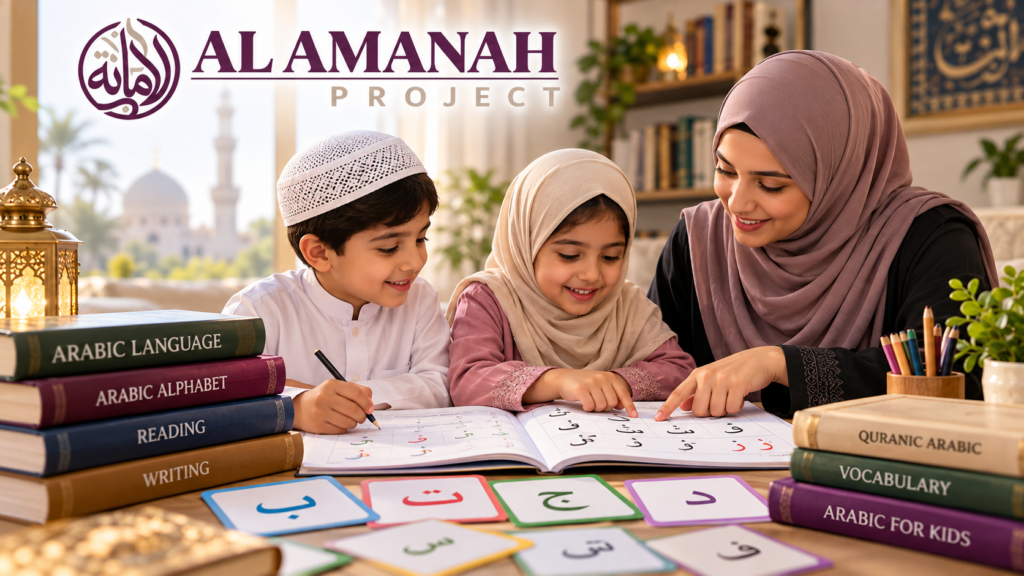
Learning Arabic for Kids: A Parent’s Complete Guide
Imagine your child confidently recognising Arabic letters, reading simple words, understanding familiar expressions and eventually forming sentences independently. For many parents, this is an important educational goal, but knowing where to begin can feel overwhelming.
Should children start with the alphabet? Is speaking more important than writing? Can online lessons work for young learners? And how do parents help when they cannot speak Arabic themselves?
The good news is that learning the Arabic Language does not have to begin with complicated grammar books or lengthy classroom sessions. With age-appropriate activities, consistent practice and patient guidance, children can develop strong language foundations while enjoying the experience.
Arabic is particularly meaningful for families interested in Quranic education, Islamic studies, cultural connections and multilingual communication. However, the benefits extend beyond religious learning. Children can use their skills to communicate with Arabic-speaking communities, explore literature and develop an appreciation of different cultures.
This comprehensive guide from Al Amanah Project explains how parents can introduce Arabic effectively, choose suitable learning methods, build a realistic home routine and recognise meaningful progress.
Why Learning Arabic Is Valuable for Children
Introducing a second language during childhood can create opportunities for communication, cultural understanding and future education.
However, parents should focus on sustainable learning rather than expecting immediate fluency.
1. Building Early Communication Skills
Children who regularly hear and use Arabic become familiar with its rhythm, pronunciation and vocabulary.
Simple expressions such as مرحباً (Marhaban, hello) and شكراً (Shukran, thank you) introduce practical communication without requiring advanced reading skills.
As confidence improves, children can progress from isolated words to short exchanges.
For example, a parent might ask:
ما اسمك؟ (Ma ismuka? / Ma ismuki?) — What is your name?
A child can respond with:
اسمي أحمد (Ismi Ahmad) — My name is Ahmad.
Such everyday conversations make language learning purposeful.
2. Supporting Quranic and Islamic Education
For Muslim families, developing Arabic reading skills can support Quran recitation and engagement with Islamic texts.
Learning letter shapes, vowel marks and pronunciation prepares children for foundational reading programmes such as Noorani Qaida.
However, it is important to understand that Quranic recitation and conversational Arabic require overlapping but different skills.
A child who reads Quranic text accurately may not automatically understand everyday Arabic conversations.
Parents should therefore select lessons according to their child’s educational goals.
Families seeking foundational Quran reading instruction can explore the Noorani Qaida Course at Al Amanah Project.
3. Strengthening Cultural Awareness
Learning the Arabic Language also introduces children to different traditions, stories, greetings and cultural practices.
Arabic is used across numerous countries, with regional differences in everyday speech.
Children who learn Modern Standard Arabic gain access to a shared formal variety commonly found in educational materials, books and formal communication.
They may later explore spoken dialects according to family background or communication needs.
The UNESCO guidance on multilingual education highlights the importance of recognising linguistic diversity and supporting inclusive learning environments.
What Is the Best Age for Kids to Start Learning Arabic?
Parents often wonder whether children should begin at three, five or ten years old.
There is no universal starting age that guarantees success.
Early exposure can help children become comfortable with unfamiliar sounds, but older beginners can also develop excellent reading and communication skills with suitable instruction.
The key is matching activities to developmental readiness.
Ages 3–5: Listening, Songs and Recognition
Preschool children benefit from play-based exposure.
Useful activities include:
- Listening to Arabic nursery rhymes and simple stories.
- Identifying colours, animals and household objects.
- Matching Arabic letters with colourful picture cards.
- Repeating greetings and familiar expressions.
- Tracing large letter shapes through sensory activities.
Formal grammar instruction is usually unnecessary at this stage.
A five-minute activity completed with enthusiasm may be more valuable than a prolonged session that creates frustration.
Ages 6–8: Alphabet and Basic Reading
Children in this group can often begin structured letter recognition and sound blending.
A typical lesson might introduce the letters ب, ت and ث, followed by guided pronunciation and writing practice.
Students can gradually learn short vowel marks and simple word construction.
For children developing Quran-reading skills, this is also a suitable stage for carefully paced beginner lessons, depending on individual readiness.
Ages 9–12: Vocabulary and Sentence Formation
Older children can begin learning grammar through meaningful examples.
They may describe family members, write short sentences, read illustrated stories and participate in guided conversations.
At this stage, teachers can introduce concepts such as masculine and feminine nouns without overwhelming students with advanced terminology.
Ages 13 and Above: Structured Language Development
Teenagers often benefit from clear educational targets.
These might include understanding simple written passages, improving pronunciation or preparing for more advanced Arabic studies.
Older beginners should not feel disadvantaged simply because they started later.
Motivation, teaching quality and regular practice remain important.
Understanding the Arabic Alphabet: The First Important Step
The Arabic alphabet contains 28 basic letters and is written from right to left.
Unlike English, many Arabic letters change their written appearance depending on their position within a word.
This can initially confuse children who are accustomed to the Latin alphabet.
A practical teaching sequence should therefore introduce recognition before demanding fluent writing.
Step 1: Recognise Letter Shapes
Start with a small group of letters rather than presenting the entire alphabet at once.
For example:
- ا — Alif
- ب — Bāʾ
- ت — Tāʾ
- ث — Thāʾ
Ask children to identify these letters in different sizes and printed styles.
The goal is recognition, not perfect handwriting.
Step 2: Learn Correct Sounds
Certain Arabic sounds do not have direct equivalents in English, Urdu or Telugu.
Letters such as ع and ح may require additional listening and careful guidance.
Parents should avoid relying entirely on English transliteration because Roman letters cannot consistently represent Arabic pronunciation.
Listening to a competent teacher and observing mouth movements can help.
Step 3: Understand Short Vowels
Once children recognise letters, introduce the basic vowel marks:
- Fatha (َ): a short a sound.
- Kasra (ِ): a short i sound.
- Damma (ُ): a short u sound.
For example, بَ, بِ and بُ represent different syllables.
Practising these combinations helps children move from memorising letters toward decoding words.
Step 4: Connect Letters into Words
The next step is understanding how letters join together.
Children should practise reading simple, fully vowelled words before advancing to longer sentences.
Teachers can demonstrate how the same letter changes shape while retaining its identity.
This reduces confusion and develops reading accuracy.
Step 5: Introduce Writing Gradually
Arabic handwriting requires practice with direction, joining rules and letter placement.
Begin with tracing, then copying, and finally independent writing.
Correct formation matters more than speed.
Parents should celebrate recognisable letters rather than insisting on perfect handwriting during every practice session.
Arabic Language Learning Methods: Which Is Best for Your Child?
Different teaching methods serve different purposes. The best option depends on the child’s age, confidence, existing knowledge and learning goals.
| Learning Method | Main Advantages | Possible Limitations | Best Suited For |
|---|---|---|---|
| Online teacher-led classes | Live correction, structured lessons and convenience | Requires reliable internet and attention | Children needing guided learning |
| In-person Arabic classes | Direct interaction and classroom participation | Travel and scheduling requirements | Children who prefer classroom routines |
| Arabic learning apps | Interactive games and independent revision | Limited personalised pronunciation correction | Supplementary practice |
| Parent-led learning | Flexible, familiar and inexpensive | Depends on parental knowledge | Young beginners |
| Storybooks and flashcards | Vocabulary building and reading exposure | May not teach accurate pronunciation alone | Early and intermediate learners |
| Noorani Qaida lessons | Structured letter and Quran-reading foundations | Does not replace comprehensive conversational Arabic | Quran-reading beginners |
For many families, a blended approach works well.
A child might attend teacher-led classes several times a week and practise vocabulary through short activities at home.
The important consideration is not how many resources are available but whether the child can use them consistently.
Pros and Cons of Learning Arabic Online for Kids
Online education has made specialist language instruction more accessible, including for families living outside major cities.
Nevertheless, it should be evaluated carefully.
Advantages
Flexible scheduling: Families can choose lessons around school, homework and other commitments.
Access to guided instruction: Online programmes can connect children with teachers who understand Arabic pronunciation and beginner reading.
Comfortable learning environment: Some shy children participate more confidently from familiar surroundings.
Regular revision: Digital worksheets, recordings and teacher feedback may help children revisit challenging topics.
Parental involvement: Parents can observe learning activities and reinforce them between classes.
Disadvantages
Screen fatigue: Younger children may struggle with long sessions.
Distractions: Notifications, toys and background noise can interfere with attention.
Technical interruptions: Poor internet connectivity can affect speaking and listening exercises.
Reduced physical interaction: Certain children respond better to classroom games and group participation.
Uneven course quality: Not every online programme offers structured progression or individual feedback.
The practical solution is to choose an appropriate lesson duration, provide a quiet learning space and confirm that the teacher regularly checks understanding.
Parents interested in guided reading, writing, vocabulary and grammar instruction can review the Arabic Language Course offered by Al Amanah Project.
How Parents Can Teach Arabic at Home Without Being Fluent
Many parents hesitate to support Arabic lessons because they cannot pronounce every letter correctly or explain grammar.
Fortunately, effective parental involvement does not require fluency.
Your primary responsibility is to create opportunities for practice, encourage curiosity and maintain a consistent routine.
The British Council’s guidance for parents recommends short, enjoyable activities and encourages parents to participate even when they are not proficient in the language being studied. Although the resource focuses on English, several of its principles are useful for supporting Arabic learners.
Create an Arabic Learning Corner
Choose a quiet place with an alphabet chart, beginner books, flashcards and writing materials.
Keep resources accessible so children can revisit them independently.
Avoid filling the space with too many materials. A few well-chosen resources are usually easier to manage.
Introduce Five Everyday Arabic Words
Choose vocabulary connected to objects your child sees regularly.
| Arabic Word | Pronunciation | English Meaning |
|---|---|---|
| كِتَاب | Kitāb | Book |
| بَاب | Bāb | Door |
| بَيْت | Bayt | House |
| مَاء | Māʾ | Water |
| قَلَم | Qalam | Pen |
Instead of asking children to memorise all five words immediately, introduce them through practical activities.
For example, show a book and pronounce كِتَاب. Ask your child to repeat it and identify the object.
During the following session, revise the previous word before introducing another.
Make Arabic Language Practice Part of Daily Life
Daily activities provide natural opportunities for vocabulary revision.
During breakfast, practise food-related words. During playtime, revise colours and numbers. Before bedtime, review one short story or familiar expression.
This method connects language with real experiences rather than treating every lesson as a separate academic task.
A Practical 30-Day Arabic Learning Plan for Kids
Parents frequently ask how much a child can learn during the first month.
The answer depends on age, lesson frequency and previous exposure.
Rather than promising fluency in 30 days, use the first month to establish familiarity and positive learning habits.
| Period | Learning Focus | Suggested Activities | Progress Indicator |
|---|---|---|---|
| Week 1 | Letter recognition | Flashcards, alphabet listening and matching games | Recognises selected letters |
| Week 2 | Sounds and vowels | Listening, pronunciation and vowel exercises | Distinguishes practised sounds |
| Week 3 | Words and vocabulary | Picture cards, blending and everyday expressions | Reads or recalls simple items |
| Week 4 | Revision and application | Short reading, writing and conversation games | Demonstrates skills with less assistance |
These are suggested activities, not compulsory milestones. Some children will need several weeks on letter recognition alone.
A 15-Minute Daily Practice Routine
For a school-age beginner, a simple routine could look like this:
- Minutes 1–3: Revise previously learned letters.
- Minutes 4–7: Introduce or practise a sound.
- Minutes 8–11: Complete a reading or matching activity.
- Minutes 12–14: Practise vocabulary or handwriting.
- Minute 15: Celebrate progress and identify tomorrow’s activity.
Preschool children may benefit from shorter sessions.
Consistency matters more than forcing children to finish a predetermined number of exercises.
Fun Arabic Language Activities That Encourage Real Learning
Children are more likely to participate when activities are varied and achievable.
Arabic Alphabet Treasure Hunt
Write familiar Arabic letters on separate cards and hide them around a room.
Ask your child to find a particular letter.
When they discover it, encourage them to pronounce its sound.
For greater difficulty, ask them to identify a word beginning with that letter.
Picture and Word Matching
Prepare picture cards showing familiar objects and separate cards containing their Arabic names.
Start with two or three pairs.
Once the child understands the activity, gradually introduce more vocabulary.
This game supports visual recognition and word association.
Arabic Storytelling
Choose illustrated stories containing simple vocabulary.
Read the story aloud while pointing to relevant pictures.
Ask questions such as, “Where is the cat?” or “Can you find the house?”
Children do not need to understand every word to benefit from listening practice.
Record and Compare Pronunciation
With appropriate parental supervision, children can record themselves pronouncing selected words.
Compare the recordings with teacher-provided examples.
Focus on one improvement at a time rather than correcting every mistake simultaneously.
A knowledgeable teacher should guide difficult sounds because recordings alone may not reveal articulation errors.
Common Mistakes Parents Should Avoid
Even supportive parents sometimes introduce unnecessary difficulties.
One common mistake is requiring children to memorise too many letters at once.
Another is concentrating exclusively on written exercises while neglecting listening and speaking.
Parents should also avoid using transliteration as a permanent replacement for Arabic script.
Romanised spellings may help beginners understand an unfamiliar word, but long-term dependence can interfere with direct reading.
A particularly important mistake is comparing siblings.
One child may learn new vocabulary quickly but struggle with handwriting. Another may read confidently while needing more speaking practice.
These differences do not necessarily indicate poor progress.
A practical approach is to assess each skill separately.
The ACTFL proficiency guidelines recognise listening, speaking, reading and writing as distinct domains. Parents can use this distinction to develop balanced learning goals instead of judging ability through reading performance alone.
How to Measure Your Child’s Arabic Language Progress
Successful learning should be measured by what children can independently demonstrate.
A child who remembers ten meaningful words and uses them correctly may be making better practical progress than one who recites a long memorised vocabulary list without understanding it.
The Four-Skill Progress Check
Use the following questions during a monthly review.
Listening: Can your child identify familiar words after hearing them?
Speaking: Can your child pronounce practised words and respond to simple prompts?
Reading: Can your child recognise letters and decode age-appropriate combinations?
Writing: Can your child form familiar letters or copy words accurately?
Record progress as:
- Needs full assistance
- Can perform with a prompt
- Can perform independently
This simple system helps parents identify where additional support is necessary.
A further improvement is to retain one small work sample each month, such as a handwriting page or short audio recording.
Comparing samples over time offers more meaningful evidence than repeatedly testing children against arbitrary deadlines.
Expert Recommendations from Al Amanah Project
The following recommendations are practical applications of the structured lessons, guided practice and teacher-feedback approach described in Al Amanah Project’s educational programmes.
1. Begin with a Clear Learning Objective
Determine whether your priority is Quran reading, general Arabic communication, writing or vocabulary development.
Children may eventually study all these areas, but identifying an initial goal allows teachers to choose suitable activities.
2. Prioritise Pronunciation Before Reading Speed
Accurate letter recognition and pronunciation provide an important foundation for subsequent learning.
When children confuse similar sounds, teachers should provide individual correction before encouraging faster reading.
3. Combine Guided Lessons with Home Revision
Formal lessons introduce concepts and provide feedback.
Home revision reinforces those concepts.
A manageable routine is more sustainable than occasional intensive practice.
4. Introduce Grammar Through Examples
Young beginners generally do not need lengthy explanations of grammatical terminology.
Instead, teachers can demonstrate sentence patterns and help children recognise how meaning changes.
As students mature, formal explanations can be introduced gradually.
5. Select the Appropriate Learning Path
Children focused on Quran reading may begin with Noorani Qaida and progress to more detailed pronunciation and recitation instruction.
Students interested in wider vocabulary, writing and comprehension may benefit from a general Arabic course.
Families working toward accurate Quran recitation can explore the Tajweed Course at Al Amanah Project, which includes guided practice and pronunciation correction.
6. Review Progress Without Creating Pressure
Regular feedback should help parents understand what their child has learned, which difficulties remain and what should happen next.
Al Amanah Project’s course information and student-learning resources provide a starting point for families considering a structured programme.
Before enrolling, parents should confirm current scheduling, teacher availability, lesson suitability and fees.
Frequently Asked Questions About Learning Arabic for Kids
1. What is the easiest way to teach Arabic to a child?
Begin with listening exercises, simple greetings and a small number of alphabet letters. Use pictures, games and teacher-supported pronunciation practice. Introduce reading and handwriting gradually, once the child can recognise familiar sounds and shapes. Short, consistent activities are generally easier for young learners to sustain than lengthy sessions.
2. Can a five-year-old start learning the Arabic Language?
Yes. Many five-year-olds can begin with playful alphabet recognition, familiar vocabulary and simple listening activities. However, the content and lesson duration should suit the child’s attention span and individual development. At this age, building interest and confidence is usually more important than completing an advanced syllabus.
3. How long does it take children to learn Arabic?
There is no fixed timeline. Recognising selected letters might take weeks, while developing comfortable reading and conversational ability can require substantially longer. Progress depends on previous exposure, learning frequency, teacher guidance and opportunities to use the language. Parents should set gradual goals rather than expecting fluency within a few months.
4. Is the Arabic Language difficult for English-speaking children?
Arabic introduces unfamiliar letters, right-to-left writing and sounds that may not exist in English. These features can initially seem challenging. However, carefully sequenced lessons, repeated listening and patient practice help children become familiar with them. Difficulty varies between learners and should not be interpreted as a lack of ability.
5. Should kids learn Arabic speaking or reading first?
Young children can develop listening and speaking familiarity before formal reading. School-age beginners can also practise these skills alongside alphabet recognition. The order should reflect the child’s goals. A Quran-reading programme may emphasise script and pronunciation, while a conversational programme may prioritise listening and everyday expressions.
6. Are online Arabic classes effective for children?
Online classes can be effective when lessons are interactive, age-appropriate and supported by regular teacher feedback. Parents should look for opportunities to hear correct pronunciation, ask questions and practise independently. A programme consisting only of prerecorded videos may not provide sufficient support for children who need individual correction.
7. Can parents teach Arabic without knowing the language?
Yes, parents can support lessons by organising practice time, using teacher-approved recordings, reviewing flashcards and encouraging children to explain what they have learned. However, they should seek qualified guidance for difficult pronunciation or grammatical questions rather than relying on guesses.
8. Is Noorani Qaida enough to learn conversational Arabic?
Noorani Qaida primarily supports Arabic letter recognition, pronunciation and foundational Quran-reading skills. It is not designed to replace a complete conversational language curriculum. Children who want to communicate in Arabic should also study practical vocabulary, sentence formation, listening comprehension and speaking.
9. How many minutes should children practise Arabic every day?
Young children may begin with approximately five to fifteen minutes of enjoyable practice, while older children may manage longer sessions. The appropriate duration depends on concentration, motivation and existing commitments. Consistent practice with meaningful engagement is generally preferable to exhausting sessions that discourage participation.
10. How can I choose the best Arabic course for my child?
Start by identifying your child’s current reading level, age and learning objectives. Ask whether the programme offers an age-appropriate curriculum, individual pronunciation feedback, revision materials and progress updates. Consider whether online or in-person classes suit your family. A suitable course should build confidence while gradually increasing difficulty.
Begin Your Child’s Arabic Learning Journey with Al Amanah Project
Learning a new language becomes easier when children receive a combination of structured instruction, encouraging feedback and manageable practice opportunities.
Al Amanah Project provides learning pathways covering Arabic reading, writing, vocabulary, basic grammar and foundational Quran-reading skills.
Parents can explore the available programmes and discuss suitable learning options according to their child’s current abilities.
Contact Al Amanah Project
Location: Hyderabad, Telangana, India
Phone: +91 98492 87719
Website: https://alamanahproject.com/
Arabic Language Course: Explore Course Details
Conclusion: Help Your Child Build a Lasting Connection with Arabic
The most valuable result of early Arabic education is not how quickly a child finishes the alphabet or completes a textbook.
It is the confidence to recognise familiar words, attempt new sounds, understand simple expressions and continue learning without fear of mistakes.
Parents contribute significantly to this process through encouragement, consistency and thoughtful involvement.
By combining suitable instruction with storytelling, vocabulary games, pronunciation practice and regular revision, families can make the Arabic Language a meaningful part of childhood education.
Whether the goal is better Quran reading, improved communication or a deeper connection with cultural heritage, progress begins with an achievable first step.
Al Amanah Project offers a structured starting point for families who want to help children develop those foundations and continue learning with confidence.