
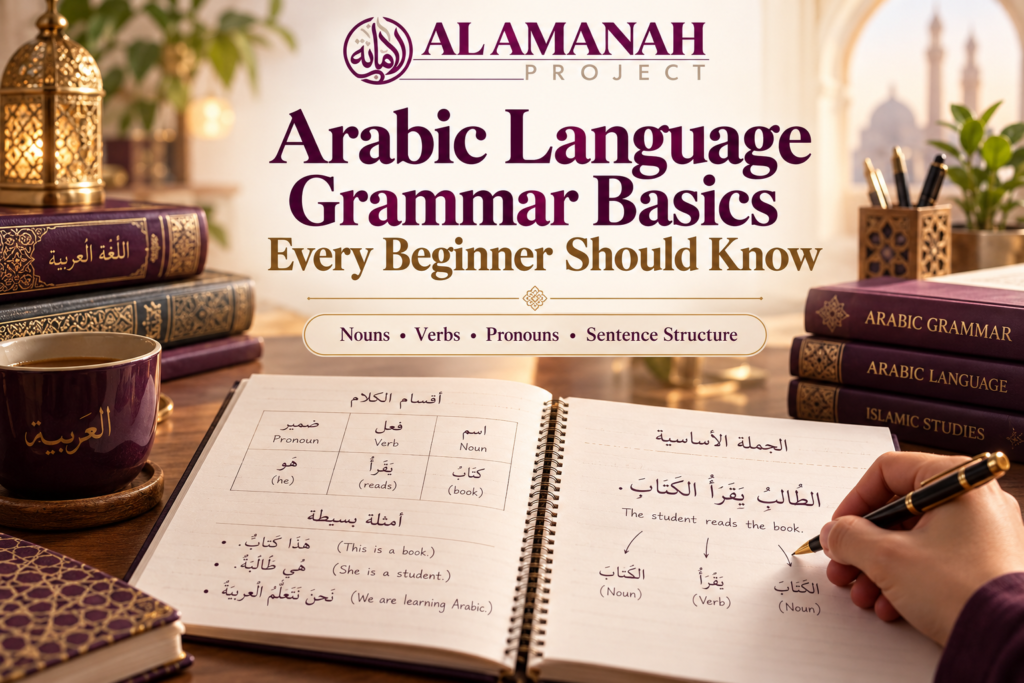
Arabic Language Grammar Basics Every Beginner Should Know
Learning the Arabic Language can feel challenging in the beginning, especially when a learner sees unfamiliar letters, new sentence patterns, masculine and feminine forms, verb changes, and case endings all at once.
The good news is that beginners do not need to master every grammar rule before they can start reading or forming meaningful sentences.
A better approach is to learn a small set of high-value grammar concepts first, practise them repeatedly, and then build more advanced knowledge on top of that foundation.
This is especially important for students who want to study Arabic for everyday communication, academic purposes, Islamic studies, or a deeper understanding of Quranic vocabulary.
Al Amaanah Project follows a structured approach to Arabic learning. Its Arabic Language Course includes reading, writing, vocabulary, and basic grammar, while its wider learning pathway also includes Noorani Qaida and Tajweed for learners working toward stronger Quran-reading skills. Alamanah Project
This guide explains the most useful Arabic Language grammar basics every beginner should understand, with examples that are simple enough to use immediately.
Why Arabic Grammar Matters for Beginners
Grammar is not simply a collection of rules.
It explains why words behave differently in different sentences.
For example, a learner may know the words:
طالب — student
كتاب — book
قرأ — read
But vocabulary alone does not explain how to say:
“The student read the book.”
Once grammar is introduced, these words can become:
قرأ الطالبُ الكتابَ
Qara’a at-taalibu al-kitaaba.
The basic pattern is:
Verb + subject + object
This is a verbal sentence.
Arabic learning resources commonly distinguish between nominal sentences and verbal sentences, which is one of the first important structural concepts for students to understand. تعلم العربية
For a beginner, grammar should therefore be viewed as a practical tool for combining vocabulary correctly.
1. Learn the Three Main Parts of Speech First
One of the strongest starting points in the Arabic Language is understanding that Arabic words are traditionally divided into three major categories:
- Ism — noun
- Fi’l — verb
- Harf — particle
Al Jazeera’s Arabic learning resources also introduce these three categories as the fundamental parts of speech in Arabic grammar. تعلم العربية
Ism: Nouns and Descriptive Words
An ism may refer to a person, place, thing, quality, or description. Arabic Language Arabic Language
Examples:
كتاب — book
طالب — student
مدرسة — school
جميل — beautiful
Arabic nouns may also carry features such as gender, number, definiteness, and grammatical case.
Fi’l: Verbs
A verb expresses an action or occurrence.
Examples:
كتب — he wrote
يكتب — he writes
قرأ — he read
يقرأ — he reads
Arabic verbs change according to tense, person, number, and gender.Arabic Language
Harf: Particles
Particles connect words or change their grammatical relationship.
Examples include:
في — in
من — from
إلى — to
على — on
A beginner who learns to identify these three categories can analyse sentences more confidently.Arabic Language
2. Understand Nominal and Verbal Sentences
Arabic commonly uses two major sentence types.
Nominal Sentence
A nominal sentence usually begins with a noun or pronoun.
Example:
البيتُ كبيرٌ
The house is big.
The two main components are traditionally called:
Mubtada’ — the subject or topic
Khabar — the information given about the topic
Al Jazeera’s Arabic grammar material explains that the nominal sentence is commonly formed from a mubtada’ and khabar. تعلم العربية
Another example:
الطالبُ مجتهدٌ
The student is hardworking.
Notice something important.
There is no separate Arabic word equivalent to “is” in this simple present-tense nominal sentence.
Beginners often try to translate English word for word and become confused.
Arabic sentence logic is different.Arabic Language
Verbal Sentence
A verbal sentence normally begins with a verb.Arabic Language Arabic Language Arabic Language Arabic Language Arabic Language
Example:
كتبَ الطالبُ الدرسَ
The student wrote the lesson.
The usual structure is:
Verb + subject + object Arabic Language Arabic Language Arabic Language Arabic Language
Arabic grammar references explain that the verbal sentence can contain a verb and subject, with an object added when the verb requires one. تعلم العربية
Understanding this difference helps learners read sentences more naturally instead of trying to force English word order onto Arabic.
3. Learn Masculine and Feminine Forms
Gender plays an important role in the Arabic Language.
Arabic nouns are generally treated as masculine or feminine.Arabic Language Arabic Language Arabic Language Arabic Language
Examples:
طالب — male student
طالبة — female student
معلم — male teacher
معلمة — female teacher
A common feminine marker is the taa marbuta:
ة
For example:
مدرسة — school
سيارة — car
طالبة — female student
However, beginners should remember that not every feminine noun ends in ة, and not every noun should be guessed from appearance alone.
Why Gender Matters
Gender can affect:
- Adjectives
- Pronouns
- Verbs
- Demonstratives
For example:
طالبٌ مجتهدٌ
A hardworking male student
طالبةٌ مجتهدةٌ
A hardworking female student
Both the noun and adjective change.
A beginner should therefore learn vocabulary together with gender whenever possible.
4. Learn Singular, Dual, and Plural
English mainly distinguishes between singular and plural.
Arabic adds another category:
Dual, used specifically for two.
This is a distinctive feature of Arabic Language grammar.
Consider:
كتاب — one book
كتابان — two books
كتب — books
Similarly:
طالب — one student
طالبان — two students
طلاب — students
Why the Dual Is Important
Instead of saying “two students” using a separate number every time, Arabic often changes the noun itself.
This may feel unusual at first, but it becomes easier through repeated exposure.
5. Understand Definite and Indefinite Nouns
English uses “a,” “an,” and “the.”
Arabic expresses definiteness differently.
Indefinite
كتابٌ
A book
Definite
الكتابُ
The book
The Arabic definite article is:
ال
It is placed at the beginning of a noun.
Examples:
بيت — a house
البيت — the house
طالب — a student
الطالب — the student
This small rule has a major impact on adjective agreement and sentence construction.
6. Learn Adjective Agreement
One of the most important Arabic Language grammar rules for beginners is that adjectives normally agree with the nouns they describe.
They can agree in areas such as:
- Gender
- Number
- Definiteness
- Grammatical case
Example:
كتابٌ جديدٌ
A new book
الكتابُ الجديدُ
The new book
Notice that when the noun becomes definite, the adjective also becomes definite.
Another example:
طالبةٌ مجتهدةٌ
A hardworking female student
This agreement system may initially look complicated, but beginners usually improve quickly when they practise noun-adjective pairs instead of memorising adjectives in isolation.
7. Learn Personal Pronouns Early
Pronouns are among the most frequently used words in any language.
Some common independent Arabic pronouns include:
أنا — I
أنتَ — you, masculine
أنتِ — you, feminine
هو — he
هي — she
نحن — we
هم — they
These pronouns are important because verb forms often change according to the person performing the action.
For example:
أنا أكتب
I write
هو يكتب
He writes
هي تكتب
She writes
نحن نكتب
We write
Instead of memorising a verb as a single fixed word, learners should gradually learn how it changes with common pronouns.
8. Understand Basic Verb Tenses
Arabic verb study can become very detailed, but beginners should first concentrate on three core forms:
- Past
- Present or imperfect
- Imperative
Arabic learning resources commonly introduce these three basic verb categories. تعلم العربية
Consider the root idea “to write”:
كتبَ
He wrote
يكتبُ
He writes
اكتبْ
Write!
A beginner does not need to memorise every advanced verb pattern immediately.
Start with common verbs such as:
قرأ — read
كتب — wrote
ذهب — went
جلس — sat
فتح — opened
شرب — drank
Then practise them in short sentences.
9. Learn Subject-Verb Agreement Gradually
Arabic verb agreement is an area where beginners often become frustrated because the verb changes depending on the subject.
For example:
كتبَ الطالبُ
The male student wrote.
كتبتِ الطالبةُ
The female student wrote.
Gender affects the verb.
Plural subjects introduce additional patterns.
However, learners should avoid trying to memorise an enormous conjugation chart before they can use basic sentences.
A more effective progression is:
Learn “I.”
Then learn “he” and “she.”
Then learn “you.”
Then “we.”
After that, add dual and plural patterns.
This reduces cognitive overload.
10. Understand Attached Pronouns
Arabic can attach pronouns directly to words.
For example:
كتاب — book
كتابي — my book
كتابك — your book
كتابه — his book
كتابها — her book
This feature makes Arabic Language sentences compact.
The same concept appears with objects and prepositions at more advanced levels.
Beginners should become comfortable recognising attached pronouns because they appear frequently in Arabic reading.
11. Learn Prepositions With Examples
Prepositions are short words, but they influence the form of the noun that follows.
Common examples include:
في — in
على — on
من — from
إلى — to
مع — with
Examples:
في البيت
In the house
إلى المدرسة
To the school
مع المعلم
With the teacher
Instead of memorising isolated prepositions, learn them inside short phrases.
This gives the learner an intuitive feel for sentence structure.
12. Understand Basic Case Endings Without Becoming Overwhelmed
One feature that often makes beginners nervous is grammatical case.
Classical and formal Arabic can use endings that indicate grammatical function.
Three important case concepts are:
Nominative
Often associated with subjects.
Accusative
Often associated with direct objects.
Genitive
Common after prepositions and in possessive constructions.
For example:
كتبَ الطالبُ الدرسَ
The student wrote the lesson.
Here:
الطالبُ is the subject.
الدرسَ is the direct object.
A beginner does not need to master every exception at once.
First understand that word endings can indicate what role a noun plays.
Then learn the detailed rules step by step.
Arabic Grammar Concepts Compared
| Grammar Area | Beginner Question | Simple Rule | Example |
|---|---|---|---|
| Parts of speech | What type of word is this? | Noun, verb, or particle | كتاب، كتب، في |
| Sentence type | How does the sentence begin? | Nominal or verbal | البيتُ كبيرٌ / كتبَ الطالبُ |
| Gender | Is the word masculine or feminine? | Many feminine nouns use ة | طالب / طالبة |
| Number | How many? | Singular, dual, plural | كتاب / كتابان / كتب |
| Definiteness | Is it “a” or “the”? | Add ال for definite nouns | كتاب / الكتاب |
| Adjective agreement | Does the adjective match? | Match noun in key features | طالبة مجتهدة |
| Verb tense | When does it happen? | Past, present, command | كتب / يكتب / اكتب |
| Pronouns | Who performs the action? | Pronouns affect verb forms | أنا أكتب |
| Case | What is the noun’s role? | Subject, object, or governed noun | الطالبُ / الدرسَ |
| Possession | Whose is it? | Pronouns may attach to nouns | كتابي |
A Practical Learning Sequence for Beginners
A common mistake is learning grammar according to the order found in advanced grammar books.
For beginners, a functional order is usually more useful.
Try this sequence:
Stage 1: Reading and Recognition
Learn:
- Arabic letters
- Short vowels
- Joining letters
- Common words
Students who still struggle with letter recognition may benefit from strengthening those fundamentals first. Al Amaanah Project’s Noorani Qaida Course focuses on Arabic letters, pronunciation, joining letters, and progressive Quran-reading preparation. Alamanah Project
Stage 2: Basic Sentence Building
Learn:
- Nouns
- Verbs
- Pronouns
- Masculine and feminine
- Nominal sentences
- Verbal sentences
Stage 3: Word Relationships
Learn:
- Adjectives
- Definite article
- Prepositions
- Possession
- Attached pronouns
Stage 4: Verb Development
Learn:
- Past tense
- Present tense
- Common conjugations
- Negative forms
- Commands
Stage 5: Advanced Accuracy
Then begin learning:
- Case endings
- Derived verb forms
- Complex sentence patterns
- Relative clauses
- Advanced agreement rules
This sequence keeps Arabic practical.
Why Memorising Rules Alone Does Not Work
Grammar knowledge is useful, but grammar without practice creates a familiar problem:
A student may explain a rule correctly but still be unable to build a sentence.
Suppose a learner knows that a verbal sentence can follow the pattern:
Verb + subject + object
That knowledge becomes useful only when the learner repeatedly produces sentences such as:
قرأَ الطالبُ الكتابَ
The student read the book.
فتحَ الرجلُ البابَ
The man opened the door.
شربَ الطفلُ الماءَ
The child drank the water.
The brain begins recognising patterns through repetition.
That pattern recognition is more valuable than memorising terminology without application.
Pros and Cons of Studying Arabic Grammar Early
Pros
- Helps learners understand sentence structure
- Makes vocabulary easier to use correctly
- Improves reading comprehension
- Supports more accurate writing
- Helps learners recognise relationships between words
- Builds a foundation for studying Classical and Quranic Arabic
- Makes advanced lessons easier later
Cons
- Too many rules can overwhelm beginners
- Excessive terminology can slow practical speaking
- Students may become afraid of making mistakes
- Memorising grammar tables without examples can reduce motivation
- Grammar-only learning does not automatically improve listening or pronunciation
The solution is balance.
Grammar should support communication and comprehension rather than replace them.
Arabic for Quran Understanding
For many learners, studying the Arabic Language is connected to understanding Quranic vocabulary and structure.
Even elementary grammar can make familiar phrases easier to analyse.
Students begin recognising:
- Pronouns
- Verb forms
- Definite nouns
- Prepositions
- Adjectives
- Possessive structures
Al Amaanah Project notes that learning letter recognition, vocabulary, word formation, and basic grammar can support stronger engagement with Quranic Arabic and related learning. Alamanah Project
Learners interested in this path can explore the Arabic Language Course, which covers Arabic reading, writing, vocabulary, and basic grammar. Alamanah Project
Students working specifically on accurate Quran recitation can also continue into the Quran Tajweed Course, which focuses on essential Tajweed rules, articulation, and guided recitation practice. Alamanah Project
Al Amaanah Project also explains the broader connection between language study and Quran comprehension in its guide on the Benefits of Learning Arabic for Understanding the Quran. Alamanah Project
Expert Recommendations from Al Amaanah Project
Based on a structured beginner-learning approach, students can make grammar easier by following several practical principles.
Learn Grammar Through Short Sentences
Do not begin with large paragraphs.
Use five-word or six-word sentences.
Master them before moving forward.
Study Vocabulary in Families
Instead of learning unrelated words, group vocabulary.
For example:
School:
مدرسة — school
طالب — student
معلم — teacher
درس — lesson
كتاب — book
Then use those words inside grammar exercises.
Read Aloud
Grammar is not purely visual.
Reading aloud helps learners connect sentence structure with pronunciation.
Revise Before Adding New Rules
If a student learns ten rules but remembers three, progress becomes unstable.
It is better to understand five rules thoroughly.
Keep a Personal Example Notebook
For every grammar rule, write three original examples.
If the topic is feminine nouns, create your own noun list.
If the topic is present-tense verbs, write sentences about your daily routine.
Use Guided Learning When Possible
Teacher feedback can correct small mistakes before they become habits.
Al Amaanah Project’s learning model includes course materials, assignments, teacher feedback, attendance tracking, and structured lessons through its student portal. Alamanah Project
Useful External Resources for Arabic Grammar Practice
Learners who want additional grammar exercises can explore the Al Jazeera Learn Arabic Grammar section, which provides lessons on beginner and intermediate Arabic grammar. تعلم العربية
For an introduction to the key grammar concepts needed by beginners, Al Jazeera also provides a Basic Grammar introduction covering commonly used structures without overloading beginners with unnecessary terminology. تعلم العربية
Learners wanting more sentence practice can review the Arabic Nominal Sentence lesson from Madinah Arabic. Madinah Arabic
The Arabic Verbal Sentence and doer lesson provides further examples of how verbs and subjects work together. Madinah Arabic
Frequently Asked Questions
1. Is Arabic grammar difficult for beginners?
Arabic grammar can look difficult because it contains features that may not exist in a learner’s first language, including dual nouns, gender agreement, verb conjugation, and case endings. However, beginners do not need to master everything immediately. Learning high-frequency patterns first makes the process considerably easier.
2. What Arabic grammar should I learn first?
Begin with nouns, verbs, particles, masculine and feminine forms, pronouns, definite and indefinite nouns, and the difference between nominal and verbal sentences. These topics give you enough structure to build simple sentences.
3. Should I learn Arabic vocabulary or grammar first?
Learn both together. Vocabulary gives you the words, while grammar shows you how to connect them. A useful routine is to learn five to ten words and immediately use them in one grammar pattern.
4. What is the difference between a nominal and verbal sentence in Arabic?
A nominal sentence commonly starts with a noun or pronoun and usually contains a topic and information about that topic. A verbal sentence typically starts with a verb and includes the person or thing performing the action. تعلم العربية
5. Does Arabic always use subject-verb-object order?
No. Arabic commonly uses verb-subject-object order in verbal sentences, but different structures are possible depending on the sentence and emphasis. Beginners should first become comfortable with common sentence patterns before studying word-order variation.
6. Do I need to memorise all Arabic verb conjugations?
Not at the beginning. Start with common verbs and frequently used pronouns such as I, you, he, she, and we. Expand gradually into dual and plural forms.
7. Why do Arabic adjectives change?
Arabic adjectives usually agree with the nouns they describe in important grammatical features such as gender and definiteness. This is why the form of an adjective may change depending on the noun.
8. Do I need case endings to speak Arabic?
Case endings are particularly important in formal and Classical Arabic. Beginners can first focus on sentence meaning and structure, then develop more accurate case usage as their grammar improves.
9. Can learning Arabic grammar help me understand the Quran?
Yes. Grammar can help learners recognise sentence relationships, verb forms, pronouns, prepositions, descriptions, and word patterns. However, Quran understanding also requires vocabulary, context, interpretation, and wider linguistic knowledge. Al Amaanah Project specifically links Arabic foundations with deeper engagement in Quranic vocabulary and structure. Alamanah Project
10. How long does it take to understand basic Arabic grammar?
The answer depends on study frequency, previous language-learning experience, reading ability, and practice. A learner who studies consistently several times each week can gradually build useful beginner grammar knowledge over a few months, but long-term fluency requires sustained reading, listening, vocabulary development, and practical use.
Conclusion
The best way to learn Arabic Language grammar is not to memorise the entire system before using the language.
Start with the structures that appear constantly.
Learn the three parts of speech. Understand nominal and verbal sentences. Recognise masculine and feminine forms. Practise singular, dual, and plural nouns. Learn the definite article. Use common pronouns. Build simple past- and present-tense sentences.
Then practise.
A learner who creates ten correct simple sentences every day will often develop stronger practical understanding than someone who reads grammar explanations without applying them.
Arabic becomes far less intimidating when grammar is treated as a sequence of understandable patterns rather than one enormous subject.
For learners interested in Arabic reading, writing, vocabulary, grammar, and Quran-related learning, Al Amaanah Project offers a structured pathway designed to help students progress step by step. Alamanah Project
Contact Al Amaanah Project
Al Amaanah Project
Hyderabad, Telangana
Phone: +91 98492 87719
Website: alamanahproject.com
The official website lists Arabic Language, Noorani Qaida, and Tajweed among its learning programs and provides structured course resources for learners at different stages.