
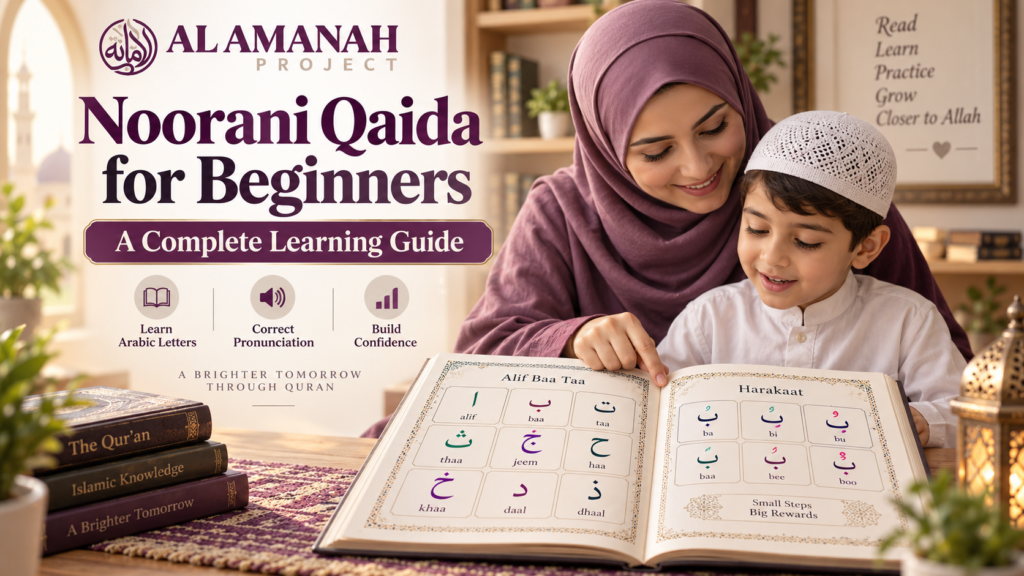
Noorani Qaida for Beginners: A Complete Learning Guide
Learning to read the Quran can feel challenging when Arabic is not your first language. A beginner may recognize a few letters but struggle when those letters change shape, join together, carry vowel marks, or appear with pronunciation rules that do not exist in English, Urdu, Hindi, or other languages.
This is exactly where Noorani Qaida becomes useful.
Rather than asking a new learner to begin directly with full Quranic verses, it breaks Quran reading into smaller skills. Students first become comfortable with Arabic letters, then vowels, combinations, joined forms, longer sounds, sukoon, shaddah, tanween, and progressively more complex reading patterns.
The objective is not merely to finish a book. The real purpose is to build reading habits that make later Quran recitation more accurate, confident, and manageable.
Al Amanah Project follows this foundation-first approach in its beginner programme, describing its Noorani Qaida course as a structured path covering Arabic letter recognition, correct pronunciation, joining letters, and preparation for Quran reading.
This guide explains what beginners should learn, how to practise effectively, common mistakes to avoid, and how parents and adult learners can tell whether genuine progress is taking place.
What Is Noorani Qaida?
Noorani Qaida is a foundational Arabic reading primer commonly used to prepare beginners for Quran recitation.
It introduces the building blocks of Quranic reading in a gradual sequence instead of presenting learners with long verses immediately.
A typical learner progresses through topics such as:
- Individual Arabic letters
- Similar-looking letters
- Correct articulation
- Short vowels or harakat
- Tanween
- Madd or elongated sounds
- Sukoon
- Shaddah
- Joined letters and words
- Basic Quran-style reading patterns
- Early Tajweed awareness
The important word here is progressive.
A student who cannot reliably distinguish ب, ت and ث, for example, will probably struggle when those letters appear inside words. Similarly, someone who has not understood fatha, kasra, and damma will find full Quranic words unnecessarily difficult.
This is why Noorani Qaida should be viewed as a skill-building system rather than simply a children’s textbook.
Who Should Learn Noorani Qaida?
The method is suitable for far more than young children.
Children Beginning Quran Education
For children, Noorani Qaida provides a manageable introduction to Arabic reading without requiring them to understand complex grammar.
Short lessons work particularly well because young learners usually benefit from frequent repetition rather than long study sessions.
Adults Who Never Learned Arabic Reading Properly
Some adults can recite familiar surahs from memory but struggle to decode unfamiliar Quranic words independently.
Returning to the Qaida is not a step backwards. In many cases, it helps correct gaps that were never properly addressed.
New Muslims
A convert may initially encounter Arabic through Salah and frequently recited surahs. Learning the alphabet systematically can make Quran study less dependent on transliteration.
Learners Who Read but Have Pronunciation Problems
Someone may technically “read Arabic” while repeatedly confusing articulation points.
In that situation, selected Noorani Qaida exercises can be used diagnostically. A teacher can identify whether the underlying issue is letter recognition, vowel reading, joining, or makharij.
Why Noorani Qaida Is Helpful Before Full Quran Reading
The strongest reason to study Noorani Qaida is that it isolates individual reading skills.
Consider a beginner reading a complete Quranic word.
They may simultaneously need to:
recognise four Arabic letters, identify their joined shapes, read vowel marks, notice a shaddah, produce the right articulation, and decide whether a sound needs lengthening.
That is a heavy cognitive load for someone at the beginning.
Qaida lessons separate these tasks.
First the learner practises the letter. Then the sound. Then combinations. Eventually, those components are brought together.
This approach also makes mistakes easier to diagnose. If a student repeatedly struggles with words containing ع, the teacher knows where targeted practice is needed.
The Quranic Arabic Corpus demonstrates how Arabic letters and diacritics combine to represent Quranic pronunciation, including distinctions among short vowels, long vowels, shaddah, and other written features.
The Main Stages of Learning Noorani Qaida
1. Recognising Arabic Letters
A beginner should be able to identify each Arabic letter without depending entirely on alphabetical order.
This matters because memorising “Alif, Baa, Taa, Thaa…” as a sequence is different from instantly recognising ث when it appears by itself.
A useful exercise is random recognition.
Instead of pointing to letters from right to left in the book, a teacher can point randomly and ask the student to name them.
If recognition becomes slow when the order changes, more practice is needed.
2. Learning Correct Letter Sounds
Knowing the name of a letter is not the same as pronouncing it correctly.
Letters such as:
ح and ه
س and ص
ت and ط
د and ض
ك and ق
require attention because learners may replace unfamiliar Arabic sounds with the closest sound from their native language.
This is where teacher feedback becomes particularly valuable.
Written transliteration cannot fully show where a sound originates inside the mouth or throat.
In the traditional study of Quranic recitation, oral transmission and directly hearing qualified reciters play an important role. A detailed Yaqeen Institute discussion of qira’at likewise notes that aspects of Quranic readings cannot be mastered through books alone and depend on direct hearing and transmission.
For a beginner, the practical lesson is simple: listen, pronounce, receive correction, and repeat.
3. Understanding Harakat
Once individual letters are familiar, Noorani Qaida usually introduces the three short vowels:
Fatha: a short “a” sound
Kasra: a short “i” sound
Damma: a short “u” sound
The learner needs to understand that the letter remains the same while its sound changes according to the vowel mark.
For example, the same consonant may be read differently depending on whether it carries fatha, kasra, or damma.
One useful technique is contrast practice.
Instead of repeating ten identical examples, practise related combinations so the ear begins noticing the difference.
4. Reading Joined Letters
Arabic letters change appearance depending on their position in a word.
This often surprises beginners.
A learner who easily recognises ع by itself may hesitate when it appears at the beginning, middle, or end of a connected word.
A good Noorani Qaida programme therefore moves gradually from isolated characters to connected forms.
At this stage, speed should not be the priority.
Accurate recognition is more valuable than finishing a page quickly.
5. Learning Tanween
Tanween introduces doubled vowel endings commonly represented as:
-an
-in
-un
Beginners sometimes read only the visible vowel and forget the additional “n” sound.
The best correction is not lengthy theory.
The learner should first hear paired examples, then repeat them slowly until the sound pattern becomes familiar.
6. Understanding Madd
Madd introduces lengthened vowel sounds.
One common beginner mistake is giving every vowel approximately the same duration.
The learner needs to hear the difference between a short vowel and an elongated sound.
Clapping, finger counting, or gentle timing cues can help younger students understand duration before more formal Tajweed terminology is introduced.
7. Learning Sukoon
Sukoon indicates the absence of a vowel after a consonant.
This can initially feel unnatural to learners whose first language tends to insert extra vowel sounds around consonants.
For example, a beginner may unconsciously add an “a” or “u” after a consonant that should end cleanly.
Regular Noorani Qaida practice trains the student to stop the sound correctly.
8. Understanding Shaddah
Shaddah indicates strengthening or doubling of a consonant.
Beginners may either ignore the doubling or overemphasise it.
The teacher should demonstrate how the sound is held and released while connecting it to the surrounding vowels.
Shaddah becomes especially important later because missing it can materially change how a Quranic word is recited.
Noorani Qaida vs Starting Directly with the Quran
| Learning Area | Noorani Qaida First | Starting Directly with Quran |
|---|---|---|
| Letter recognition | Practised separately | Learned inside complete words |
| Pronunciation | Can focus on one sound at a time | Multiple pronunciation challenges occur together |
| Harakat | Introduced gradually | Encountered immediately |
| Joined letters | Progressive exercises | Must be recognised during recitation |
| Error correction | Easier to isolate weaknesses | Harder to identify root cause |
| Beginner confidence | Builds through short milestones | Longer verses may feel difficult |
| Tajweed preparation | Foundation develops gradually | Rules may appear before basics are secure |
The table does not mean that Noorani Qaida and Quran reading are competing approaches.
The Qaida prepares the learner to engage with the Mushaf more effectively.
Once the fundamentals are strong enough, Quran reading should gradually become part of the learning process.
How Long Does Noorani Qaida Take to Complete?
There is no responsible universal answer.
A child studying twice per week may progress differently from an adult practising every day.
Completion time depends on:
- Age
- Previous Arabic exposure
- Lesson frequency
- Home practice
- Teacher feedback
- Pronunciation difficulty
- Attendance consistency
- Whether mastery or speed is prioritised
The better question is:
What can the learner now do independently?
A student who finishes Noorani Qaida quickly but still guesses letters has not achieved the intended outcome.
Another learner may take longer yet leave with dependable reading skills.
Progress should therefore be measured by ability rather than page count.
A Practical 20-Minute Daily Practice Routine
For beginners, consistency often matters more than long sessions.
A useful session might look like this:
First 3 minutes: Review difficult letters from the previous lesson.
Next 5 minutes: Read the current exercise slowly with attention to pronunciation.
Next 5 minutes: Repeat difficult combinations without looking at easier examples.
Next 4 minutes: Listen to teacher-approved pronunciation and imitate carefully.
Final 3 minutes: Re-read a previously mastered section to develop fluency.
The key is targeted repetition.
Reading an entire page five times while repeating the same mistake is less useful than spending two focused minutes correcting the exact sound causing difficulty.
Common Noorani Qaida Mistakes Beginners Make
Memorising the Page Instead of Reading It
Children in particular can memorise exercise order surprisingly quickly.
They may appear fluent while actually predicting what comes next.
A teacher should occasionally point to examples randomly.
Using English or Urdu Pronunciation for Arabic Letters
Approximations may help briefly, but learners should gradually move toward the actual Arabic sound.
This is particularly important for throat and emphatic letters.
Racing Through Lessons
Parents sometimes judge progress by the number of pages completed.
That can create pressure to move forward before a skill is stable.
Good Noorani Qaida teaching includes revision.
Correcting Everything at Once
If a student makes five different errors in one line, constant interruption may become discouraging.
A skilled teacher may prioritise one recurring error, correct it, then address the next problem.
Depending Too Much on Transliteration
Roman-letter transliteration can help at the earliest stage, but continued dependence may prevent direct recognition of Arabic script.
The long-term goal is reading Arabic as Arabic.
Pros and Cons of Learning Noorani Qaida
Advantages
Structured Progression
The learner develops one reading skill before combining it with more difficult material.
Suitable for Different Ages
Children, adults, new Muslims, and returning learners can all benefit from the same fundamental structure.
Helps Identify Pronunciation Weaknesses
Individual exercises make recurring errors easier to detect.
Builds Preparation for Tajweed
Basic familiarity with vowels, lengthening, sukoon, shaddah, and pronunciation supports later Tajweed study.
Encourages Independent Reading
The goal is to reduce dependence on memorised surahs or transliteration.
Possible Limitations
A Book Alone Cannot Correct Pronunciation
A printed Noorani Qaida can show letters and symbols, but it cannot hear a learner’s mistakes.
Repetition Can Become Mechanical
Students who only repeat pages without understanding the pattern may memorise exercises rather than develop transferable reading ability.
It Does Not Replace Advanced Tajweed Study
Completing the primer establishes a foundation; it does not mean every rule of Quranic recitation has been mastered.
Progress Varies Considerably
Comparing one child or adult with another can create unnecessary pressure.
Moving from Noorani Qaida to Tajweed
Completing the beginner foundation should lead naturally into more deliberate Quran recitation.
Al Amanah Project’s Tajweed course focuses on Tajweed fundamentals, makharij practice, recitation correction, guided revision, and teacher feedback.
Learners ready for that next stage can explore the Al Amanah Project Tajweed Course. Explore the Tajweed Course
It is helpful to understand the distinction:
Noorani Qaida teaches you how to decode and pronounce foundational Arabic reading patterns.
Tajweed develops how Quranic recitation should be performed more accurately according to recitation rules.
Quran.com also provides an accessible introduction to the recognized qira’at and explains that Quranic recitation includes preserved traditions involving pronunciation and reading forms.
Should Beginners Also Study Arabic?
Reading and understanding are related but different goals.
A person can learn to recite Quranic Arabic without yet understanding every word.
However, learning Arabic vocabulary and structure can deepen engagement with what is being recited.
Al Amanah Project’s Arabic programme covers reading foundations, writing, vocabulary, and basic grammar, while its own learning resources explain that Arabic study can help learners engage more directly with Quranic vocabulary and structure.
A learner who has established basic reading through Noorani Qaida can therefore consider progressing into structured Arabic study. Explore the Arabic Language Course
Yaqeen Institute similarly emphasizes that Quran learning can include multiple complementary dimensions—recitation, Arabic, interpretation, and reflection—rather than treating them as mutually exclusive paths.
Expert Recommendations from Al Amanah Project
Al Amanah Project’s course structure emphasizes guided lessons, teacher-led practice, feedback, progressive learning, and options for different ages and learning levels.
Based on that approach, beginners can benefit from several practical principles.
Master Recognition Before Seeking Speed
A student should be able to recognise a letter accurately even when it appears unexpectedly.
Fluency develops from recognition becoming automatic.
Let the Teacher Hear the Student Regularly
Pronunciation cannot be evaluated properly through silent workbook practice.
Students should read aloud.
Maintain a Personal Error List
Instead of simply writing “needs more practice,” record specific difficulties.
For example:
“Confuses س and ص.”
“Adds a vowel after letters with sukoon.”
“Shortens madd sounds.”
“Misses shaddah.”
This makes revision much more efficient.
Use Short, Frequent Revision
Ten or fifteen minutes on most days can be more productive than a long session followed by several days without practice.
Do Not Move Forward Simply to Finish the Book
A page is complete when the skill is reasonably stable—not when it has merely been read once.
Learners who want structured guidance can review the Al Amanah Project Noorani Qaida Course, which offers beginner-level lessons, pronunciation practice, teacher feedback, and online or offline learning options. View the Noorani Qaida Course
The broader Al Amanah Project learning platform also includes Quran, Arabic, Tajweed, and related resources for learners at different stages. Visit Al Amanah Project
How Parents Can Support a Child Learning Noorani Qaida
Parents do not need to become substitute teachers.
Their role is mainly to create consistency.
Ask the child to read a small portion each day. Praise careful reading rather than speed. If the teacher corrected a particular sound, spend the week’s practice on that specific correction.
Avoid constantly saying:
“You completed only one page?”
A better question is:
“What did you learn to pronounce correctly today?”
This changes the child’s definition of progress.
Another useful practice is asking the child to teach one concept back to the parent. If they can explain the difference between fatha and kasra or show what shaddah does, they are processing rather than merely repeating.
Frequently Asked Questions About Noorani Qaida
1. What age should a child start Noorani Qaida?
There is no single compulsory age. Many children begin when they can concentrate for short periods, imitate sounds, and recognise visual patterns. Readiness is more important than comparing children by age. Younger students often benefit from 10–15 minute lessons rather than long sessions.
2. Can adults learn Noorani Qaida?
Absolutely. Noorani Qaida is a foundation method, not a children’s-only subject. Adults who never learned Arabic, converts, and people wanting to correct old reading habits can all benefit from structured beginner study.
3. Can I learn Noorani Qaida without a teacher?
You can learn letter shapes and review exercises independently, but pronunciation is harder to assess alone. A teacher can hear subtle errors in makharij, vowel length, sukoon, and joined pronunciation that the learner may not notice.
4. How many months does Noorani Qaida take?
The duration varies according to practice frequency, age, prior Arabic knowledge, attendance, and pronunciation needs. It is better to focus on mastery than promise completion within a fixed number of weeks.
5. What should I learn after Noorani Qaida?
Most learners should gradually move into Quran reading while continuing pronunciation correction. More formal Tajweed study can then develop makharij and recitation rules in greater depth.
6. Is Noorani Qaida enough to learn Tajweed?
It provides an excellent foundation, but it is not a complete substitute for comprehensive Tajweed instruction. It introduces reading patterns that make later Tajweed lessons easier to understand and apply.
7. Why can my child read the Qaida but struggle with the Quran?
This often happens when exercises have been memorised or when skills were practised only in familiar patterns. Randomised reading, unfamiliar combinations, and gradual transition into Quranic words can show whether recognition is genuinely independent.
8. How often should a beginner practise Noorani Qaida?
Short daily practice is ideal for many learners. Even 15–20 focused minutes can be valuable when the student receives regular teacher feedback and revises specific errors rather than simply repeating pages mechanically.
9. Should I use transliteration while learning?
Transliteration can temporarily help complete beginners, but it should gradually disappear. Permanent dependence on Roman letters can delay direct recognition of Arabic script and does not represent every Arabic sound accurately.
10. Can Noorani Qaida improve Quran pronunciation?
Yes, especially when it is taught with careful listening and correction. The exercises help isolate letters, vowels, lengthening, doubled sounds, and connected reading. Actual improvement, however, depends heavily on correct teacher guidance and regular practice.
Conclusion
Learning to read the Quran becomes far less overwhelming when the process is divided into understandable steps.
That is the real value of Noorani Qaida.
It gives beginners time to become familiar with Arabic letters before tackling words, to hear correct sounds before developing speed, and to practise essential patterns before encountering them repeatedly in Quranic recitation.
The most important lesson for both learners and parents is not to confuse completion with mastery.
Finishing twenty pages quickly is less valuable than confidently recognising letters, producing sounds correctly, understanding basic vowel marks, and reading unfamiliar combinations without guessing.
A strong Noorani Qaida journey therefore has three ingredients: structured progression, consistent practice, and correction from someone who can actually hear the learner.
Once these foundations are secure, students can transition more confidently into Quran recitation, Tajweed, and—if they wish—deeper Arabic study and understanding.
For beginners, the target should never be to rush through the Qaida.
The target is to reach the Quran with a foundation strong enough to keep improving for years to come.
Contact Al Amanah Project
Al Amanah Project
Hyderabad, Telangana
Phone: +91 98492 87719
Website: alamanahproject.com