
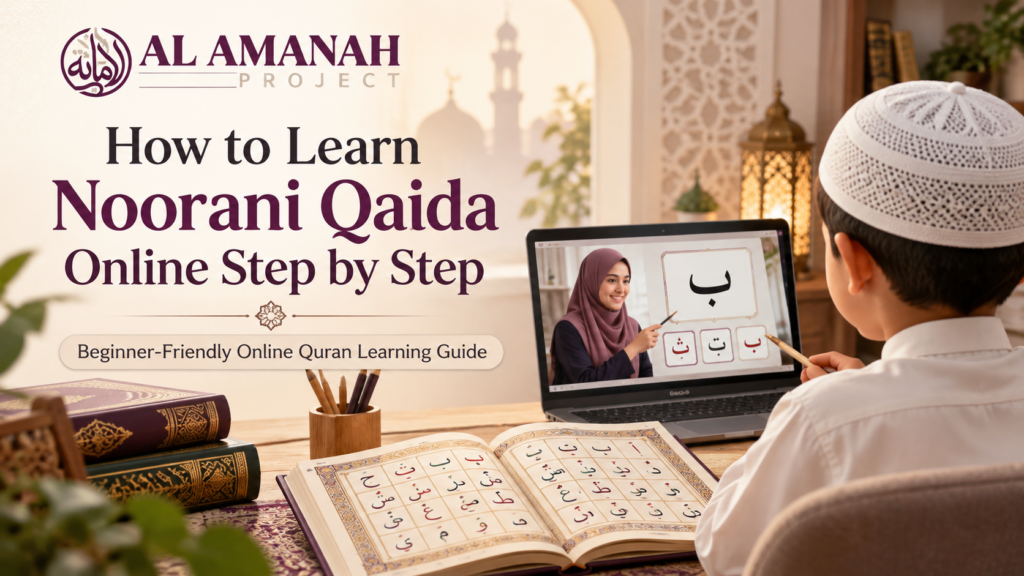
How to Learn Noorani Qaida Online Step by Step
Learning to read the Holy Quran is a meaningful journey, but the first few lessons can feel challenging when Arabic is not your native language. A beginner may recognise some Arabic letters yet struggle to pronounce them correctly. A child might memorise letter names without understanding how those letters change when joined. An adult may know several short Surahs by heart but still find it difficult to read unfamiliar Arabic words.
This is where Noorani Qaida provides a structured starting point.
Instead of asking beginners to read complete Quranic verses immediately, this foundational method introduces Arabic letters, vowel marks, pronunciation, letter combinations and essential reading rules in a logical sequence.
Today, learning through online classes has made Quranic education more accessible to families, working professionals and students who cannot regularly attend physical classes.
However, effective online learning requires more than watching videos or repeating letters from a book. Students benefit from clear explanations, individual pronunciation correction, consistent revision and gradual progress.
At Al Amanah Project, the emphasis is on developing strong foundations through structured learning and guided practice.
This guide explains how to learn Noorani Qaida online step by step, how to organise daily lessons, what mistakes to avoid and how to determine when you are ready to begin reading the Quran.
What Is Noorani Qaida and Why Is It Important?
Noorani Qaida is a beginner-level educational method designed to introduce the essential foundations of Arabic reading, particularly for students preparing to read the Holy Quran.
It begins with individual Arabic letters and gradually develops the learner’s ability to recognise connected forms, understand vowel signs, pronounce combinations and read increasingly complex words.
The method is widely used in foundational Quranic education because it divides reading into manageable stages.
What Makes This Learning Method Effective?
The primary advantage is its progressive lesson structure.
Instead of memorising long passages without understanding the written letters, students gradually develop several connected skills:
- Identifying Arabic letters independently.
- Recognising letters in different written positions.
- Understanding short vowel marks.
- Distinguishing similar Arabic sounds.
- Reading letters with Sukoon and Shaddah.
- Recognising long vowels and selected Tajweed patterns.
- Combining letters into words.
- Developing confidence before reading Quranic verses.
A strong foundation is particularly important because some Arabic sounds are unfamiliar to speakers of English, Urdu, Hindi and Telugu.
For example, the letters ح and ه can initially sound similar to beginners, even though they have different articulation characteristics.
A trained teacher can demonstrate the distinction and identify pronunciation mistakes before they become regular habits.
Why Correct Recitation Matters
The Quran encourages careful, measured recitation in Surah Al-Muzzammil, verse 73:4.
Students can read the verse and its translation through Quran.com.
القرآن الكريم
The objective is not simply to complete a beginner’s book quickly. It is to develop the ability to read Arabic text accurately, patiently and with appropriate pronunciation.
How to Prepare for Online Noorani Qaida Classes
Before beginning formal lessons, students should establish a simple learning environment.
Expensive equipment is unnecessary. A reliable internet connection, a smartphone or computer, an appropriate textbook and a quiet location are generally sufficient.
Choose a Suitable Learning Space
A consistent study location helps students associate a particular environment with focused learning.
For children, parents should choose an area with limited distractions. For adults, a quiet room away from television and work interruptions is preferable.
Position the learning device so the teacher can hear the student’s pronunciation clearly.
Keep Essential Learning Materials Ready
A practical setup includes the prescribed Qaida book or digital copy, headphones if necessary, a notebook and a pencil for tracking difficult letters.
Students should use the same edition as their teacher whenever possible, because lesson ordering and page references can differ.
Set Realistic Learning Goals
Avoid setting unrealistic targets such as completing the entire book within a fixed number of days.
A student who spends additional time improving difficult sounds may develop a stronger foundation than someone who rushes through every page.
Online learning works best when lessons are organised around demonstrated understanding rather than page numbers alone.
Step-by-Step Guide to Learning Noorani Qaida Online
The following ten stages provide a practical roadmap for beginners. The order of some topics can vary between textbooks and teachers.
Step 1: Learn the Arabic Alphabet
The first stage introduces the Arabic letters individually.
Students commonly begin with letters such as:
ا ب ت ث ج ح خ د ذ ر ز س ش
The complete Arabic alphabet contains 28 basic letters. Beginners should learn to recognise the letters accurately before moving to complex combinations.
How to Practise Letter Recognition
Start with a small group of letters rather than trying to memorise everything in one session.
For example, the teacher might introduce ب, ت and ث.
These letters have similar basic shapes but differ in their dots.
A useful practice exercise is to display the letters in random order and ask the student to identify each one.
This tests genuine recognition instead of simple memorisation of the textbook sequence.
Students should also understand that letter names and sounds used in reading are not always identical.
Practical recommendation: Spend more time on letters that look similar rather than repeating every letter equally.
Step 2: Understand Makharij and Correct Pronunciation
Makharij refers to the articulation points from which Arabic sounds are produced.
Correct articulation is essential for distinguishing letters that may appear similar to beginners.
For example:
- ح and ه require different articulation.
- س and ص have different pronunciation qualities.
- ت and ط are not interchangeable.
- ق and ك originate from different areas of the mouth.
An online teacher can demonstrate pronunciation, listen to the student and provide corrective feedback.
A Simple Pronunciation Exercise
Choose one challenging pair of letters.
Listen to your teacher pronounce each letter individually. Repeat the sounds slowly, recording yourself if permitted.
Then compare your pronunciation with the teacher’s demonstration.
Rather than repeating a sound twenty times incorrectly, pause after a few attempts and request clarification.
This prevents the learner from reinforcing the wrong pronunciation.
Step 3: Learn Harakat — Fatha, Kasra and Damma
After recognising individual letters, students begin understanding short Arabic vowels known as Harakat.
These signs change how a consonant is pronounced.
| Harakat | Arabic sign | Example | Approximate sound |
|---|---|---|---|
| Fatha (Zabar) | َ | بَ | ba |
| Kasra (Zer) | ِ | بِ | bi |
| Damma (Pesh) | ُ | بُ | bu |
These English approximations are learning aids, not exact substitutes for Arabic pronunciation.
How to Practise Short Vowels
Start with one familiar letter and apply all three vowel marks.
Read بَ, بِ and بُ separately.
Next, change the consonant while keeping the vowel mark consistent.
This encourages students to recognise the relationship between the written vowel sign and the pronounced sound.
A frequent beginner mistake is stretching a short vowel unnecessarily. Teachers should correct this before introducing long vowels.
Step 4: Understand Tanween and Common Sound Patterns
Tanween refers to the doubled vowel marks that generally produce a final ‘n’ sound in pronunciation.
Common forms include:
- Fathatain: ً
- Kasratain: ٍ
- Dammatain: ٌ
Examples include بًا, بٍ and بٌ, with contextual spelling conventions applying to particular words.
Beginners should first understand the basic sound patterns before studying the more detailed rules of Tanween during Tajweed lessons.
Why This Stage Matters
A learner who can identify ordinary vowel marks but does not recognise Tanween may misread common Quranic word endings.
Teachers can introduce short exercises containing mixed Harakat and Tanween.
Students should read the combinations aloud rather than merely naming the symbols.
Step 5: Learn Sukoon and Letters Without Vowels
Sukoon is a symbol indicating that a consonant does not carry a vowel sound.
It is commonly represented by ْ.
Consider the example أَبْ.
The letter ب is pronounced without adding another short vowel after it.
Some learners accidentally read an extra vowel because they are accustomed to pronouncing every letter separately.
Practical Exercise
Ask the teacher to demonstrate pairs of examples containing an ordinary vowel and a consonant with Sukoon.
Read them slowly, paying attention to when the vowel sound ends.
Students should also begin practising how individual letters connect into a syllable instead of reading each symbol in isolation.
This stage creates an important bridge between recognising letters and reading complete words.
Step 6: Learn Shaddah and Doubled Consonants
Shaddah indicates that a consonant is doubled.
The symbol is written as ّ.
For example, رَبَّ contains a doubled ب sound.
The learner should not treat Shaddah as an ordinary decorative mark or pronounce the letter only once.
How to Practise Shaddah
Begin with examples where the doubled sound is easy to hear.
Ask the teacher to demonstrate the difference between a single consonant and a doubled consonant.
Students can then read examples containing Shaddah with different vowel marks.
The objective is to develop accurate pronunciation without introducing unnecessary pauses.
Step 7: Understand Madd and Long Vowels
Madd involves extending sounds according to the applicable reading rules.
At the beginner level, students first learn the basic long-vowel patterns involving Alif, Waw and Ya.
Examples include:
- بَا — baa
- بُو — boo
- بِي — bee
These transliterations only approximate the sounds.
Distinguishing Short and Long Vowels
Compare بَ with بَا.
The first has a short vowel. The second has a long vowel.
Beginners sometimes stretch every vowel because they believe longer pronunciation sounds more attractive.
That approach can produce reading errors.
The correct duration depends on the relevant vowel and Tajweed rule. Teachers should explain the difference between basic natural Madd and more advanced categories before introducing complex recitation exercises.
Step 8: Learn Joined Arabic Letters and Word Formation
Arabic is written from right to left, and many letters change their written appearance depending on their position within a word.
A student may recognise ب individually but struggle to identify it in a connected word.
This is why understanding letter shapes is different from memorising alphabet names.
Example: Building a Word
Consider the Arabic word كَتَبَ.
Instead of memorising the appearance of the entire word, the learner can identify its three consonants and their vowel marks.
The letters are ك, ت and ب, each carrying Fatha.
The student then combines the sounds in sequence.
This skill is often called blending or joining sounds.
A Better Way to Check Understanding
Give the student unfamiliar but appropriately simple combinations.
If the learner can identify the letters, vowels and sounds without a demonstration, that indicates growing independent reading ability.
If the student can only repeat examples already memorised, additional practice may be necessary.
Step 9: Begin Essential Tajweed Rules
Once learners are comfortable with the foundational reading patterns, they can begin applying selected Tajweed rules more systematically.
Topics may include:
- Noon Sakinah and Tanween.
- Meem Sakinah.
- Qalqalah.
- Ghunnah.
- Rules of Madd.
- Basic stopping and starting principles.
Students should not attempt to memorise every advanced Tajweed rule immediately.
Instead, teachers should introduce rules when learners have enough reading ability to understand and apply them.
For further guided study, explore the Quran Tajweed Course.
Step 10: Transition to Reading the Holy Quran
Completing introductory lessons does not automatically mean a student can read every Quranic passage fluently.
The next stage involves applying previously learned skills to authentic Quranic text.
A teacher may begin with shorter Surahs and familiar passages.
Surah Al-Fatihah can provide useful pronunciation practice, although students should continue to read carefully rather than relying entirely on memorisation.
The learner should gradually develop the ability to:
- Recognise Quranic words without transliteration.
- Identify vowel marks accurately.
- Apply foundational recitation rules.
- Read at a steady, controlled pace.
- Notice and correct mistakes.
- Maintain concentration throughout a passage.
Resources such as Quran.com provide accessible Quranic text, translations and recitation tools that can supplement teacher-led practice.
For learners interested in examining individual Arabic words, the Quranic Arabic Corpus provides word-by-word linguistic information. It is more useful after beginners have established their reading foundations.
Quranic Arabic Corpus
+1
How Long Does It Take to Learn Noorani Qaida Online?
There is no universal completion time.
Some learners progress quickly because they already recognise Arabic letters. Others need additional practice because they are learning a new writing system or correcting long-standing pronunciation habits.
Age, previous knowledge, lesson frequency, teacher feedback and daily revision all influence progress.
The following table illustrates possible learning stages rather than guaranteed completion deadlines.
| Learning stage | Main objective | Suggested practice |
|---|---|---|
| Foundation | Recognise Arabic letters | 10–15 minutes daily |
| Early reading | Learn Harakat and combinations | 15–20 minutes daily |
| Intermediate | Practise Sukoon, Shaddah and Madd | 15–25 minutes daily |
| Advanced beginner | Read joined letters and words | 20–25 minutes daily |
| Quran readiness | Apply reading and basic Tajweed rules | 20–30 minutes daily |
A learner may require several weeks or multiple months depending on individual circumstances.
The most reliable measure of progress is reading accuracy, not the number of lessons completed.
Online Noorani Qaida Classes vs Traditional Classroom Learning
Both online and offline learning can provide effective foundations when students receive appropriate instruction.
Choosing between them depends on the learner’s age, study habits, access to teachers and ability to maintain a regular schedule.
| Feature | Online Classes | Traditional Classes |
|---|---|---|
| Location | Learn from home | Travel to learning centre |
| Scheduling | Potentially flexible | Usually fixed |
| Teacher interaction | Live video and audio | Face-to-face |
| Pronunciation correction | Through live feedback | Direct in-person feedback |
| Parent supervision | Easier to observe at home | Depends on centre |
| Learning materials | Digital and printed resources | Primarily printed materials |
| Revision | Recordings if permitted, plus homework | Homework and physical notes |
| Best suited for | Remote learners and busy families | Students preferring classroom structure |
Advantages of Learning Online
Online education offers convenience for families who cannot travel regularly to a learning centre.
Children can practise in familiar surroundings, while working adults may find it easier to arrange lessons around professional responsibilities.
Students may also have access to teachers outside their immediate neighbourhood.
Digital materials, homework records and guided revision can make progress easier to track.
Limitations of Online Learning
Online classes require stable internet access, clear audio and consistent attention.
Younger children may need parental supervision, particularly during early lessons.
Some students also find it difficult to remain focused during long virtual sessions.
Most importantly, recorded lessons alone cannot reliably identify every pronunciation mistake. Live teacher feedback is valuable when learning unfamiliar Arabic sounds.
Expert Recommendations from Al Amanah Project
Al Amanah Project provides a structured Noorani Qaida Course focused on letter recognition, pronunciation, guided learning and preparation for Quran reading.
Al Amaanah Project
The following practical teaching recommendations reflect that foundational approach.
1. Use a Recognition–Pronunciation–Application Method
Every new lesson should involve three activities.
First, identify the written symbol. Second, pronounce it correctly. Third, apply it within a new reading example.
For instance, when learning Kasra, students should recognise the sign, produce the corresponding short vowel and then read unfamiliar letter combinations containing that mark.
This three-stage approach helps reveal whether the learner genuinely understands the lesson.
2. Correct Mistakes Before Increasing Reading Speed
Reading quickly is not evidence of proficiency.
A student who reads slowly and correctly is building more useful habits than someone who reads rapidly while repeatedly confusing letters.
Encourage learners to develop accuracy first. Fluency can improve through regular, guided reading.
3. Use a Personal Pronunciation Checklist
Not every student struggles with the same sounds.
One learner may need more practice distinguishing س and ص, while another may struggle with ق and ك.
A simple pronunciation checklist helps teachers and students target those difficulties instead of repeatedly reviewing already-mastered material.
4. Schedule Regular Revision
A useful daily study pattern is:
- Five minutes revising previous lessons.
- Ten minutes practising current material.
- Five minutes reading unfamiliar examples.
- Five minutes correcting difficult sounds.
This 25-minute routine is illustrative and can be shortened for younger children.
Similar principles of home practice, individual support and ongoing feedback are discussed in the British Council’s educational guidance.
British Council
5. Advance Based on Mastery
Before moving forward, the learner should demonstrate the current skill using examples they have not simply memorised.
For example, after studying vowel marks, the teacher can present ten mixed combinations.
If the learner reads most of them correctly and consistently distinguishes the sounds, advancement may be appropriate.
The precise standard should be determined by the teacher rather than treated as a universal passing score.
A Practical 30-Day Learning Plan for Beginners
The following plan provides an organised starting routine. It is not intended to guarantee completion of the book within thirty days.
| Days | Learning objective | Home activity |
|---|---|---|
| 1–5 | Arabic alphabet recognition | Identify letters in random order |
| 6–10 | Pronunciation and letter differences | Practise difficult sounds |
| 11–15 | Harakat | Read mixed vowel combinations |
| 16–20 | Tanween and revision | Read combinations aloud |
| 21–25 | Sukoon and early blending | Practise short combinations |
| 26–30 | Revision and assessment | Review strengths and weaknesses |
Students who already know the alphabet may begin at a more advanced stage after teacher assessment.
Students requiring additional pronunciation practice should repeat earlier exercises without pressure.
Later lessons involving Shaddah, Madd, joined letters and Quranic reading should receive their own dedicated practice periods.
How Parents Can Help Children Learn Noorani Qaida
Parental involvement is particularly valuable for young beginners, even when the parent is not an Arabic teacher.
The goal is to support consistency without introducing incorrect pronunciation.
Create a Positive Routine
Choose a time when the child is attentive rather than exhausted after school.
A short lesson followed by an enjoyable revision activity often works better than a long session filled with interruptions.
Parents can use flashcards, letter recognition games and simple encouragement to keep children engaged.
Avoid Correcting Sounds Without Confidence
Parents who are unsure about a letter’s pronunciation should refer the question to the teacher.
Repeatedly practising an incorrect sound may make future correction more difficult.
Children can listen to teacher-approved recordings, but active pronunciation correction should remain part of guided instruction.
Track Progress Without Comparing Children
A useful weekly record might include three questions:
What did my child learn?
Which sounds remain difficult?
What should we practise before the next class?
Comparing one child’s progress with another’s can create unnecessary pressure. Focus instead on improvement over the learner’s previous performance.
Common Mistakes Students Should Avoid
Several habits can slow progress even when learners attend regular lessons.
Memorising pages instead of reading: A learner may recite an entire exercise correctly from memory but struggle when the order changes. Teachers should occasionally present unfamiliar examples.
Depending on English transliteration: Transliteration can help explain a sound initially, but Arabic pronunciation cannot always be represented accurately using English letters.
Skipping difficult lessons: Students sometimes move forward before understanding Sukoon, Shaddah or long vowels. These gaps become more noticeable during Quran reading.
Practising irregularly: Attending a weekly lesson without revision may lead to repeated relearning.
Ignoring pronunciation feedback: Correcting familiar but inaccurate habits requires attention and patience.
The solution is not necessarily longer lessons. More focused practice, suitable feedback and consistent revision can make existing study time more productive.
Frequently Asked Questions About Noorani Qaida
1. Can I learn Noorani Qaida online without previous Arabic knowledge?
Yes. Beginners can start without knowing Arabic letters or vocabulary. A properly structured course introduces the alphabet and essential reading symbols before moving to combinations and words. Teacher guidance is especially useful for unfamiliar pronunciation.
2. What is the best age to start Noorani Qaida for children?
There is no single age suitable for every child. Some children begin learning basic Arabic letter recognition during their early school years. Readiness depends on attention span, communication ability, interest and the capacity to follow simple instructions. Short, interactive lessons are generally preferable for young learners.
3. How many months does it take to complete Noorani Qaida?
Completion varies according to previous knowledge, practice frequency and learning difficulties. Some learners may complete the course within a few months, while others need longer. Correct pronunciation and independent reading are more important than meeting a predetermined deadline.
4. Can adults learn Noorani Qaida from the beginning?
Absolutely. Adults can begin with individual Arabic letters just as children do. Adult learners may benefit from understanding the purpose of each lesson and following a predictable practice schedule. Previous Quranic memorisation can be helpful, but it does not automatically replace reading instruction.
5. Is Noorani Qaida necessary before learning Tajweed?
It is a useful foundation but not the only possible route. Beginners benefit from understanding letters, vowels and sound combinations before studying advanced recitation rules. Students who already read Arabic accurately may begin with an appropriate Tajweed assessment rather than repeating every introductory lesson.
6. Can I learn Noorani Qaida using only YouTube videos?
Videos can support revision and introduce basic concepts. However, they cannot listen to your pronunciation or identify mistakes in real time. A qualified teacher provides feedback that recorded resources cannot offer. A combination of guided lessons and supplementary videos is generally more useful for beginners.
7. What is the difference between Noorani Qaida and learning Arabic?
The foundational Qaida method primarily develops Arabic script recognition, pronunciation and Quran-reading readiness. A broader Arabic language course may also teach vocabulary, grammar, writing, listening and conversation. Learners interested in these additional skills can explore the Arabic Language Course at Al Amanah Project.
8. How can I improve my Arabic pronunciation during online lessons?
Listen closely to your teacher, practise difficult letters in pairs, repeat unfamiliar sounds slowly and request feedback. Recording your reading for personal review may also help if your teacher permits it. Avoid relying entirely on transliteration, because it cannot precisely represent every Arabic sound.
9. How do I know when I am ready to read the Quran?
A learner should be able to recognise connected letters, read common vowel combinations, distinguish essential pronunciation patterns and apply introductory reading rules with reasonable consistency. A teacher should assess unfamiliar examples and decide whether the student is ready to transition into Quranic text with supervision.
10. How do I choose a suitable online Noorani Qaida teacher?
Look for a teacher who demonstrates accurate pronunciation, explains lessons clearly, listens to individual reading and corrects mistakes respectfully. Ask about lesson structure, class duration, revision assignments, assessment methods and language preferences. Parents should also consider age-appropriate teaching methods and safe online supervision.
Why Choose Al Amanah Project for Quran Learning?
Al Amanah Project is an Islamic educational initiative offering structured learning opportunities for students interested in Arabic, Quran reading and Tajweed.
Its published course information highlights beginner-friendly instruction, teacher-led pronunciation practice and flexible learning options. Students can enquire about online or offline lessons, along with individual or group arrangements.
Al Amaanah Project
+1
The most useful starting point for any prospective learner is an assessment of their existing reading ability.
A complete beginner may require alphabet recognition lessons, while a learner who already understands Harakat might benefit from targeted pronunciation correction and more advanced practice.
Families should discuss the student’s age, preferred teaching language, available class timings and learning objectives before enrolling.
Conclusion: Build Your Quran Reading Foundation One Lesson at a Time
Learning Noorani Qaida online is not simply about memorising Arabic letters or finishing exercises in a textbook. It is about developing the reading skills necessary to approach the Holy Quran with accuracy, understanding of the written symbols and confidence.
Beginners benefit from a carefully organised sequence: recognising letters, improving pronunciation, understanding vowel marks, learning essential reading rules and gradually combining sounds into words.
The most important habit is consistent, attentive practice supported by constructive correction.
A child learning the alphabet for the first time and an adult returning to Quranic education may progress at different speeds, but both can develop stronger foundations through patience and appropriate guidance.
Al Amanah Project offers a starting point for students seeking structured Quranic education. By concentrating on genuine reading ability rather than rushing through lessons, learners can prepare for continued study of Quran recitation and Tajweed.
Start Your Quran Learning Journey with Al Amanah Project
For information about beginner courses, guided pronunciation lessons and suitable learning options, contact Al Amanah Project.
Al Amanah Project
Location: Hyderabad, Telangana, India
Phone: +91 98492 87719
Website: www.alamanahproject.com
Course Enquiry: Explore Noorani Qaida Classes
Begin with the foundations, practise regularly and progress towards reading the Holy Quran with greater confidence.