
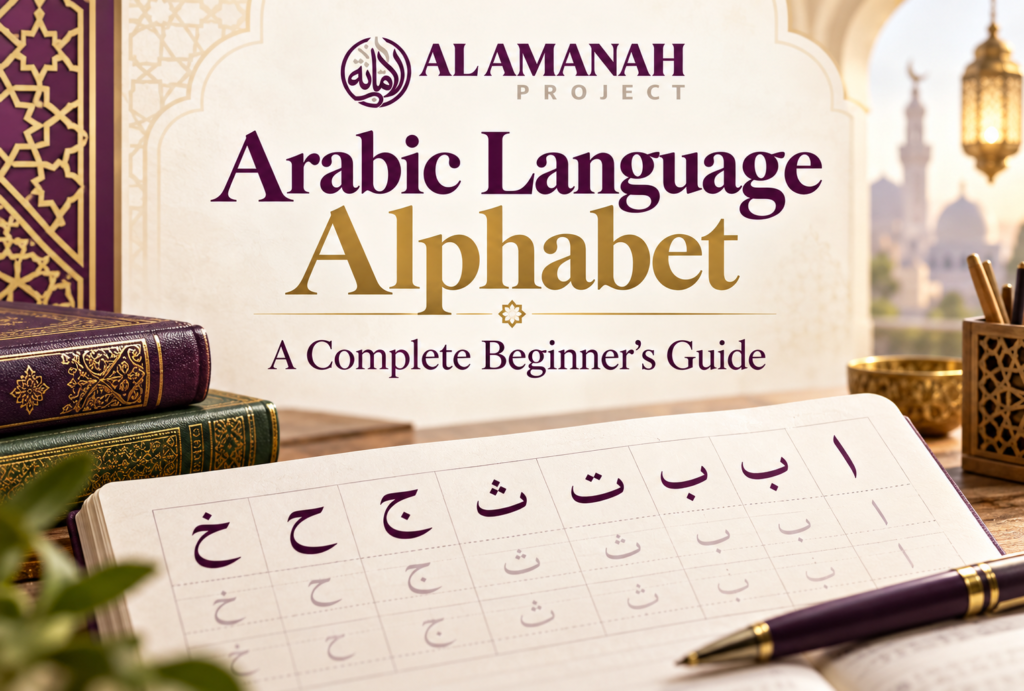
Arabic Language Alphabet: A Complete Beginner’s Guide
Learning a new alphabet can feel like opening a book written in an unfamiliar code. The letters look different, words flow in the opposite direction from English, and some sounds seem impossible to pronounce at first. Yet the Arabic Language has a surprisingly logical writing system. Once you understand how its letters work, what initially looks complicated begins to make sense.
Arabic has 28 basic letters, and the writing system follows consistent patterns that beginners can learn through practice. You do not need previous experience with Arabic, advanced grammar knowledge, or an exceptional memory to get started. You need a clear learning sequence, reliable pronunciation examples, and a little time each day.
For students interested in reading the Holy Quran, understanding Islamic literature, communicating with Arabic speakers, or learning a valuable international language, the alphabet is the natural starting point.
This beginner’s guide explains each letter, common pronunciation challenges, vowel marks, joining rules, writing techniques, and a practical study plan. It also explores how structured learning through Al Amanah Project can help learners build confidence.
Contact Al Amanah Project for Arabic Language course
What Is the Arabic Language Alphabet?
The Arabic Language alphabet, called Al-Abjadiyyah Al-Arabiyyah (الأبجدية العربية), is the writing system used for Modern Standard Arabic, Classical Arabic, and many regional Arabic varieties.
It contains 28 basic letters. Unlike English, Arabic is written from right to left, and most letters connect within words.
Linguistically, Arabic writing is often described as an abjad: a system primarily representing consonants, while short vowels may be indicated by additional marks.
According to Northwestern University, letter shapes vary according to their positions within words, and diacritical marks can indicate short vowel sounds.
Five important characteristics of Arabic writing
- Right-to-left direction: Arabic words and sentences are generally read and written from right to left.
- 28 basic letters: Each letter has a recognizable name and characteristic sound.
- Connected writing: Most letters connect to adjacent letters within a word.
- Position-based shapes: Letters may look different at the beginning, middle, or end of a word.
- Vowel markings: Short vowel signs help learners identify correct pronunciation.
Arabic also has no uppercase and lowercase letter distinction. Instead of learning separate capital forms, students focus on recognizing the same letter in different positions.
Contact Al Amanah Project for Arabic Language course
All 28 Arabic Alphabet Letters With English Pronunciation
The first major step in learning the Arabic Language is recognizing the individual letters before attempting complete words.
The following chart gives the standard alphabetical sequence, commonly used English transliterations, and approximate pronunciation guidance.
Complete Arabic Alphabet Chart
| No. | Arabic | Letter Name | Pronunciation Guide |
|---|---|---|---|
| 1 | ا | Alif | Supports long ā and other vowel-related forms |
| 2 | ب | Baa | B as in book |
| 3 | ت | Taa | T as in table |
| 4 | ث | Thaa | Th as in think |
| 5 | ج | Jeem | J as in jam in many standard pronunciations |
| 6 | ح | Haa | Strong, breathy sound from the throat |
| 7 | خ | Khaa | Raspy kh sound from the back of the mouth |
| 8 | د | Daal | D as in door |
| 9 | ذ | Dhaal | Th as in this |
| 10 | ر | Raa | Brief tapped or rolled R |
| 11 | ز | Zaay | Z as in zebra |
| 12 | س | Seen | S as in sun |
| 13 | ش | Sheen | Sh as in ship |
| 14 | ص | Saad | Emphatic, heavier S sound |
| 15 | ض | Daad | Emphatic D sound |
| 16 | ط | Taa | Emphatic T sound |
| 17 | ظ | Zaa | Emphatic dh sound in many standard pronunciations |
| 18 | ع | Ayn | Voiced sound produced deep in the throat |
| 19 | غ | Ghayn | Voiced guttural sound |
| 20 | ف | Faa | F as in fish |
| 21 | ق | Qaaf | Deep K-like sound formed farther back |
| 22 | ك | Kaaf | K as in kite |
| 23 | ل | Laam | L as in lamp |
| 24 | م | Meem | M as in moon |
| 25 | ن | Noon | N as in name |
| 26 | ه | Haa | H as in house |
| 27 | و | Waaw | W as in water, or long ū |
| 28 | ي | Yaa | Y as in yes, or long ī |
English approximations provide useful starting points, but they cannot represent every Arabic sound accurately. Learners should listen to native or qualified instructional recordings rather than relying exclusively on transliteration.
The Open University provides introductory letter instruction with listening exercises, making it a useful supplementary resource.
Understanding Arabic Letter Shapes and Joining Rules
One of the most distinctive features of the Arabic Language writing system is that the same letter can appear in several connected forms.
Contact Al Amanah Project for Arabic Language course
Consider the letter Baa (ب).
| Letter Position | Arabic Form | Meaning |
|---|---|---|
| Isolated | ب | Letter written independently |
| Initial | بـ | At the beginning of a connected segment |
| Medial | ـبـ | Connected on both sides |
| Final | ـب | Connected from the preceding letter |
These variations are not separate letters. They are different shapes of the same character.
Why do Arabic letters change shape?
Arabic developed as a connected writing system. Rather than writing every character separately, most letters join together to form continuous words.
For example:
- ب + ا + ب becomes باب (baab), meaning door.
- ك + ت + ا + ب becomes كتاب (kitaab), meaning book.
- ق + ل + م becomes قلم (qalam), meaning pen.
In these examples, some letters connect while others remain separated according to established writing rules.
Contact Al Amanah Project for Arabic Language course
The six letters that do not connect forward
Six Arabic letters cannot connect to the letter following them in normal writing:
ا، د، ذ، ر، ز، و
They may connect to a preceding letter, but the connection stops after them.
Consider the word ورد (ward), meaning rose. Although it is one word, its letters do not form one continuous connected shape.
This is important because beginners sometimes assume that a visible break indicates the end of a word. In Arabic, a word may contain several disconnected sections.
A useful classroom exercise is to underline these six non-forward-connecting letters in a reading passage. Doing so helps learners understand why some words contain unexpected spaces between letter shapes.
Arabic Vowels: Fatha, Kasra, and Damma Explained
Recognizing consonants is only half the learning process. To read accurately, beginners must also understand how Arabic vowel marks affect pronunciation.
In the Arabic Language, short vowels are commonly represented by small symbols placed above or below letters. These signs are known as Harakat (حركات).
1. Fatha (َ) – The short A sound
Fatha appears above a letter and produces a short vowel similar to the a in the English word cat, although the exact quality varies by context.
Examples:
- بَ — ba
- تَ — ta
- مَ — ma
Practice the sounds slowly before increasing speed.
2. Kasra (ِ) – The short I sound
Kasra appears below a letter and represents a short i sound.
Examples:
- بِ — bi
- تِ — ti
- مِ — mi
A useful beginner exercise is to compare بَ (ba) and بِ (bi). The consonant remains the same, but the vowel changes.
3. Damma (ُ) – The short U sound
Damma appears above a letter and represents a short u sound.
Examples:
- بُ — bu
- تُ — tu
- مُ — mu
Repeat the three vowel combinations together:
بَ — بِ — بُ
Ba — Bi — Bu
This exercise trains your eyes to identify vowel markings while your mouth learns to produce the corresponding sounds.
Contact Al Amanah Project for Arabic Language course
Other essential pronunciation signs
Once students understand the three basic vowels, they can gradually introduce additional marks.
| Mark | Name | Function | Example |
|---|---|---|---|
| َ | Fatha | Short a vowel | بَ |
| ِ | Kasra | Short i vowel | بِ |
| ُ | Damma | Short u vowel | بُ |
| ْ | Sukoon | No following vowel sound | بْ |
| ّ | Shaddah | Doubles or strengthens a consonant | بّ |
| ً | Fathatayn | Final -an sound | بًا |
| ٍ | Kasratayn | Final -in sound | بٍ |
| ٌ | Dammatayn | Final -un sound | بٌ |
The doubled vowel signs are collectively called Tanween. Their actual pronunciation also depends on grammatical context and whether a reader stops at the end of a word.
For additional guided examples, the Michigan State University Arabic learning resource explains letter forms, short vowels, and long vowels.
Contact Al Amanah Project for Arabic Language course
Short Vowels vs Long Vowels in Arabic
Another essential part of learning Arabic Language pronunciation is distinguishing short vowel sounds from long vowels.
A short vowel occupies approximately one basic timing unit, while a long vowel generally occupies about twice that duration in careful standard pronunciation.
Consider these examples:
| Short Vowel | Long Vowel | Explanation |
|---|---|---|
| بَ (ba) | بَا (baa) | Alif extends the a sound |
| بُ (bu) | بُو (buu) | Waaw extends the u sound |
| بِ (bi) | بِي (bii) | Yaa extends the i sound |
Long vowels are typically written with ا, و, or ي in appropriate contexts.
Take the word باب (baab), meaning door. Its central Alif indicates the long aa sound. By comparison, the first syllable in بَطَل (baṭal), meaning hero, contains a short vowel.
This difference matters because vowel length can distinguish words with different meanings.
For Quran-focused learners, developing accurate vowel duration also helps prepare for the study of recitation rules.
Contact Al Amanah Project for Arabic Language course
Common Arabic Letters That Beginners Confuse
Memorizing the complete alphabet does not automatically mean you can recognize every letter quickly.
Several Arabic characters share similar basic shapes, and small dots distinguish them.
The Baa, Taa, and Thaa family
Consider:
ب — ت — ث
These three letters have related shapes but different dot arrangements.
- ب has one dot below.
- ت has two dots above.
- ث has three dots above.
A beginner should identify the main shape first, then examine the number and location of the dots.
The Jeem, Haa, and Khaa family
ج — ح — خ
These letters share a related structural shape.
- ج has one dot below.
- ح has no dot.
- خ has one dot above.
Although visually similar, they have substantially different pronunciations.
Contact Al Amanah Project for Arabic Language course
The Seen and Sheen family
س — ش
Seen has no dots, while Sheen has three dots above it.
Students often recognize these letters easily in isolation but confuse them inside connected words.
Contact Al Amanah Project for Arabic Language course
The Saad and Daad family
ص — ض
Saad has no dot, while Daad has one dot above.
Both involve emphatic articulation, but they represent different consonants.
A practical letter recognition technique
Instead of memorizing 28 unrelated shapes, group letters according to their visual similarities.
Create small practice sheets containing five or six related characters. Mix their order and identify them without looking at their English names.
This develops visual recognition rather than dependence on memorized alphabetical order.
How to Pronounce Difficult Arabic Sounds Correctly
For many learners in India, English, Hindi, Urdu, or Telugu pronunciation habits influence how unfamiliar Arabic consonants are produced.
Some sounds have close equivalents in familiar languages, while others require special attention.
Understanding Makharij
Makharij refers to the articulation points from which Arabic letters are produced.
Different sounds involve the lips, tongue, teeth, throat, and other parts of the vocal tract.
Learning these distinctions is particularly important for students who want to read the Quran accurately.
Contact Al Amanah Project for Arabic Language course
Distinguishing Haa (ح) from Haa (ه)
The letter ه is relatively close to an ordinary English H.
The letter ح is produced with a deeper pharyngeal articulation. It should not simply be replaced by a louder English H.
Beginners can improve by listening to the two sounds separately, then comparing words containing each letter.
Distinguishing Kaaf (ك) from Qaaf (ق)
Kaaf is similar to the familiar K sound.
Qaaf is traditionally articulated farther back, using the rear of the tongue against the uvular region.
Although spoken dialects vary, students studying Quranic Arabic should learn the pronunciation appropriate to the recitation tradition they are following.
Understanding Ayn (ع)
Ayn is often challenging because English does not have a direct equivalent.
Trying to describe it simply as the letter A can create incorrect pronunciation habits.
A better approach is to listen to a qualified instructor, observe the articulation, and repeat short syllables containing the sound.
Contact Al Amanah Project for Arabic Language course
Why audio feedback matters
Written descriptions explain where a sound is formed, but hearing and correcting the sound is equally important.
Record yourself reading five difficult letters. Compare your recording with a reliable demonstration, then ask a teacher to identify any remaining articulation errors.
This is more productive than repeating an incorrect pronunciation dozens of times.
Students preparing for Quran reading may benefit from the structured Noorani Qaida course, which introduces letter recognition and pronunciation before advancing to connected reading.
Contact Al Amanah Project for Arabic Language course
How to Learn Arabic Writing Step by Step
Writing is an effective way to reinforce recognition because it requires attention to letter direction, proportions, joining patterns, and dots.
However, repeatedly copying whole pages without understanding the shapes is often inefficient.
A more systematic Arabic Language writing routine moves from individual characters to meaningful words.
Step 1: Practice isolated letters
Start with five letters per session.
Write each character slowly while saying its name and sound aloud.
Concentrate on stroke direction, dots, and proportions rather than decorative handwriting.
Contact Al Amanah Project for Arabic Language course
Step 2: Learn connected forms
Once you can recognize isolated letters, practice their initial, medial, and final shapes.
A word such as كتب (kataba, meaning he wrote) is useful because its three letters connect.
Compare ك, ت, and ب individually with their appearance in كتب.
Step 3: Introduce short vowels
Write combinations such as:
كَ — كِ — كُ
Then repeat the exercise using م, ن, and ب.
This connects written shapes with spoken syllables.
Step 4: Copy familiar words
Begin with short, meaningful vocabulary.
| Arabic Word | Transliteration | English Meaning |
|---|---|---|
| باب | Baab | Door |
| بيت | Bayt | House |
| كتاب | Kitaab | Book |
| قلم | Qalam | Pen |
| ماء | Maa’ | Water |
| نور | Noor | Light |
| سلام | Salaam | Peace or greeting |
| مدرسة | Madrasah | School |
Notice that the letter ة in مدرسة is called Taa Marbuta. It is a common additional written form that beginners should learn after becoming familiar with the 28 basic letters.
Step 5: Read before checking transliteration
Once you recognize the letters, cover the English spelling and attempt to read the Arabic word independently.
Transliteration is helpful at the beginning, but using it indefinitely can slow progress toward actual reading fluency.
Contact Al Amanah Project for Arabic Language course
Comparing Different Methods of Learning the Arabic Alphabet
There are several approaches to studying Arabic Language fundamentals. Each offers benefits, but their effectiveness depends on the learner’s goals, available time, and preferred study style.
| Learning Method | Main Advantage | Main Limitation | Best Suited For |
|---|---|---|---|
| Self-study books | Affordable and flexible | Limited pronunciation feedback | Independent learners |
| Mobile learning apps | Convenient daily exercises | May encourage guessing | Vocabulary and letter review |
| Video lessons | Clear audio and visual examples | Little individual correction | Beginners exploring pronunciation |
| Teacher-led online classes | Personalized guidance and feedback | Requires scheduled participation | Students seeking structured progress |
| Noorani Qaida instruction | Strong foundation for Quran reading | Limited focus on everyday conversation | Quran-focused beginners |
Advantages of independent learning
Self-study is convenient and allows students to repeat lessons whenever necessary.
It is particularly useful for alphabet recognition, memorizing letter names, and basic writing practice.
Disadvantages of independent learning
Without feedback, learners may repeat pronunciation mistakes without realizing it.
Some students also progress to longer words before mastering vowels or connected letter forms.
Advantages of guided learning
A teacher can identify exactly why a learner is struggling.
For example, one student may confuse letters with similar dots, while another recognizes every letter but cannot distinguish long vowels.
Different difficulties require different exercises.
For learners interested in structured instruction, Al Amanah Project offers Arabic Language, Noorani Qaida, and Quran Tajweed learning options that can support different study goals.
Contact Al Amanah Project for Arabic Language course
Pros and Cons of Learning the Arabic Language Alphabet
Like any unfamiliar writing system, Arabic presents challenges alongside worthwhile learning benefits.
Pros
- Systematic structure: Letter recognition and joining patterns follow learnable rules.
- Quran reading foundation: Alphabet knowledge is essential for beginning Quranic reading.
- Broader communication opportunities: Arabic literacy supports travel, education, and communication.
- Vocabulary development: Reading allows learners to discover words beyond memorized phrases.
- Cultural understanding: Arabic opens access to literature, historical texts, and different cultural traditions.
- Flexible learning options: Students can combine independent exercises with teacher-supported lessons.
Cons
- Unfamiliar sounds: Several consonants require articulation practice.
- Changing letter shapes: Connected writing takes time to recognize comfortably.
- Vowel omission: Ordinary Arabic texts often leave out short vowel marks.
- Dialect differences: Spoken Arabic varies across regions.
- Need for consistent revision: Progress can become uneven when letters are not practiced regularly.
These challenges are manageable. The key is to separate the skills of recognition, pronunciation, writing, and reading before combining them.
A Practical 30-Day Arabic Alphabet Learning Plan
One common mistake among beginners is attempting to memorize all letters in a single sitting.
A more sustainable approach uses short, repeated practice sessions.
The following plan is a suggested learning framework, not a guarantee that every student will reach the same proficiency within 30 days.
Contact Al Amanah Project for Arabic Language course
Week 1: Learn the basic letter shapes
Goal: Recognize all 28 isolated letters.
During the first week, divide the alphabet into small groups.
Spend approximately 15–20 minutes daily listening, repeating, and writing.
At the end of each session, review previously studied letters without looking at the chart.
Contact Al Amanah Project for Arabic Language course
Week 2: Understand connected writing
Goal: Recognize initial, medial, and final forms.
Practice common letter combinations and identify the six letters that do not connect forward.
Read simple words such as باب, بيت, and قلم.
Avoid attempting long sentences until short words become easier to decode.
Week 3: Master basic vowels
Goal: Recognize Fatha, Kasra, Damma, and Sukoon.
Practice syllables and short vowel-marked words.
Listen closely to differences between short and long vowel sounds.
Begin recording your pronunciation and reviewing difficult letters.
Contact Al Amanah Project for Arabic Language course
Week 4: Read simple words independently
Goal: Combine letter recognition, pronunciation, and vowel knowledge.
Read short, fully vowelled passages appropriate for beginners.
Write a small vocabulary list and test yourself without transliteration.
Ask a teacher or experienced reader to check your pronunciation before progressing.
A 20-minute daily study routine
Sample daily practice schedule
Review previous letters
5 min
Learn or practice new sounds
5 min
Read short syllables and words
6 min
Writing and recall test
4 min
Consistency matters more than completing a large amount of material in one sitting.
Contact Al Amanah Project for Arabic Language course
Expert Recommendations From Al Amanah Project
For students beginning their Arabic Language learning journey, Al Amanah Project’s structured course approach offers a useful foundation for organizing study.
The following recommendations reflect sound beginner-teaching practices and the project’s emphasis on foundational Arabic and Quranic education.
1. Prioritize pronunciation before speed
Reading quickly is not the same as reading correctly.
Start with careful articulation and increase speed only when letters and vowels become familiar.
2. Learn similar letters together
Rather than studying every character as an unrelated symbol, group letters according to shape, dots, and pronunciation.
This makes the alphabet easier to organize mentally.
3. Practice listening and writing together
Listening develops sound recognition, while writing reinforces the visual structure of each letter.
Combining both activities strengthens recall.
4. Choose lessons according to your objective
Students learning Arabic for conversation may eventually need vocabulary, listening comprehension, and grammar instruction.
Students preparing for Quran recitation should give additional attention to correct letter articulation, vowel marks, and Tajweed.
5. Use a reliable teacher for correction
A qualified teacher can detect errors that may remain unnoticed during independent practice.
Regular feedback is particularly valuable for Ayn, Haa, Qaaf, and emphatic consonants.
The Al Amanah Project learning platform provides a starting point for exploring Arabic education and identifying suitable beginner courses.
Frequently Asked Questions About the Arabic Language Alphabet
1. How many letters are there in the Arabic Language alphabet?
The Arabic Language alphabet contains 28 basic letters. Each letter has a distinct identity, although several share similar shapes. Most characters can change their written appearance depending on their position within a word. Beginners should learn the isolated shapes first, followed by connected forms and vowel markings.
2. Is the Arabic alphabet difficult for English-speaking beginners?
The alphabet initially appears challenging because Arabic is written from right to left and uses unfamiliar characters. However, its writing conventions follow consistent patterns. With regular practice, students can gradually recognize letters, identify vowel sounds, and read simple words. Pronunciation generally requires additional listening and correction.
3. How long does it take to learn all 28 Arabic letters?
Some learners can memorize the isolated letters within one or two weeks, while others need longer. Recognizing connected shapes and reading independently takes additional practice. Students who dedicate 15–20 minutes daily and regularly review previous lessons often find the process more manageable than those studying only occasionally.
4. Can I learn the Arabic Language alphabet online?
Yes. Beginners can study through online classes, educational videos, reading exercises, and digital resources. A structured Arabic Language course can be especially useful when learners need pronunciation feedback. Online instruction also allows students to revisit lessons and practice at home, although teaching quality and learning support vary.
5. Why is Arabic written from right to left?
Arabic belongs to a family of writing systems with longstanding right-to-left conventions. Its script developed historically through earlier Semitic writing traditions. Readers follow the established direction for letters and words, while numerals and mixed-language text may follow additional formatting conventions.
6. What is the difference between Arabic letters and Arabic vowels?
Arabic letters provide the main written structure of words and primarily represent consonants, with certain letters also representing long vowels. Short vowels are generally indicated by marks such as Fatha, Kasra, and Damma. Understanding both letters and vowel signs is essential for reading fully vowelled beginner texts.
7. Can I read the Quran after learning the Arabic alphabet?
Alphabet knowledge is the first important step toward Quran reading, but it is not the complete process. Learners also need to understand connected letters, vowel marks, Sukoon, Shaddah, and relevant pronunciation rules. Guided Noorani Qaida lessons can help establish these foundations before students progress to more advanced recitation.
8. What is the difference between Noorani Qaida and an Arabic Language course?
Noorani Qaida primarily develops letter recognition, pronunciation, vowel reading, and foundational skills for Quranic recitation. A broader Arabic Language course may also teach vocabulary, grammar, sentence formation, listening, and communication. Students should choose according to whether their main objective is Quran reading, language comprehension, or both.
9. Should I learn Arabic handwriting or typing first?
Handwriting is often helpful for absolute beginners because physically forming letters reinforces their distinctive shapes and joining patterns. Typing becomes useful once students can recognize characters comfortably. Ideally, learners develop both skills, using handwriting for foundational study and typing for everyday digital communication.
10. What should I learn after mastering the Arabic alphabet?
After learning the letters, focus on short and long vowels, connected word reading, basic vocabulary, and simple sentence structures. Students interested in conversational Arabic can begin introductory grammar and listening exercises. Quran-focused learners can continue with Noorani Qaida and then study Tajweed with qualified guidance.
Contact Al Amanah Project for Arabic Language course
Conclusion: Start Your Arabic Learning Journey With Confidence
Learning the Arabic Language alphabet is not simply about memorizing 28 symbols. It involves discovering how letters represent sounds, how words are constructed, and how pronunciation and writing work together.
The most effective beginners focus on accuracy before speed. They recognize individual letters, practice their connected forms, understand vowel marks, and gradually progress toward meaningful words.
An important insight is that learning to recognize Arabic, learning to pronounce it, and learning to understand it are three related but different achievements. Recognizing this distinction helps students set realistic goals and avoid frustration.
Whether your motivation is Quranic study, personal development, education, or communication, learning the alphabet creates a foundation for future progress.
With structured lessons, consistent revision, and appropriate guidance, unfamiliar characters can gradually become readable words and meaningful sentences.
Begin Learning With Al Amanah Project
Al Amanah Project offers educational opportunities for learners interested in Arabic reading, pronunciation, foundational Quran studies, and related subjects.
Students and parents can explore suitable learning options, discuss their current level, and enquire about classes based on their educational objectives.
Al Amanah Project
Hyderabad, Telangana, India
+91 98492 87719
Take your first step today: Begin with five Arabic letters, practice their sounds carefully, and build your learning routine one lesson at a time.