
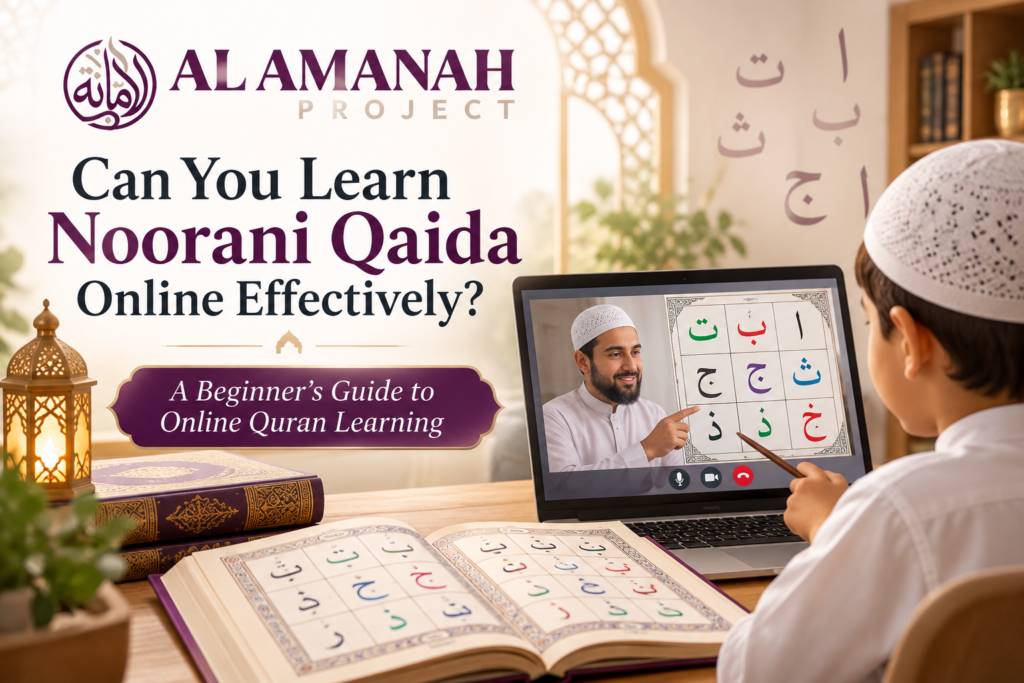
Can You Learn Noorani Qaida Online Effectively?
Learning to read the Holy Quran is a meaningful goal for Muslims of every age. Whether you are a parent introducing your child to Arabic letters or an adult beginning your Quran-reading journey, developing a reliable foundation is essential. One of the most widely used introductory methods is Noorani Qaida, a structured approach that helps beginners understand Arabic letters, pronunciation, vowel marks, and basic reading principles.
However, as online Islamic education becomes more accessible, many learners ask an important question: Can you learn Noorani Qaida online effectively, or is traditional classroom learning necessary?
The answer is yes. Online learning can be highly effective when students receive proper instruction, practise consistently, and have opportunities to correct their pronunciation.
Digital lessons make it possible to study from home, choose convenient timings, and repeat difficult exercises. Nevertheless, successfully learning to read Arabic requires more than watching recorded videos or memorising letter names.
At Al Amanah Project, the emphasis is on building meaningful Quran-reading foundations through structured Islamic learning. Understanding how online instruction works, what challenges to expect, and which learning methods produce measurable progress can help students and parents make informed decisions.
This guide explores the complete learning process, practical study techniques, differences between online and offline instruction, and recommendations for developing confident Quran-reading skills. Noorani Qaida Noorani Qaida Noorani Qaida
What Is Noorani Qaida and Why Is It Important?
Noorani Qaida is a foundational teaching method designed to introduce beginners to the Arabic writing system and prepare them for reading the Holy Quran.
Rather than asking students to read complete Quranic verses immediately, the method divides essential reading skills into manageable lessons.
Students generally begin with Arabic letters and gradually progress towards joined letters, vowel sounds, pronunciation rules, and increasingly complex combinations.
The Main Objectives of Learning Noorani Qaida
The primary purpose is to help learners:
- Recognise Arabic letters correctly.
- Understand how individual letters sound.
- Identify letters when their written shapes change.
- Read short vowel marks accurately.
- Distinguish short sounds from extended vowel sounds.Noorani QaidaNoorani QaidaNoorani Qaida
- Recognise Sukoon, Shaddah, and Tanween. Noorani QaidaNoorani Qaida
- Develop awareness of correct articulation.Noorani Qaida Noorani Qaida
- Prepare for Quran recitation with Tajweed.Noorani Qaida Noorani Qaida
For example, the Arabic letters س (Seen), ص (Saad), and ث (Tha) represent different sounds, even though unfamiliar learners may initially struggle to distinguish them.
A qualified teacher can explain these differences, demonstrate appropriate pronunciation, and identify mistakes before they become habitual.
This is particularly important because some Arabic sounds do not have direct equivalents in English, Urdu, Hindi, or other languages.
Why Beginners Should Not Skip Foundational Lessons
Students sometimes want to move directly to Quran recitation because recognising individual letters appears too basic.
However, identifying letters is different from reading connected Arabic words accurately.
Someone might know the name of the letter ب (Baa) but still struggle to recognise it within a word or pronounce it correctly with different vowel marks.
A systematic foundation helps prevent reading difficulties later.
Instead of treating introductory lessons as an unnecessary stage, learners should recognise them as preparation for accurate and increasingly independent Quran reading.
Can You Really Learn Noorani Qaida Online?
Yes, students can learn Noorani Qaida online effectively, provided the learning environment includes appropriate instruction, sufficient practice, and regular assessment.
Online Quran education typically uses video conferencing, digital lesson materials, audio demonstrations, and direct interaction between teachers and students.
The medium is different from a physical classroom, but the essential educational process remains similar.
A teacher introduces a reading principle, demonstrates the correct pronunciation, asks the learner to practise, identifies mistakes, and checks whether the student is ready to progress.
Why Online Learning Can Work
Online learning is especially useful because students can practise between lessons without travelling to an educational institution.
For working adults, parents with young children, and learners living far from qualified teachers, this flexibility can make consistent education more realistic.
For example, consider a working professional in Hyderabad who cannot attend an evening Quran class because of office commitments.
A scheduled online lesson before work, supported by short daily exercises, may be easier to maintain than commuting several times each week.
Similarly, a child can attend a supervised lesson from home while a parent monitors the learning environment.
The Importance of Teacher Interaction
Watching a video may help a beginner recognise a letter, but it does not confirm whether that learner is producing the sound correctly.
This distinction is crucial.
When studying Noorani Qaida, students need to hear accurate pronunciation and receive feedback on their own attempts.
Live teaching can help instructors identify whether a learner is confusing sounds, overlooking vowel marks, or reading letters in the wrong sequence.
Recorded materials remain useful for revision, but they should ideally support rather than completely replace interactive guidance.
How Online Noorani Qaida Classes Typically Work
An effective online course follows a progressive structure rather than presenting every Arabic reading rule simultaneously.
The sequence may vary between teachers and editions of the textbook, but the underlying learning stages remain broadly consistent.
Stage 1: Recognising Arabic Letters
The first stage focuses on recognising Arabic letters individually.
Students learn the visual appearance and names of the letters, while gradually developing awareness of their pronunciation.
A teacher may introduce a small group of letters during each lesson and ask the student to identify them in random order.
This is more effective than recognising letters only when they appear in a memorised sequence.
Stage 2: Understanding Joined Letters
Arabic letters can change their appearance depending on their position in a word.
Beginners must therefore learn to identify letters when they appear separately and in connected forms.
For instance, the letter ب can appear as ب, بـ, ـبـ, or ـب depending on its position and connections.
Teachers may use letter-matching exercises to help students understand these differences.
Stage 3: Learning Harakat
Harakat are vowel marks that influence how Arabic letters are pronounced.
Three important introductory marks are:
- Fatha (َ): a short ‘a’ sound.
- Kasra (ِ): a short ‘i’ sound.
- Damma (ُ): a short ‘u’ sound.
For example:
بَ — Ba
بِ — Bi
بُ — Bu
These English representations are approximate learning aids. A teacher should demonstrate the actual Arabic sounds.
Stage 4: Practising Sukoon, Shaddah and Tanween
As students improve, they are introduced to additional reading signs.
Sukoon indicates the absence of a vowel after a consonant. Shaddah indicates consonant doubling, while Tanween introduces final nasalised vowel sounds in applicable contexts.
The important objective is not merely memorising terminology but learning to recognise these signs during reading.
Stage 5: Combining Letters and Reading Words
Students begin connecting previously learned skills.
They practise reading unfamiliar letter combinations rather than repeating only memorised examples.
This stage helps develop reading fluency and reduces dependence on constant teacher assistance.
Stage 6: Preparing for Quran Recitation
The final learning stages help students transition towards reading Quranic text.
Basic Tajweed awareness, articulation, and careful reading become increasingly important.
Completion of a beginner textbook does not automatically mean a learner has mastered Tajweed. Continued teacher-guided recitation is valuable.
Students interested in progressing further can also explore the Islamic education programmes offered by Al Amanah Project.
Benefits of Learning Noorani Qaida Online
Online Islamic education offers several practical advantages, especially for learners who need flexible educational arrangements.
1. Greater Scheduling Flexibility
Online classes can reduce difficulties associated with travel, work schedules, school timings, and household responsibilities.
Students may be able to arrange lessons around their daily commitments, depending on instructor availability.
A consistent 20-minute session can be more valuable than an occasional lengthy class interrupted by scheduling problems.
2. Access to Qualified Teachers
Online instruction expands access to teachers beyond a student’s immediate neighbourhood.
This can be particularly valuable for families living in locations with limited Quran education facilities.
However, teacher selection remains important. Availability alone does not guarantee instructional quality.
3. Comfortable Learning Environment
Beginners sometimes hesitate to ask questions in a large classroom.
Individual online sessions may give students more opportunities to repeat difficult sounds, request explanations, and progress at a comfortable pace.
Adult beginners may particularly appreciate a supportive environment where questions are welcomed.
4. Repeated Listening and Revision
Digital learning materials can make revision easier.
Students may use approved audio recordings, lesson notes, or pronunciation demonstrations between classes.
Repeating the same sound several times allows learners to strengthen recognition and develop greater familiarity.
5. Parental Involvement
Parents can more easily observe young children’s online learning routines.
They can help maintain schedules, supervise practice, and communicate with teachers about difficulties.
However, parents should avoid correcting unfamiliar Arabic pronunciation without reliable guidance.
6. Reduced Travel Requirements
Learning from home removes daily commuting for students and their families.
This may save time and transportation expenses, although online courses still require suitable devices, connectivity, and educational supervision.
Online vs Offline Noorani Qaida Classes: Detailed Comparison
Both learning formats can produce good outcomes. The most suitable option depends on the student’s age, learning needs, available resources, and teacher quality.
| Learning Factor | Online Classes | Offline Classes |
|---|---|---|
| Location | Learn from home or another suitable place | Attend a physical classroom |
| Scheduling | Potentially flexible | Usually fixed |
| Teacher availability | Wider geographical selection | Primarily local |
| Pronunciation feedback | Live audio and video | Direct in-person interaction |
| Parental supervision | Convenient at home | Depends on classroom arrangements |
| Travel | Usually unnecessary | Often required |
| Digital resources | Easily integrated | Varies by institution |
| Technical requirements | Device and internet connection | Minimal technology needed |
| Peer interaction | Depends on class format | More natural in group settings |
| Best suited for | Remote learners, adults, busy families | Learners preferring face-to-face instruction |
Which Method Is More Effective?
Neither format is automatically superior.
An experienced teacher providing personalised online instruction may be more effective than a poorly organised physical classroom.
Likewise, an attentive classroom teacher may be more suitable for a student who finds remote learning difficult.
The most important factors are instructional quality, student engagement, consistent revision, and timely correction.
Pros and Cons of Learning Noorani Qaida Online
Advantages
- Convenient access from different locations.
- Potential flexibility for children and working adults.
- Opportunity for personalised instruction.
- Easy access to digital revision resources.
- Reduced commuting time.
- Convenient parental monitoring.
- Possibility of learning at an individual pace.
Disadvantages
- Internet interruptions can affect lesson continuity.
- Audio quality may influence pronunciation feedback.
- Younger children may become distracted.
- Students need consistent practice outside class.
- Some learners require stronger in-person supervision.
- Teacher quality can vary between programmes.
How to Overcome Common Challenges
Choose a quiet room with minimal background noise, use a reliable microphone or headset, and keep lesson materials ready.
For children, parents can help establish a predictable routine without taking over the actual lesson.
If internet quality becomes a repeated problem, discussing alternative class timings or appropriate backup arrangements with the teacher may help.
A Practical 30-Day Noorani Qaida Learning Plan
The following plan provides an illustrative structure for beginning online learners. It is not a promise of completing an entire textbook in 30 days.
Progress depends on age, prior familiarity, pronunciation needs, teacher assessment, and the time available for practice.
Week 1: Build Letter Recognition
Focus on identifying Arabic letters, listening carefully to their sounds, and distinguishing visually similar characters.
Practise recognising letters in random order.
At the end of the week, ask the teacher to identify which letters still cause confusion.
Week 2: Strengthen Pronunciation
Continue revising the alphabet while working on articulation and difficult sound distinctions.
Students should practise listening, repeating, and identifying sounds without relying exclusively on transliteration.
Give particular attention to letters that are unfamiliar in the student’s first language.
Week 3: Introduce Vowel Marks
Depending on readiness, begin short vowel combinations.
Practise reading examples such as بَ, بِ, and بُ while continuing pronunciation revision.
Students who need additional time on letter recognition should remain at their current stage rather than rushing forward.
Week 4: Develop Reading Confidence
Continue vowel exercises, practise changing letter combinations, and review previous lessons.
If the student is ready, introduce the next reading principle recommended by the teacher.
At the end of the month, assess reading accuracy rather than merely counting the number of lessons completed.
Suggested Daily Routine
| Activity | Suggested Time | Purpose |
|---|---|---|
| Previous lesson revision | 5 minutes | Improve retention |
| New lesson or guided practice | 10–15 minutes | Develop reading skills |
| Pronunciation correction | 5 minutes | Address mistakes |
| Independent revision | 5 minutes | Build confidence |
The daily structure can be adjusted for younger children and students with different learning requirements.
How to Measure Real Progress in Online Quran Learning
One of the most overlooked parts of beginner Quran education is progress assessment.
Students may complete multiple lessons while still depending heavily on memorised sequences.
A better approach is to measure actual reading ability.
Use the Five-Point Reading Check
At regular intervals, ask whether the student can:
- Recognise previously learned letters in random order.
- Pronounce those letters with reasonable accuracy.
- Identify letter forms within new combinations.
- Apply learned vowel marks to unfamiliar examples.
- Recognise and correct mistakes after teacher feedback.
For example, a student who can recite the Arabic alphabet fluently may still hesitate when shown individual letters in a different arrangement.
That hesitation provides useful information: letter recognition needs more practice before advancing.
Keep a Simple Error Log
Teachers or parents can record recurring difficulties in a small notebook.
| Difficulty | Example | Corrective Action |
|---|---|---|
| Confusing similar letters | س and ص | Teacher-guided listening |
| Misreading vowels | Fatha and Kasra | Short daily contrast exercises |
| Forgetting joined forms | ب in different positions | Visual matching practice |
| Rushing pronunciation | Skipping vowel sounds | Slow guided reading |
| Losing concentration | Frequent distractions | Shorter focused sessions |
This method makes revision more specific.
Instead of repeating every lesson equally, students can spend additional time on the skills that need improvement.
Common Mistakes Beginners Should Avoid
Learning Noorani Qaida becomes more effective when students recognise habits that may interfere with their progress.
Memorising Without Recognising
Some beginners memorise entire lines without understanding the individual letters.
To prevent this, teachers should occasionally rearrange examples and ask learners to read unfamiliar combinations.
Depending Too Much on English Transliteration
Transliteration can offer temporary guidance, but it cannot represent every Arabic sound precisely.
Students should gradually rely on Arabic script and correct audio demonstrations.
Ignoring Small Pronunciation Differences
Arabic includes sounds that learners may not regularly use in everyday speech.
Ignoring these differences can make later correction more difficult.
Practising a small number of sounds accurately is generally more productive than rushing through many incorrectly.
Studying Without Revision
New information becomes harder to retain when previous lessons are neglected.
Regular repetition helps students recognise letters and reading patterns more confidently.
Comparing Progress With Other Learners
Children and adults develop new language skills at different rates.
A student who needs extra pronunciation practice should not be considered unsuccessful simply because another learner progresses faster.
The goal is accurate and confident reading, not finishing first.
Expert Recommendations From Al Amanah Project
For learners exploring structured Quran education, Al Amanah Project encourages a foundation-first approach consistent with its emphasis on accessible Islamic learning.
The following practical recommendations are especially useful when selecting or following an online beginner course.
Prioritise Correct Pronunciation
Learning individual Arabic letters accurately should come before speed.
Students benefit from listening closely, practising carefully, and asking teachers to explain unfamiliar sounds.
Choose a Structured Learning Programme
A suitable course should have clear learning objectives, logical lesson progression, and opportunities for assessment.
Students can explore the Noorani Qaida and Quran-learning resources at Al Amanah Project when planning their studies.
Encourage Questions
Teachers should create an environment where beginners can ask questions without embarrassment.
This is particularly valuable for adults who may feel uncomfortable learning basic reading skills later in life.
Practise Consistently
Small, regular study sessions are generally easier to sustain than irregular periods of intensive revision.
Where possible, maintain a predictable practice schedule while allowing flexibility for family and professional commitments.
Review Before Advancing
Learners should demonstrate reasonable understanding of current material before moving to more difficult exercises.
The teacher should decide when additional revision is necessary.
Connect Foundational Learning With Long-Term Goals
After developing basic reading confidence, students can continue studying Quran recitation, Tajweed, and Arabic language skills.
Those interested in broader Islamic education can explore the learning opportunities at Al Amanah Project.
Is Online Noorani Qaida Suitable for Children?
Online Noorani Qaida lessons can be suitable for children when teaching methods are adjusted to their age and attention span.
Young learners often respond well to short explanations, visual examples, repetition, and encouraging feedback.
However, children may need adult assistance with devices, lesson preparation, and maintaining a distraction-free environment.
Practical Tips for Parents
Establish a regular class time, prepare the Qaida book before each session, and encourage a few minutes of revision after class.
Avoid turning every correction into criticism.
If a child struggles with a letter, ask the teacher for a suitable practice technique rather than demanding repeated recitation without guidance.
Most importantly, evaluate progress through understanding and pronunciation, not simply the number of pages completed.
Can Adults Learn Noorani Qaida Online?
Absolutely. Learning to read the Quran is not restricted to childhood.
Adults who did not receive Quran-reading instruction earlier can begin with foundational lessons and progress gradually.
In some cases, adults may understand written explanations more quickly than younger learners.
However, they may also need additional practice producing unfamiliar Arabic sounds.
A Practical Example
Consider an adult who recognises several Arabic letters from childhood but cannot read connected words fluently.
Rather than restarting every lesson without assessment, a teacher can first identify existing skills.
The student may need focused instruction on vowel marks, joined letters, and correct pronunciation.
This targeted approach can make learning more relevant and motivating.
Working adults may also benefit from shorter, consistently scheduled sessions instead of demanding daily study periods that are difficult to maintain.
How to Choose the Right Online Noorani Qaida Course
Not all online courses offer the same level of educational support.
Before enrolling, students and parents should evaluate the teaching approach carefully.
Teacher Qualifications
Ask whether instructors have appropriate Quran-reading knowledge, Tajweed competence, and experience teaching beginners.
A teacher should be able to demonstrate pronunciation accurately and explain common reading mistakes.
Individual Feedback
A course should provide opportunities for students to read aloud and receive correction.
Videos and self-study materials alone may not provide sufficient feedback.
Class Structure
Look for a logical sequence covering Arabic letters, joined forms, vowel marks, and progressively more advanced reading.
Student Assessment
Ask how progress is evaluated and whether lessons can be repeated when necessary.
Suitable Scheduling
Select a timetable that can be maintained consistently.
For children, the best class schedule should also account for schoolwork, rest, and family routines.
Communication With Parents
For younger learners, periodic communication between parents and teachers can help address attendance, attention, and pronunciation difficulties.
Useful Educational Resources for Better Quran Reading
Independent learning resources can support teacher-led instruction when used appropriately.
Quran.com provides Quranic text, recitations, and word-by-word listening tools. These features can be useful as students progress towards reading Quranic words.
Quranic Arabic Corpus includes information about Arabic phonetic transcription and vowel notation. It is a technical reference rather than a substitute for pronunciation teaching.
OpenArabic Arabic Alphabet Chart illustrates Arabic letters in different written positions, helping learners understand how characters change within words.
Quran.co.in Beginner Reading Course presents a foundational reading sequence based on Arabic letters, vowel sounds, and gradual progression towards Quran reading.
These resources can improve familiarity and support revision. Nevertheless, students should rely on qualified teachers for personalised pronunciation correction.
Frequently Asked Questions About Noorani Qaida Online
1. Can beginners learn Noorani Qaida online without knowing Arabic?
Yes. Beginners do not need previous knowledge of Arabic to begin. Introductory lessons teach letter recognition, pronunciation, vowel marks, and essential reading patterns. Students should begin with a structured learning sequence and receive feedback from a teacher, especially when practising unfamiliar Arabic sounds.
2. How long does it take to complete Noorani Qaida online?
There is no universal completion period. Some learners progress through introductory material within a few months, while others require longer. Learning frequency, age, pronunciation difficulties, and prior experience all influence the timeline. Accurate reading matters more than finishing the textbook by a particular date.
3. Is Noorani Qaida difficult for adults?
It can be challenging at first, particularly when learning unfamiliar sounds or recognising connected Arabic letters. However, adults can make steady progress through structured instruction and regular revision. Previous Arabic knowledge is helpful but not essential.
4. How many minutes should children practise Noorani Qaida daily?
Young beginners may benefit from approximately 10–20 minutes of focused practice, adjusted according to age, concentration, and teacher recommendations. Short, engaging exercises are often easier to maintain than long sessions that cause frustration. The objective should be attentive repetition rather than completing a fixed number of pages.
5. Can I learn Noorani Qaida through YouTube videos alone?
Videos can help explain concepts and demonstrate sounds, but they cannot reliably assess your individual pronunciation. Students may repeat mistakes without realising it. A combination of instructional videos, consistent revision, and direct teacher feedback generally provides a stronger learning arrangement.
6. What equipment is needed for online Noorani Qaida classes?
Most learners need a smartphone, tablet, or computer with a stable internet connection and clear audio. A microphone or headset can improve communication. Students should also keep their learning materials nearby and choose a quiet, well-lit place for lessons.
7. What is the difference between Noorani Qaida and Tajweed?
Noorani Qaida is primarily a foundational reading method, while Tajweed refers to the principles governing correct Quran recitation. Beginner lessons introduce essential pronunciation concepts, but advanced Tajweed involves additional rules and detailed application. Students commonly progress from foundational reading into more comprehensive recitation studies.
8. Can a five-year-old child start Noorani Qaida online?
Some five-year-olds may be ready for introductory lessons, depending on attention span, interest, language development, and available supervision. A teacher should assess readiness and use age-appropriate methods. Short lessons, visual activities, repetition, and positive encouragement can make learning more comfortable.
9. How can parents check whether their child is learning correctly?
Parents can ask teachers for periodic feedback and observe whether the child recognises previously learned letters in different arrangements. Progress should also include improving pronunciation and confidence. Parents who are unfamiliar with Arabic articulation should seek teacher guidance rather than independently correcting difficult sounds.
10. What should students learn after completing Noorani Qaida?
After developing foundational reading skills, students can begin guided Quran reading and continue improving pronunciation and Tajweed. Some may also study Arabic vocabulary, grammar, and Quranic understanding. The next stage should reflect the learner’s abilities and educational goals, with guidance from a qualified instructor.
Start Your Quran Learning Journey With Al Amanah Project
Beginning Quran education does not require perfect Arabic knowledge or previous classroom experience.
With a structured learning approach, consistent revision, and suitable guidance, children and adults can develop the skills needed for Quran reading.
Al Amanah Project offers an accessible starting point for individuals and families interested in Quranic and Arabic education.
Whether you are exploring beginner instruction or planning to develop your reading abilities further, selecting the right learning pathway is an important first step.
Visit Al Amanah Project to explore its educational resources and enquire about suitable learning opportunities.
Contact Al Amanah Project
Location: Hyderabad, Telangana, India
Phone: +91 98492 87719
Website: https://alamanahproject.com/
Conclusion: Is Online Noorani Qaida Learning Worth It?
Learning Noorani Qaida online can be an effective and practical way to develop foundational Quran-reading skills. Its greatest advantage is not simply convenience, but the opportunity to combine structured teaching, repeated practice, and personalised feedback in a familiar learning environment.
However, success requires active participation.
Students must practise beyond scheduled lessons, listen carefully to pronunciation demonstrations, and remain willing to correct mistakes. Parents should support younger learners without placing unnecessary pressure on them, while adult beginners should recognise that gradual progress is a normal part of learning.
The real measure of success is not how quickly someone finishes a book. It is whether they can recognise Arabic letters, apply reading rules accurately, and approach Quranic text with growing confidence.
With patience, qualified guidance, and a consistent routine, Noorani Qaida can provide a valuable foundation for a lifelong relationship with Quran reading, whether studied online or in a traditional classroom.