
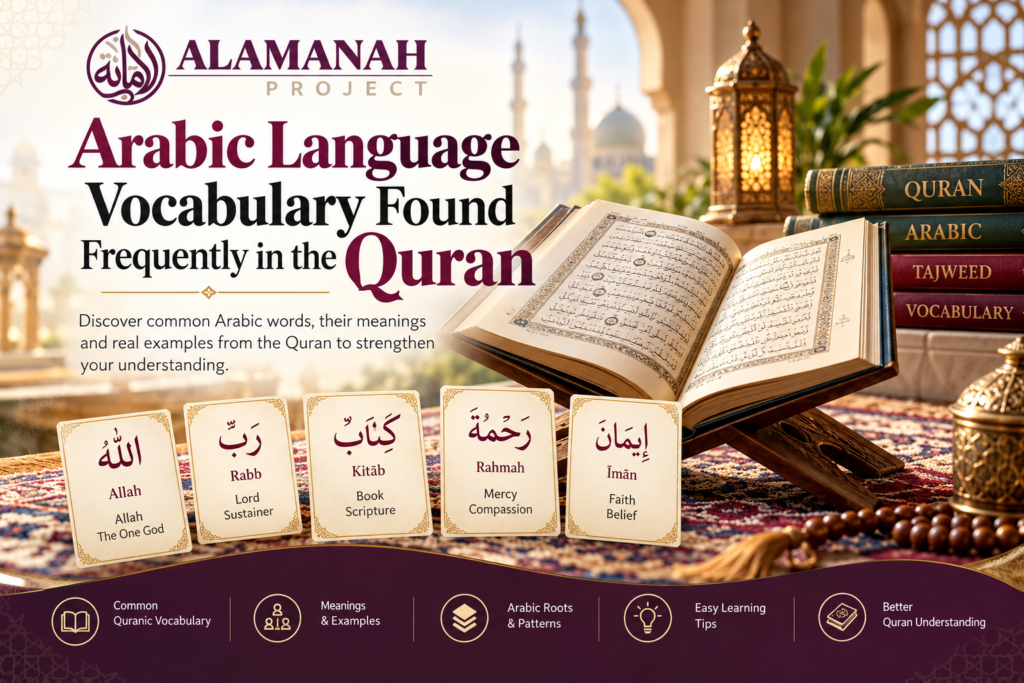
Arabic Language Vocabulary Found Frequently in the Quran
Learning the Arabic Language for Quran understanding does not mean that a beginner must memorise thousands of unrelated words before noticing progress.
A more practical approach is to begin with words, particles and roots that appear repeatedly throughout the Quran.
Once a learner starts recognising words such as رَبّ (Rabb), يَوْم (Yawm), آمَنَ (Āmana), عِلْم (‘Ilm) and رَحْمَة (Rahmah), Quran reading changes. Instead of seeing every verse as an unfamiliar line of text, the learner begins identifying familiar building blocks.
This is one of the most useful differences between studying general vocabulary and studying Quranic Arabic Language vocabulary.
The Quranic Arabic Corpus, an annotated linguistic resource maintained by the Quran.com team and originating from the University of Leeds Language Research Group, provides word-by-word morphology, grammatical analysis, roots and syntax for Quranic words. It demonstrates an important principle for learners: the same Arabic root can appear in different grammatical forms while maintaining a related core meaning. Quranic Arabic Corpus
This guide explains frequently encountered Quranic vocabulary, how Arabic roots work, which small words deserve special attention, and how to build vocabulary without turning Quran study into mechanical memorisation. Arabic Language Arabic Language Arabic Language Arabic Language
Why Frequent Quranic Vocabulary Matters
Beginners often make one of two mistakes when learning the Arabic Language.
The first is trying to memorise long vocabulary lists without seeing the words inside verses.
The second is concentrating only on translation and never learning how Quranic words themselves are constructed.
A better approach combines:
Vocabulary recognition
Root awareness
Grammar
Pronunciation
Context
Repeated Quran reading
This allows the learner to understand not simply “what this word means,” but also how its meaning changes inside a sentence.
For example, a dictionary may give a basic meaning for a root, but Quranic meaning still depends on context, grammatical form and surrounding words. The Quranic Arabic Corpus explicitly notes that its English glosses are guides and that an Arabic word can carry a range of meanings according to context. Quranic Arabic Corpus
That distinction is essential when studying Quranic vocabulary responsibly.Arabic Language Arabic Language Arabic Language
Arabic Language Vocabulary: Words, Roots and Patterns
Arabic works differently from English in several important ways.
Many Arabic words are organised around consonantal roots, commonly consisting of three letters.
One root can generate several related words.
Consider the root:
ع ل م — ‘Ayn, Lām, Mīm
This root is associated with knowledge.
From it, learners may encounter forms connected with:
عِلْم — ‘Ilm — knowledge
عَلِمَ — ‘Alima — he knew
يَعْلَمُ — Ya‘lamu — he knows
عَالِم — ‘Ālim — one who knows / scholar
The forms are not interchangeable, but recognising the root allows a learner to see their relationship.
This is why studying the Arabic Language through roots can be more efficient than treating every Quranic word as completely separate.
Common Quranic Arabic Vocabulary for Beginners
The following words are useful starting points because learners encounter their meanings repeatedly while reading different surahs.
| Arabic Word | Transliteration | Common Meaning | Learning Note |
|---|---|---|---|
| الله | Allah | Allah | Central proper name throughout the Quran |
| رَبّ | Rabb | Lord, Sustainer | Often appears with possessive endings |
| يَوْم | Yawm | Day | Frequently associated with the Day of Judgment |
| كِتَاب | Kitāb | Book, Scripture | Related to the root ك ت ب |
| آيَة | Āyah | Sign, verse | Meaning depends on context |
| عِلْم | ‘Ilm | Knowledge | Root ع ل م |
| حَقّ | Haqq | Truth, right | Used in several contextual senses |
| رَحْمَة | Rahmah | Mercy | Related to ر ح م |
| نَاس | Nās | People, mankind | Extremely useful noun to recognise |
| أَرْض | Arḍ | Earth, land | Frequently contrasted with heaven |
| سَمَاء | Samā’ | Sky, heaven | Often appears in creation passages |
| قَلْب | Qalb | Heart | Can refer to the inner heart |
| نَفْس | Nafs | Self, soul, person | Meaning varies by context |
| دِين | Dīn | Religion, judgment, way | Context determines the precise sense |
| خَيْر | Khayr | Good, goodness | Appears in many grammatical constructions |
| نَار | Nār | Fire | Frequently appears in eschatological passages |
| جَنَّة | Jannah | Garden, Paradise | Used for gardens and Paradise according to context |
| عَذَاب | ‘Adhāb | Punishment | Common in warning passages |
| إِيمَان | Īmān | Faith | Connected with the root أ م ن |
| صَلَاة | Ṣalāh | Prayer | One of the most recognisable Quranic terms |
These translations are useful learning aids, but they should not be treated as one-to-one replacements in every verse.
Small Arabic Words That Carry Big Meaning
A major breakthrough in Quranic Arabic Language study comes when learners stop focusing only on nouns.
Very small words appear constantly and often determine how sentences connect. Arabic Language Arabic Language
وَ — Wa
Usually means:
and
It may attach directly to the following word.
For example:
وَالْكِتَاب
The learner should recognise that the initial وَ is functioning separately from the noun that follows.
فِي — Fī
Common meaning:
in
It is a preposition and affects the grammatical case of the noun after it.
مِن — Min
Common meanings include:
from
of
among
Translation depends on construction.
إِلَى — Ilā
Usually means:
to or towards
عَلَى — ‘Alā
Often means:
on, upon or over
لَا — Lā
Commonly expresses:
no or not
Its grammatical function can vary depending on the sentence. Arabic Language Arabic Language
مَا — Mā
This small word can have several functions.
Depending on context it may mean:
what
that which
whatever
or act as part of a negative construction.
This is a good example of why learning isolated translations is not sufficient. Arabic Language Arabic Language
Personal Pronouns Commonly Seen in the Quran
Pronouns are another high-value area when learning the Arabic Language.
Arabic frequently attaches pronouns directly to nouns, verbs and prepositions.
Common independent pronouns include:
هُوَ — Huwa — he
هِيَ — Hiya — she
هُمْ — Hum — they
أَنْتَ — Anta — you, masculine singular
أَنْتُمْ — Antum — you, masculine plural
نَحْنُ — Naḥnu — we
Attached pronouns are equally important.
For example:
رَبُّهُمْ
can be analysed as:
رَبّ — Lord
plus
هُمْ — their
giving the sense of:
their Lord
Learning to separate these pieces visually can dramatically improve Quranic reading comprehension.
Frequently Encountered Quranic Verbs
Verbs are more challenging than nouns because Arabic verbs change according to person, number, gender and tense.
However, recognising common verb roots is extremely useful. Arabic Language
قَالَ — Qāla
Common meaning:
he said
The Quranic Arabic Corpus search for forms related to قُلْ shows hundreds of occurrences across forms such as “We said,” “you said” and the imperative “say.” Quranic Arabic Corpus
From this root, learners may encounter:
قَالَ — he said
قُلْ — say
قُلْنَا — We said
قَالُوا — they said
Once the learner sees these as related forms rather than unrelated vocabulary, reading becomes easier.
آمَنَ — Āmana
Common meaning:
he believed
Related Quranic forms include expressions translated as:
they believed
those who believe
believe
This root is central to Quranic discussions of faith.
عَمِلَ — ‘Amila
Common meaning:
he did / performed / worked
Learners frequently encounter it in expressions relating to righteous deeds.
خَلَقَ — Khalaqa
Common meaning:
he created
This is especially useful in passages concerning creation.
جَعَلَ — Ja‘ala
Depending on context, this can mean:
made
placed
appointed
It illustrates why verbs cannot always be translated using a single fixed English equivalent.
عَلِمَ — ‘Alima
Common meaning:
he knew
Related forms commonly express:
knows
you know
they know
knowledge
Vocabulary Connected With Faith and Worship
Learners studying the Arabic Language for Quran understanding should group vocabulary by themes rather than memorising words randomly.
Faith
إِيمَان — Īmān — faith
مُؤْمِن — Mu’min — believer
كُفْر — Kufr — disbelief / rejection
تَقْوَى — Taqwā — God-consciousness / piety
هُدًى — Hudā — guidance
Worship
صَلَاة — Ṣalāh — prayer
زَكَاة — Zakāh — prescribed charity
صَوْم — Ṣawm — fasting
ذِكْر — Dhikr — remembrance
دُعَاء — Du‘ā — supplication / calling
Moral and Spiritual Concepts
صَبْر — Ṣabr — patience / steadfastness
شُكْر — Shukr — gratitude
تَوْبَة — Tawbah — repentance
مَغْفِرَة — Maghfirah — forgiveness
رَحْمَة — Rahmah — mercy
Grouping vocabulary this way helps the learner build semantic connections.
Vocabulary About People
Frequently encountered Quranic terms referring to people include:
نَاس — Nās — people
إِنْسَان — Insān — human being
قَوْم — Qawm — people / community
عَبْد — ‘Abd — servant
مُؤْمِنُون — Mu’minūn — believers
كَافِرُون — Kāfirūn — disbelievers
مُنَافِقُون — Munāfiqūn — hypocrites
The root associated with قَوْم appears in numerous forms throughout the Quranic corpus, demonstrating how root study can reveal related vocabulary that may look different to beginners. Quranic Arabic Corpus
Vocabulary Connected With Time and the Hereafter
Several Quranic themes repeatedly use vocabulary related to time, accountability and the Hereafter.
Useful terms include:
يَوْم — Yawm — day
آخِرَة — Ākhirah — Hereafter
قِيَامَة — Qiyāmah — Resurrection
حِسَاب — Ḥisāb — account / reckoning
جَنَّة — Jannah — Paradise / garden
نَار — Nār — fire
عَذَاب — ‘Adhāb — punishment
أَجْر — Ajr — reward
مَوْت — Mawt — death
حَيَاة — Ḥayāh — life
When learners recognise these words, entire themes become easier to follow even before advanced grammar is mastered.
Learning Vocabulary Through Surah Al-Fatihah
Surah Al-Fatihah is a powerful starting point for vocabulary study because it is already familiar to many learners.
The Quranic Arabic Corpus breaks the surah down word by word and identifies grammar and morphology for each term. For example, it analyses بِسْمِ, اللَّهِ, الرَّحْمَٰنِ, الرَّحِيمِ, الْحَمْدُ, رَبِّ, and other words individually. Quranic Arabic Corpus
A learner can study:
الْحَمْدُ — Al-ḥamdu — praise
رَبّ — Rabb — Lord
الْعَالَمِينَ — Al-‘ālamīn — worlds / creation
الرَّحْمَٰن — Ar-Raḥmān — the Most Merciful
الرَّحِيم — Ar-Raḥīm — the Especially Merciful
يَوْم — Yawm — day
الدِّين — Ad-Dīn — judgment / recompense
صِرَاط — Ṣirāṭ — path
This creates an immediate connection between vocabulary and actual recitation.
Root-Based Learning vs Word-by-Word Memorisation
| Learning Method | Root-Based Learning | Isolated Word Memorisation |
|---|---|---|
| Recognises word families | Strong | Limited |
| Helps identify unfamiliar forms | Yes | Less effectively |
| Builds morphology awareness | Yes | Minimal |
| Easy for absolute beginners | Moderate | Easy initially |
| Long-term vocabulary growth | Strong | Can become slow |
| Requires grammar knowledge | Eventually | Less initially |
| Best approach | Combine with context | Combine with roots |
Neither method should completely replace the other.
Beginners still need individual vocabulary.
However, once a learner has a basic foundation, root-based learning makes the Arabic Language more systematic.
How to Memorise Quranic Arabic Vocabulary Effectively
Learn Vocabulary Inside Verses
Do not memorise only:
رحمة = mercy
Instead, notice where the word occurs and observe the sentence around it.
This helps you learn meaning, grammar and usage together.
Use a Root Notebook
Create three columns:
Arabic word
Root
Meaning in the verse
For example:
مغفرة | غ ف ر | forgiveness
Later, when you encounter another form from غ ف ر, you already have a semantic anchor.
Learn 5–10 Words at a Time
Trying to memorise 100 words in one sitting often produces weak recall.
A smaller daily target with repeated revision is usually more effective.
Review Through Quran Reading
Instead of reviewing flashcards alone, open a familiar surah and actively search for vocabulary you have studied.
This converts passive memorisation into recognition.
Learn Grammar Gradually
You do not need advanced Arabic grammar before learning vocabulary.
But basic concepts make vocabulary much easier.
Start with:
Nouns
Verbs
Prepositions
Pronouns
Definite article ال
Attached pronouns
Basic verb forms
Singular and plural patterns
Why Pronunciation Matters Alongside Vocabulary
Vocabulary knowledge and correct recitation are related but distinct skills.
A learner may understand the meaning of a word while still pronouncing its letters incorrectly.
For this reason, students should combine vocabulary study with letter articulation and Tajweed practice.
Al Amanah Project’s Noorani Qaida programme focuses on Arabic letter recognition, pronunciation and gradual Quran reading preparation, while its Tajweed programme covers Tajweed fundamentals, makharij, guided recitation correction and revision. Alamanah Project
Learners who still struggle to distinguish letters such as:
ح / ه
ص / س
ض / د
ط / ت
ق / ك
should not rely only on transliteration.
Hearing and practising the actual Arabic sounds is essential.
A Practical 30-Day Quran Vocabulary Routine
A structured routine can make the Arabic Language manageable.
Days 1–7: High-Frequency Function Words
Study:
و
في
من
على
إلى
لا
ما
ثم
إن
أن
Read short surahs and highlight them.
Days 8–14: Core Quranic Nouns
Study words connected with:
Allah
Lord
people
day
book
earth
heaven
heart
knowledge
mercy
Days 15–21: Common Verb Families
Choose five roots such as:
ق و ل — saying
ع ل م — knowing
ع م ل — doing
خ ل ق — creating
أ م ن — believing
Write several forms under each root.
Days 22–30: Apply Vocabulary to Surahs
Select familiar surahs.
Before reading a translation:
Identify known Arabic vocabulary.
Recognise prefixes and suffixes.
Guess the general subject carefully.
Then compare your understanding with a reliable translation and tafsir.
This process trains recognition without encouraging overconfidence.
Pros and Cons of Learning Quranic Arabic Vocabulary First
Pros
Faster recognition while reading
Frequently recurring vocabulary gives beginners early progress.
Improves concentration
Recognising words can make recitation more meaningful.
Creates a foundation for grammar
Vocabulary provides material that grammar lessons can later explain.
Makes root learning easier
Repeated exposure reveals patterns naturally.
Supports long-term Quran study
Vocabulary becomes a foundation for deeper study rather than an isolated subject.
Cons
Vocabulary alone does not equal complete understanding
Grammar and context still matter.
One Arabic word may have several meanings
Literal memorisation can create misunderstandings.
Transliteration can create pronunciation problems
Learners should hear Arabic directly.
Roots do not always produce an obvious English equivalent
Related Arabic words can develop specialised meanings.
Translation remains an interpretation
Serious study may require reliable tafsir and qualified teachers.
Expert Recommendations from Al Amanah Project
Al Amanah Project recommends building Quranic Arabic Language skills in stages rather than jumping immediately into advanced grammar.
Its current Arabic Language Course focuses on reading, writing, practical vocabulary and basic grammar through structured lessons and teacher guidance. Alamanah Project
A useful learning sequence is:
1. Make Sure You Can Read Arabic Correctly
Students who cannot confidently recognise letters and vowel marks should first strengthen reading foundations.
The Noorani Qaida Course is designed around letter recognition, pronunciation and step-by-step Quran reading preparation. Alamanah Project
2. Build Core Vocabulary
Start with repeated Quranic words instead of obscure vocabulary.
Learn meaning together with pronunciation.
3. Learn Basic Grammar
Understand nouns, verbs, pronouns, prepositions and common sentence structures.
Al Amanah Project’s Arabic Language Course combines vocabulary, reading, writing and basic grammar rather than teaching vocabulary in isolation. Alamanah Project
4. Add Root Recognition
Once basic vocabulary becomes familiar, start grouping words by roots.
5. Study Tajweed Separately but Alongside Arabic
Meaning does not replace correct recitation.
Al Amanah Project’s Tajweed Course includes makharij practice, recitation correction and guided revision. Alamanah Project
6. Keep Returning to the Quran
A vocabulary notebook is useful, but the Quran itself must remain the main context in which vocabulary is reviewed.
Helpful Learning Resources from Al Amanah Project
Students who want structured study can explore the Arabic Language Course, which covers reading, writing, useful vocabulary and basic grammar. Alamanah Project
Beginners who need stronger letter recognition and pronunciation can start with the Noorani Qaida Course. Alamanah Project
Learners working specifically on correct Quran recitation can explore the Quran Tajweed Course. Alamanah Project
The Al Amanah Project courses section also brings its Arabic Language, Noorani Qaida and Tajweed learning options together in one place. Alamanah Project
Authoritative Resources for Quranic Arabic Study
The Quranic Arabic Corpus is particularly useful for checking morphology, roots, word-by-word grammar and syntax. It identifies grammatical roles rather than providing only translations. Quranic Arabic Corpus
Its Quran search can also help learners locate repeated words and compare their use across verses. Quranic Arabic Corpus
For example, its noun search identifies more than 25,000 Quranic noun occurrences in the annotated corpus, showing how extensively grammatical categorisation can be used for structured study. Quranic Arabic Corpus
Because meanings change with context, these linguistic resources should complement reliable translation, tafsir and teacher guidance rather than replace them.
Frequently Asked Questions
1. How many Arabic words do I need to know to understand the Quran?
There is no single vocabulary number that guarantees Quran comprehension.
Knowing frequent vocabulary certainly improves recognition, but understanding the Quran also requires grammar, morphology, context and reliable explanation. A learner who knows 500 words with good grammar awareness may understand more accurately than someone who has memorised a much larger list without context.
2. Is Quranic Arabic different from modern Arabic?
The Quran uses Classical Arabic.
Modern Standard Arabic shares a substantial grammatical and lexical foundation with Classical Arabic, but Quranic style, vocabulary, rhetoric and certain constructions require specialised study.
Learning modern Arabic Language skills can be useful, but Quran study should also include Quran-specific vocabulary and grammar.
3. What are the best Arabic words to learn first?
Begin with words you repeatedly encounter, including:
Allah
Rabb
Yawm
Kitāb
Āyah
Nās
Arḍ
Samā’
Rahmah
‘Ilm
Hudā
Haqq
Then add common prepositions, pronouns and verbs.
4. Can I understand the Quran by learning vocabulary only?
No.
Vocabulary is an important foundation, but Arabic word endings, verb forms, pronouns, sentence structure and context can change meaning.
Vocabulary should therefore be combined with grammar and reliable Quran explanation.
5. Should I learn Arabic roots?
Yes, once you have basic vocabulary.
Arabic roots help learners recognise relationships between words.
However, a root gives a semantic family rather than a complete translation. Always check the actual form and context.
6. Is transliteration useful for learning Quranic vocabulary?
It can help beginners temporarily, especially when recording vocabulary.
It should not replace Arabic script or teacher-guided pronunciation because transliteration cannot represent every Arabic sound accurately.
7. How many Quranic Arabic words should I memorise every day?
For many beginners, five to ten words with regular revision is more useful than memorising a very large list.
Study each word with:
Arabic spelling
Pronunciation
Basic meaning
Root where appropriate
One Quranic example
Then review it several times during the week.
8. Should children learn vocabulary before Tajweed?
The two can develop together.
Children may first need strong Arabic letter recognition and pronunciation through a structured foundation such as Noorani Qaida. Vocabulary can then be introduced gradually while Tajweed skills continue developing.
9. How long does it take to learn Quranic Arabic?
It depends on the learner’s starting level, consistency, teacher support and desired depth.
Recognising basic vocabulary can begin within weeks. Understanding morphology and grammar takes longer, while advanced comprehension is an ongoing field of study.
Regular study is more important than trying to finish quickly.
10. What is the easiest way to remember Quran vocabulary?
Use repetition in context.
Learn the word, identify its root, find it inside a verse, read the verse aloud and review the same word whenever it reappears.
That gives the brain several memory connections instead of only one English translation.
Conclusion
Learning frequently occurring vocabulary is one of the most practical starting points for understanding the Quranic Arabic Language.
The goal, however, should not be simply collecting translations.
A stronger learner gradually begins to see how Arabic works.
They notice that و connects ideas.
They recognise في and من as prepositions.
They see an attached هم and understand that possession or reference is being expressed.
They encounter different forms of قال and recognise that they belong to the same family of “saying.”
They see words built around ع ل م and recognise the broader concept of knowledge.
This type of recognition transforms Quran study.
The page stops looking like a collection of unfamiliar words and begins revealing recurring structures.
For beginners, the most sustainable path is therefore straightforward:
Read Arabic accurately.
Learn frequent vocabulary.
Study words inside verses.
Recognise common roots.
Add grammar gradually.
Practise pronunciation and Tajweed.
Review consistently.
And seek qualified guidance whenever a verse, grammatical construction or religious interpretation requires deeper explanation.
Al Amanah Project provides structured learning options in Arabic Language, Noorani Qaida and Tajweed, with its website describing guided lessons, teacher support and learning paths suitable for different levels. Alamanah Project
Learn Arabic and Quran with Al Amanah Project
Al Amanah Project
Hyderabad, Telangana
Phone: +91 98492 87719
Website: https://alamanahproject.com/
Al Amanah Project offers structured Islamic learning resources and courses focused on Arabic, Quran reading and Tajweed.