
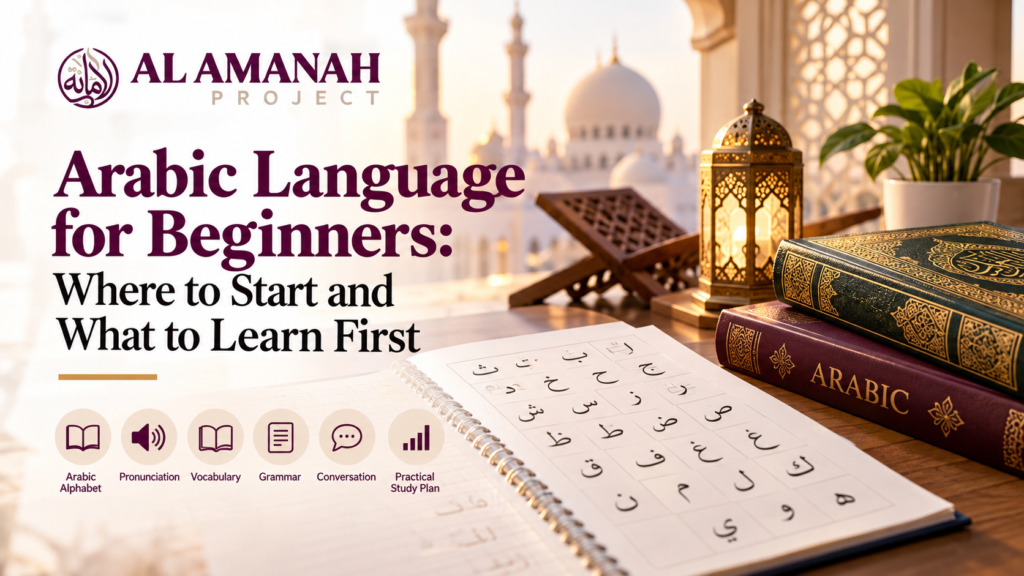
Arabic Language for Beginners: Where to Start and What to Learn First
Learning a new language can feel overwhelming at first. Arabic may seem particularly challenging because of its different script, unfamiliar sounds, word patterns, and the distinction between formal Arabic and regional spoken varieties. But beginners often make the process harder than necessary by trying to learn everything at once.
The better approach is to build Arabic step by step.
Start with the alphabet and pronunciation. Then learn how letters connect, how short vowels work, how simple words are formed, and how basic sentences are structured. Once those foundations become comfortable, vocabulary, reading, grammar, listening, and conversation become much easier to develop.
For students interested in Islamic studies, Quranic understanding, travel, communication, academics, or simply learning one of the world’s major languages, a structured approach can make a significant difference.
This guide explains exactly where beginners should start, what to learn first, which areas can wait, and how to create a realistic Arabic study routine.
Contact Al Amanah Project for Arabic language Course
What Should a Beginner Learn First in Arabic?
A beginner should not begin by memorising hundreds of vocabulary words or studying complicated grammar rules.
A practical sequence is:
- Learn the Arabic alphabet.
- Learn the correct sound of each letter.
- Understand how letters change shape when connected.
- Learn short vowels and basic vowel marks.
- Read simple syllables and words.
- Build a core everyday vocabulary.
- Learn basic sentence patterns.
- Study essential grammar gradually.
- Develop listening and speaking habits.
- Move toward longer reading and real communication.
- Contact Al Amanah Project for Arabic language Course
This order matters because each stage supports the next one.
For example, memorising the Arabic word كتاب (kitāb, book) is more useful when you understand that Arabic letters connect and that the word can be read rather than merely recognised as a picture.
A beginner should aim to understand how Arabic works, not simply collect Arabic words.
Contact Al Amanah Project for Arabic language Course
Understanding the Arabic Language Before You Begin
Arabic is a Semitic language with a writing system that works differently from English and many Indian languages.
Modern Standard Arabic (MSA) is widely used in formal writing, news, education, official communication, and many formal contexts. Alongside MSA, Arabic-speaking communities use regional varieties such as Egyptian Arabic, Levantine Arabic, Gulf Arabic, Iraqi Arabic, and others.
Contact Al Amanah Project for Arabic language Course
This creates an important decision for beginners:
What kind of Arabic do you actually want to learn?
Your answer should influence your study plan.
If your objective is reading formal Arabic texts, Islamic texts, academic material, or developing a broad foundation, formal Arabic is a sensible starting point.
Contact Al Amanah Project for Arabic language Course
If your main goal is everyday conversation with people from a particular Arab country, learning the relevant spoken variety alongside a formal foundation may be more appropriate.
Qatar Foundation International’s educational resources also highlight the importance of understanding the relationship between Modern Standard Arabic and regional varieties when designing Arabic learning.
Contact Al Amanah Project for Arabic language Course
Arabic has 28 basic letters
Modern Standard Arabic contains 28 consonant letters. Their pronunciation includes sounds that may be unfamiliar to English speakers, such as ع, ح, خ, ص, ض, ط, and ظ.
QFI’s Arabic Letters and Sounds resource describes the 28 consonant phonemes of Modern Standard Arabic and explains their places and manners of articulation.
This is why pronunciation should be introduced at the beginning rather than treated as something to fix later.
Contact Al Amanah Project for Arabic language Course
Step 1: Learn the Arabic Alphabet
The Arabic alphabet is your first major milestone.
Unlike English, Arabic is written from right to left. Many letters also have different written forms depending on whether they occur at the beginning, middle, end, or alone.
For example, the letter ب is pronounced approximately like the English b.
You should learn:
- The name of each letter
- Its basic sound
- How to recognise it visually
- Its connected forms
- How it behaves inside a word
- Which letters connect differently from others
Contact Al Amanah Project for Arabic language Course
Do not rush alphabet memorisation
A common beginner mistake is trying to memorise all 28 letters in one sitting.
Instead, divide them into manageable groups.
For example:
Day 1–2: ا ب ت ث
Day 3–4: ج ح خ د ذ
Day 5–6: ر ز س ش ص
Day 7–8: ض ط ظ ع غ
Day 9–10: ف ق ك ل م
Day 11–12: ن ه و ي
The exact schedule can change according to your learning speed.
The important thing is to practise recognition and writing together.
Contact Al Amanah Project for Arabic language Course
Step 2: Focus on Arabic Pronunciation
Knowing that ح is called ḥāʼ is not enough.
You need to know how the sound is produced.
This is particularly important for learners interested in Quranic Arabic because pronunciation can affect the distinction between words and accurate recitation.
Some Arabic sounds have no exact equivalent in English.
Consider:
- ه and ح
- س and ص
- ت and ط
- د and ض
- ك and ق
A beginner should listen carefully and repeat rather than depending entirely on English transliteration.
Contact Al Amanah Project for Arabic language Course
Why transliteration should not become a crutch
Transliteration is useful during the earliest stage, but it can become a problem if you depend on it indefinitely.
For example, writing:
shukran
can help you initially recognise:
شُكْرًا
But your long-term goal should be to read شُكْرًا directly.
Transliteration should function as a temporary bridge, not a permanent replacement for Arabic script.
Contact Al Amanah Project for Arabic language Course
Step 3: Learn Short Vowels and Harakat
Once you know the letters, learn the basic vowel signs.
The three fundamental short vowels are:
- َ Fatha — generally an a sound
- ِ Kasra — generally an i sound
- ُ Damma — generally an u sound
You will also encounter:
- ْ Sukoon
- ّ Shadda
- ً ٍ ٌ Tanween
These small marks can significantly change pronunciation.
For example:
بَ = ba
بِ = bi
بُ = bu
Practise these combinations before moving into difficult grammar.
Contact Al Amanah Project for Arabic language Course
A useful beginner exercise
Take one consonant and practise all three vowels:
مَ — مِ — مُ
Then combine two letters:
بَ + تَ = بَتَ
The purpose at this stage is not vocabulary. It is developing the ability to decode Arabic automatically.
Contact Al Amanah Project for Arabic language Course
Step 4: Learn How Arabic Letters Connect
This is one of the biggest turning points for beginners.
Arabic letters may look different when they appear in different positions within a word.
For example, ب can appear as:
- بـ at the beginning
- ـبـ in the middle
- ـب at the end
- ب independently
You therefore need to stop thinking of the alphabet as 28 isolated symbols.
Start recognising the same letter in different forms.
Contact Al Amanah Project for Arabic language Course
Practise recognition rather than handwriting alone
Write a word several times, but also practise seeing it.
For example:
باب
Instead of reading each character individually every time, gradually train yourself to recognise the whole word as a unit.
This is one reason consistent reading practice matters.
Contact Al Amanah Project for Arabic language Course
Step 5: Build a Small but Useful Arabic Vocabulary
After the alphabet and basic reading system become comfortable, begin vocabulary building.
Do not memorise random lists such as 100 unrelated Arabic words.
Build vocabulary around themes.
Start with personal vocabulary
Learn words for:
- Family
- Food
- Home
- School
- Work
- Time
- Numbers
- Directions
- Common actions
- Greetings
- Daily activities
For example:
كتاب — book
بيت — house
ماء — water
باب — door
ولد — boy
بنت — girl
يوم — day
ليل — night
Then place words into simple contexts.
Knowing بيت is useful.
Knowing:
هذا بيت.
is more useful.
It means:
This is a house.
Language becomes meaningful when vocabulary is connected to sentences.
Contact Al Amanah Project for Arabic language Course
Step 6: Learn High-Frequency Arabic Phrases
Beginners should learn phrases they can actually use.
Examples include:
السلام عليكم
As-salāmu ʿalaykum
Peace be upon you.
وعليكم السلام
Wa ʿalaykum as-salām
And peace be upon you.
كيف حالك؟
Kayfa ḥāluka/ḥāluki?
How are you?
أنا بخير
Anā bikhayr
I am well.
ما اسمك؟
Mā ismuka/ismuki?
What is your name?
اسمي…
Ismī…
My name is…
شكراً
Shukran
Thank you.
من فضلك
Min faḍlik
Please.
Do not simply memorise translations.
Listen, repeat, read the Arabic, and use each expression in a sentence.
Contact Al Amanah Project for Arabic language Course
Step 7: Understand Basic Arabic Sentence Structure
Arabic grammar can become very detailed, but beginners do not need advanced grammar immediately.
Start with simple sentence structures.
Contact Al Amanah Project for Arabic language Course
Nominal sentences
A basic Arabic nominal sentence can begin with a noun or pronoun.
For example:
البيت كبير
Al-baytu kabīr.
“The house is big.”
Simple verbal sentences
Arabic also uses verbal sentences.
For example:
كتبَ الطالبُ
Kataba al-ṭālibu.
“The student wrote.”
At beginner level, focus on recognising:
- Who is doing the action?
- What is the action?
- What is being described?
- Is the sentence about a person, thing, action, or quality?
This gives you a framework before you begin studying advanced grammatical terminology.
Contact Al Amanah Project for Arabic language Course
Step 8: Learn Arabic Pronouns
Personal pronouns are among the most useful grammar topics for beginners.
Start with:
أنا — I
أنتَ — you, masculine
أنتِ — you, feminine
هو — he
هي — she
نحن — we
هم — they
Then build simple sentences.
أنا طالب.
I am a student.
هي طالبة.
She is a female student.
هو معلم.
He is a teacher.
This gives you immediate control over basic communication.
Contact Al Amanah Project for Arabic language Course
Step 9: Learn the Arabic Root System Gradually
One of the fascinating features of Arabic is its root-and-pattern system.
Many Arabic words are built around a group of consonants called a root.
For example, the root:
ك ت ب
is associated with writing.
From this root, learners encounter words connected with writing, such as:
كتب — he wrote
كتاب — book
كاتب — writer
مكتوب — written
مكتبة — library/bookstore depending on context
You do not need to master morphology on your first day.
But learning to recognise related word families can eventually make vocabulary expansion much more efficient.
Instead of treating every new word as completely unrelated, you begin seeing connections.
Contact Al Amanah Project for Arabic language Course
Step 10: Start Listening Earlier Than You Think
Many students spend months studying Arabic grammar before listening seriously.
That creates an imbalance.
Language learning involves several interconnected skills:
| Skill | Beginner Goal |
|---|---|
| Reading | Recognise letters and read simple words |
| Writing | Write letters and basic sentences |
| Listening | Identify familiar words and phrases |
| Speaking | Produce simple everyday sentences |
| Vocabulary | Build a useful high-frequency word bank |
| Grammar | Understand basic sentence patterns |
The Council of Europe’s CEFR framework describes language proficiency through activities including reception, production, interaction and mediation, rather than treating language knowledge as vocabulary and grammar alone.
That principle is useful for Arabic learners too.
You should not wait until your grammar is “perfect” before listening or speaking.
Contact Al Amanah Project for Arabic language Course
Modern Standard Arabic vs Spoken Arabic: Which Should Beginners Learn?
There is no single answer for every learner.
Your goal determines the most practical starting point.
| Learning Goal | Useful Starting Point | Why |
|---|---|---|
| Reading formal Arabic | Modern Standard Arabic | Strong foundation for formal texts |
| Academic Arabic | Modern Standard Arabic | Useful for structured written material |
| Understanding Quranic vocabulary | Quran-focused Arabic + foundational Arabic | Develops vocabulary and language awareness |
| Everyday conversation | Spoken variety + foundational Arabic | Directly supports daily communication |
| Travel | Relevant local dialect | Practical for real-life interaction |
| Reading news | Modern Standard Arabic | Commonly used in formal media |
| Islamic studies | Arabic foundation + relevant classical/Quranic study | Supports deeper engagement with texts |
The distinction between formal Arabic and spoken varieties is important enough that Arabic education resources increasingly discuss how learners can work with linguistic variation rather than assuming that one variety serves every purpose.
The practical answer for most beginners
If you are unsure, begin with a strong foundational form of Arabic that teaches reading, pronunciation, vocabulary and basic grammar.
Once your foundation is stable, add the spoken variety that matches your communication needs.
Arabic for Quran Learning: Where Should You Begin?
A learner interested specifically in the Quran may have a slightly different starting point.
There are two related but distinct goals:
Reading the Quran correctly and understanding Arabic language and vocabulary.
They overlap, but they are not identical.
A learner may know how to pronounce Quranic text without understanding its grammar or vocabulary. Conversely, someone may know general Arabic but still require focused Tajweed instruction for accurate Quranic recitation.
For this reason, learners should identify whether their immediate goal is:
- Arabic alphabet recognition
- Quran reading
- Tajweed
- Quranic vocabulary
- Arabic grammar
- Translation comprehension
- Broader Arabic communication
Al Amanah Project’s learning pathway includes Arabic, Noorani Qaida and Tajweed as distinct learning areas, reflecting the fact that these skills can complement one another without being treated as exactly the same subject.
For a learner who wants to develop Arabic alongside Quranic learning, this distinction can prevent confusion.
You can also read Al Amanah Project’s practical guide on the benefits of learning Arabic for understanding the Quran for a complementary perspective.
A 30-Day Beginner Arabic Plan
A structured month can give you a much clearer starting point than randomly downloading apps and PDFs.
Week 1: Alphabet and pronunciation
Focus on:
- Arabic letters
- Letter names
- Letter sounds
- Similar-looking letters
- Difficult sounds
- Right-to-left reading
Daily target: 20–30 minutes.
Do not worry about complex grammar yet.
Week 2: Reading fundamentals
Study:
- Connected letters
- Short vowels
- Sukoon
- Shadda
- Tanween
- Simple syllables
- Very short words
Spend part of every session reading aloud.
Week 3: Vocabulary and simple sentences
Learn approximately 10 useful words per day, but place them into sentences.
For example:
بيت — house
Then:
هذا بيت.
Do this with family, food, objects, places and everyday activities.
Week 4: Basic communication
Begin practising:
- Greetings
- Introducing yourself
- Asking simple questions
- Numbers
- Days and time
- Family vocabulary
- Common verbs
- Simple descriptions
By the end of the month, the goal should not be fluency.
The goal should be a reliable foundation.
How Long Does It Take to Learn Arabic?
There is no universal number of months or years because “learn Arabic” can mean very different things.
Being able to:
- read the alphabet,
- introduce yourself,
- understand basic phrases,
- read simple sentences,
- communicate comfortably,
- understand formal texts,
- or analyse classical Arabic
represent very different levels of ability.
A better way to measure progress is through specific “can do” goals.
For example:
Beginner goal:
“I can read simple Arabic words.”
Next goal:
“I can introduce myself and understand basic questions.”
Intermediate goal:
“I can follow a simple conversation and read uncomplicated texts.”
Advanced goal:
“I can understand complex texts and communicate with greater precision.”
The CEFR framework similarly uses proficiency descriptors and “can-do” statements to describe what learners can actually accomplish at different levels.
This is more useful than saying, “I have studied Arabic for six months.”
Time spent is not the same as ability developed.
Contact Al Amanah Project for Arabic language Course
Common Mistakes Arabic Beginners Should Avoid
Trying to learn too much grammar too early
Arabic grammar is extensive.
If you begin with advanced grammatical terminology, you may understand rules without being able to use the language.
Start with patterns that you can immediately recognise and apply.
Relying entirely on transliteration
Use transliteration when needed, but gradually remove it.
Your eyes should become comfortable with Arabic script.
Contact Al Amanah Project for Arabic language Course
Memorising isolated vocabulary
Instead of:
بيت = house
learn:
هذا بيت.
Then:
هذا بيت كبير.
You are learning vocabulary and sentence structure together.
Ignoring pronunciation
Incorrect pronunciation becomes harder to correct after it becomes a habit.
Listen carefully from the beginning.
Studying only when motivated
Consistency usually beats occasional long study sessions.
Twenty minutes every day can be more productive than two hours once a week.
Switching resources constantly
One textbook, course, teacher or structured program followed consistently is often more useful than collecting ten different resources.
Contact Al Amanah Project for Arabic language Course
Pros and Cons of Learning Arabic as a Beginner
Pros
- Opens access to a major world language.
- Helps learners engage directly with Arabic texts.
- Provides a deeper foundation for Quranic and Islamic studies.
- Develops awareness of language patterns and word families.
- Can support academic, professional and travel goals.
- Builds reading skills in a different writing system.
- Creates a pathway toward understanding different Arabic-speaking cultures.
Cons
- The alphabet initially requires adjustment.
- Some Arabic sounds may be unfamiliar.
- Formal and spoken varieties can create confusion.
- Grammar becomes increasingly detailed at higher levels.
- Progress can feel slow if pronunciation and reading are not practised regularly.
- Beginners may need guidance to choose appropriate learning materials.
The solution is not to avoid difficult areas. It is to introduce them in the right order.
Recommended authoritative Resources:
- Council of Europe — CEFR — language-learning framework and proficiency guidance.
- Council of Europe — CEFR Descriptors — practical “can-do” descriptors.
- QFI — Arabic Letters and Sounds — Arabic alphabet and pronunciation resource.
- Council of Europe — CEFR Companion Volume — expanded language-learning framework.
Expert Recommendations from Al Amanah Project
At Al Amanah Project, a beginner-friendly approach should prioritise foundation before complexity.
Contact Al Amanah Project for Arabic language Course
Our recommendations are:
1. Make reading your first measurable milestone
Before worrying about advanced conversation, make sure you can confidently recognise Arabic letters and read simple words.
2. Practise pronunciation with a teacher or reliable audio
Some sounds are difficult to self-correct.
Feedback can save weeks of repeating the same mistake.
3. Connect vocabulary to real situations
Learn words that relate to your daily life, studies, worship, family and interests.
4. Keep grammar practical
Study grammar when it helps you understand or produce a sentence. Avoid memorising terminology without application.
5. Separate Arabic goals clearly
If you want Quran reading, Tajweed, general Arabic and conversational Arabic, understand that these are connected but different skills.
Contact Al Amanah Project for Arabic language Course
6. Use a structured learning path
Al Amanah Project’s Arabic Language Course is designed around reading, writing, vocabulary and basic grammar through structured lessons. The course also provides study material, lessons, assignments, teacher feedback and attendance tracking through its student portal.
7. Review more than you add
A beginner who learns 20 words and forgets 15 has not really learned 20 words.
Revision should be part of the learning plan from day one.
Contact Al Amanah Project for Arabic language Course
A Simple Daily Arabic Routine for Busy Students
You do not need an entire afternoon to study Arabic.
Try this 30-minute routine:
5 minutes — Review
Revise yesterday’s letters, words or sentences.
10 minutes — New lesson
Learn one small topic.
5 minutes — Reading
Read Arabic aloud.
5 minutes — Listening
Listen to a short Arabic recording.
5 minutes — Speaking or writing
Say or write three to five sentences.
For example:
أنا طالب.
I am a student.
أنا أتعلم العربية.
I am learning Arabic.
أحب القراءة.
I like reading.
The routine is simple, but it forces you to interact with the language instead of merely reading about it.
Contact Al Amanah Project for Arabic language Course
How to Choose an Arabic Course as a Beginner
Before joining a course, ask:
- Does it teach pronunciation?
- Does it begin from the actual beginner level?
- Does it teach Arabic script rather than relying on transliteration?
- Is there a clear progression?
- Can you ask questions?
- Is there teacher feedback?
- Does the course include reading and writing?
- Does it explain grammar progressively?
- Are lessons supported by practical examples?
- Does the course match your reason for learning Arabic?
A good course should make your next step obvious.
Al Amanah Project provides a structured Arabic Language Course covering reading, writing, vocabulary and basic grammar, with learning materials and teacher-supported study features.
Contact Al Amanah Project for Arabic language Course
Useful Arabic Learning Resources
Beginners can supplement structured learning with reputable educational resources.
The Council of Europe CEFR resources provide internationally recognised frameworks and “can-do” descriptors for thinking about language proficiency, learning objectives and assessment.
The QFI Arabic Letters and Sounds resource is particularly useful for understanding Arabic pronunciation and the 28 consonant letters of Modern Standard Arabic.
The Council of Europe’s CEFR Companion Volume is also available in Arabic and expands the framework’s approach to language learning, including interaction, mediation and plurilingual competence.
These resources should complement—not replace—a structured course and regular practice.
Frequently Asked Questions About Learning Arabic
1. Is Arabic difficult for beginners?
Arabic can be challenging initially because the writing system, pronunciation and grammar may be unfamiliar. However, beginners do not need to learn everything simultaneously. Starting with the alphabet, pronunciation, reading and simple vocabulary creates a manageable progression.
Contact Al Amanah Project for Arabic language Course
2. Should I learn Arabic letters before vocabulary?
Yes. Learning the alphabet and basic pronunciation first gives you the ability to read Arabic words independently. Vocabulary then becomes easier to retain because you are learning words in their original script.
3. How many Arabic words should I learn each day?
There is no mandatory number. For many beginners, 5–10 useful words combined with revision and sentence practice is more sustainable than memorising a large list and forgetting it.
4. Should I learn Modern Standard Arabic or a dialect?
It depends on your objective. Modern Standard Arabic is useful for formal language and reading, while spoken varieties are important for everyday communication in particular regions. If you are uncertain, establish a solid formal foundation first and add a dialect according to your communication needs.
Contact Al Amanah Project for Arabic language Course
5. Can I learn Arabic for Quran understanding?
Yes. Arabic study can help you understand vocabulary, sentence structures and meanings more directly. However, Quran reading, Tajweed and broader Arabic language proficiency are related but distinct areas of study.
6. Do I need to learn grammar immediately?
You need some basic grammar relatively early, but you do not need advanced grammar at the beginning. Start with simple sentence structures, pronouns, gender, basic verbs and common patterns.
7. Should I use Arabic transliteration?
Transliteration can help at the beginning, especially with pronunciation. However, you should gradually reduce your dependence on it and become comfortable reading Arabic script directly.
8. Can adults learn Arabic from zero?
Absolutely. Adults may have different learning needs and schedules, but the basic principle remains the same: establish a foundation, practise consistently and gradually increase complexity.
9. How long should I study Arabic every day?
Consistency matters more than a fixed number of hours. Even 20–30 minutes of focused daily practice can provide a useful routine. As your goals become more advanced, you can increase study time.
10. What is the best way to start learning Arabic?
Start with the Arabic alphabet, pronunciation, connected letters and short vowels. Then move into simple vocabulary and sentences. Choose a structured learning path rather than jumping between unrelated resources.
Contact Al Amanah Project for Arabic language Course
Start Your Arabic Journey With the Right Foundation
Learning Arabic does not need to begin with complicated grammar books or hundreds of vocabulary cards.
It begins with one letter.
Then one sound.
Then one word.
Then one sentence.
The real progress comes from connecting these small pieces until Arabic stops looking like a collection of unfamiliar symbols and starts functioning as a language you can read, understand and use.
For beginners, the most effective approach is usually a structured progression: alphabet → pronunciation → reading → vocabulary → sentences → grammar → listening → speaking → deeper texts.
If your goal includes Quranic understanding, remember that Arabic language learning can complement Quran reading and Tajweed, while each remains a distinct area of study.
Al Amanah Project in Hyderabad provides structured learning opportunities for students who want to develop their Arabic foundation alongside broader Islamic education. Its Arabic Language Course covers reading, writing, vocabulary and basic grammar with structured lessons and student learning support.
If you are ready to begin, start small, practise consistently and measure your progress by what you can actually understand and do.
Al Amanah Project
Hyderabad, Telangana
Phone: +91 98492 87719
Website: alamanahproject.com
A strong Arabic foundation is not built in one day but it can begin with one well-learned lesson today.