
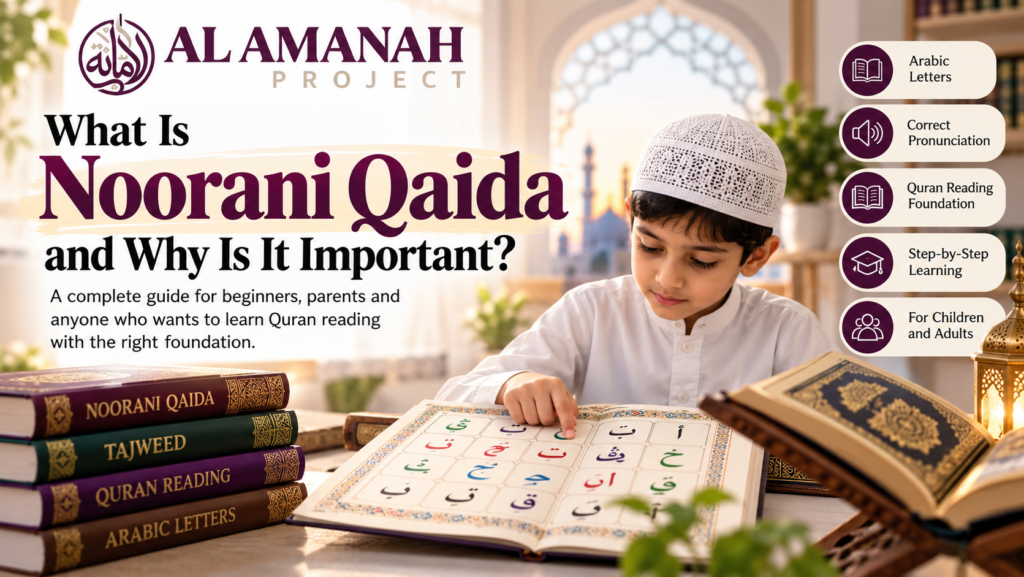
What Is Noorani Qaida and Why Is It Important?
For someone beginning to learn how to read the Quran, the Arabic script can initially feel unfamiliar. The letters may look different from the writing systems they already know, some letters have similar shapes, and correct pronunciation depends on details that are difficult to understand simply by looking at a page.
This is where Noorani Qaida plays an important role.
Rather than asking a beginner to immediately read complete Quranic verses, a Qaida introduces the building blocks of Quran reading in a progressive manner. Learners work through Arabic letters, their sounds, vowel marks, combinations and increasingly complex reading patterns before progressing toward fluent Quran recitation.
The purpose is not merely to finish a small book. The real objective is to develop a reliable reading foundation.
The Quran itself instructs believers to recite it with tarteel, or measured and deliberate recitation, in Surah Al-Muzzammil 73:4. A structured beginner’s method can help learners approach that goal with greater care.
For families choosing Quran education for children, and for adults who are learning later in life, understanding what a Qaida actually teaches can make the learning process much more productive.
What Is Noorani Qaida?
Noorani Qaida is a beginner-level instructional text used to teach the fundamentals required for reading Arabic and, particularly, the Quran.
It typically introduces learners to the Arabic alphabet before gradually moving toward combinations, vowel signs and rules needed for Quranic reading.
The important point is that a Qaida is not a replacement for the Quran. It is a preparatory learning tool.
Think of it like learning individual musical notes before attempting to play a complete piece of music. The notes themselves are not the final performance, but learning them correctly makes the next stage possible.
Similarly, the beginner first learns to recognise letters and produce their sounds. Then those letters are combined into increasingly complex forms.
Al Amaanah Project describes its Noorani Qaida course as a beginner-focused foundation covering Arabic letters, correct pronunciation, joining letters and progressive preparation for Quran reading.
Why Is Noorani Qaida Important?
The biggest advantage of Noorani Qaida is its gradual approach.
A beginner may look at a Quranic word and see several letters, vowel marks and pronunciation indicators at once. Without foundational knowledge, it can be difficult to understand what each element is doing.
A structured Qaida separates these challenges.
1. It Builds Arabic Letter Recognition
The first requirement for Quran reading is recognising Arabic letters accurately.
Some letters have visually similar forms, particularly when they appear within connected words. Regular practice helps learners distinguish between them instead of relying on guessing.
For example, a learner needs to become comfortable recognising differences between letters such as:
- ب
- ت
- ث
- ن
- ي
The shapes can become more challenging when letters are joined, making early recognition practice particularly useful.
2. It Teaches Correct Pronunciation
Recognising a letter is not the same as pronouncing it correctly.
Arabic contains sounds that may not exist in the same way in English, Hindi, Telugu or other languages spoken by learners.
This is why Quran education needs attention to articulation and pronunciation.
For example, beginners may initially struggle to distinguish sounds involving letters such as:
- ح
- ه
- ع
- خ
- غ
- ق
A qualified teacher can listen to the learner and identify whether the sound is being produced correctly.
This is one reason guided learning can be valuable: pronunciation mistakes are often difficult for learners to identify themselves.
Noorani Qaida and Makharij
Makharij al-Huruf refers to the articulation points from which Arabic letters are pronounced.
This is an important concept in Quran reading.
Different Arabic letters originate from different areas of the mouth and throat. A learner therefore needs more than visual recognition.
For example, two letters may appear familiar to a beginner but require different articulation.
A teacher can demonstrate the sound, listen to the student’s attempt and correct it immediately.
This teacher-feedback cycle is particularly valuable for young learners.
What Does Noorani Qaida Teach?
The exact organisation differs between editions and teaching traditions, but a structured course commonly progresses through several foundational areas.
Arabic Alphabet
Students first become familiar with individual Arabic letters.
The focus should be on:
- Letter recognition
- Correct letter names
- Correct sounds
- Repeated pronunciation
- Recognition without hesitation
Harakat — Short Vowel Signs
Learners are introduced to common vowel marks such as:
- Fathah
- Kasrah
- Dammah
These marks affect how letters are pronounced.
The student gradually moves from identifying an isolated letter to reading a letter together with its vowel sound.
Tanween
Learners encounter double vowel signs and practise their sounds in increasingly complex combinations.
This prepares them for reading Quranic words where such signs appear.
Sukoon
Sukoon indicates the absence of a short vowel on a letter and introduces learners to more complex sound combinations.
At this stage, learners begin to understand why simply knowing the alphabet is not enough to read Quranic Arabic accurately.
Shaddah
Shaddah represents a doubled consonant sound and requires careful pronunciation.
For a beginner, this can be an important transition from simple letter-by-letter reading toward more natural Quranic word pronunciation.
Madd and Long Sounds
Learners also encounter elongated sounds and learn that vowel duration can matter in Quranic recitation.
This becomes increasingly relevant as the learner progresses toward Tajweed.
Joining Letters
Arabic letters can take different forms depending on their position and whether they connect with neighbouring letters.
A good beginner programme therefore provides repeated practice with joined letters rather than moving too quickly to complete Quranic passages.
Noorani Qaida vs Learning Directly from the Quran
Parents sometimes ask whether a child really needs a Qaida or whether they can simply begin reading the Quran directly.
Both approaches may exist in different learning environments, but for a beginner who does not yet confidently recognise Arabic letters and pronunciation patterns, a structured foundation can make the learning process easier.
| Learning Approach | Main Focus | Suitable For | Potential Challenge |
|---|---|---|---|
| Noorani Qaida | Reading foundations | Beginners | Requires regular repetition |
| Direct Quran Reading | Applying reading skills | Learners with foundations | Difficult for complete beginners |
| Tajweed Course | Rules and quality of recitation | Existing readers | Requires prior reading ability |
| Arabic Language Course | Language, vocabulary and grammar | Learners seeking language understanding | Broader than Quran reading |
| Self-study | Independent practice | Motivated learners | Pronunciation mistakes may go unnoticed |
The distinction is important.
Noorani Qaida teaches the mechanics needed to begin reading. Tajweed develops knowledge and practice related to proper Quranic recitation. Arabic language study goes further into vocabulary, grammar and comprehension.
These areas complement each other rather than being identical.
Who Should Learn Noorani Qaida?
One of the misconceptions surrounding Noorani Qaida is that it is only for small children.
It can also be useful for:
Children
Young learners can use a structured progression to develop Arabic reading habits from an early stage.
Teenagers
Students who have studied the Quran previously but still struggle with pronunciation can revisit the fundamentals.
Adults
Adults who never learned to read Arabic can start from the beginning without feeling embarrassed about their level.
Relearners
Someone who learned Quran reading years ago but has become out of practice may benefit from reviewing foundational lessons before returning to regular recitation.
Non-Arabic Speakers
Learners whose first language is Hindi, Telugu, Urdu, English or another language may particularly appreciate a step-by-step phonetic foundation.
There is no age at which learning to read the Quran becomes inappropriate.
How Long Does It Take to Complete Noorani Qaida?
There is no universal completion period.
A child’s progress may be very different from that of an adult. Some learners practise every day, while others attend one or two classes each week.
More important than finishing quickly is whether the learner can actually:
- Recognise letters confidently
- Pronounce them correctly
- Read vowel combinations
- Handle joined letters
- Apply learned rules
- Read without excessive guessing
- Correct mistakes after feedback
A student who finishes the book quickly but repeatedly mispronounces letters may need more revision.
A student who progresses slowly but develops accurate reading habits may have a stronger foundation.
Accuracy should therefore come before speed.
How Parents Can Help Children Learn Noorani Qaida
Parents do not need to become Quran teachers to support their children.
Small habits can make a significant difference.
Create a Consistent Routine
Ten to fifteen minutes of focused practice can be more useful than an occasional long session.
Choose a time when the child is alert rather than tired or distracted.
Listen Without Turning Every Session into a Test
Children can become anxious if every practice session feels like an examination.
Instead, encourage them to read aloud and treat mistakes as part of learning.
Avoid Correcting Every Mistake at Once
If a child makes several errors in one line, correcting everything simultaneously can overwhelm them.
A teacher can prioritise the most important errors and gradually improve the rest.
Revise Previous Lessons
New material should not completely replace old material.
A useful pattern can be:
Previous lesson → New lesson → Previous difficult examples → Short independent reading
This helps maintain retention.
Don’t Compare Siblings
Two children may progress at completely different speeds.
Comparison can make Quran learning feel like competition when the real purpose is learning and worship.
A Practical Daily Noorani Qaida Routine
A simple routine can look like this:
For Young Beginners
5 minutes: Revision
5 minutes: New lesson
5 minutes: Teacher/parent correction
2–5 minutes: Independent repetition
For Adults
5–10 minutes: Revision
10 minutes: New concepts
10 minutes: Reading practice
5 minutes: Pronunciation correction
The exact timing is less important than consistency.
If someone practises for 15 minutes every day, they accumulate more meaningful practice than someone who studies for an hour once every two weeks.
Common Mistakes Beginners Make
Understanding common mistakes can save months of frustration.
Moving to the Quran Too Quickly
Some learners become excited and want to start reading complete Surahs immediately.
If basic letter recognition and pronunciation are still uncertain, however, moving forward too quickly can reinforce mistakes.
Learning Only by Looking
Quran reading is not purely visual.
The learner needs to see, hear, pronounce and receive correction.
Memorising Sounds Without Understanding the Pattern
Repeating a page from memory may create temporary fluency without developing independent reading ability.
The goal should be recognition of unfamiliar combinations as well.
Ignoring Similar Letters
A learner might recognise familiar letters but confuse letters with similar shapes.
Teachers should deliberately test these distinctions.
Focusing Only on Speed
Fast reading is not necessarily accurate reading.
The Quran calls for measured recitation, and a beginner’s training should develop control before speed.
Noorani Qaida and Tajweed: What Is the Difference?
Tajweed refers to rules and principles concerned with proper Quranic recitation.
A beginner may encounter some pronunciation principles while studying a Qaida, but a dedicated Tajweed programme generally goes further.
Al Amaanah Project’s Tajweed course describes its programme as covering articulation, essential Tajweed rules and practical recitation improvement for learners at different levels.
A useful learning progression is:
Arabic letters → Noorani Qaida → Quran reading → Tajweed development → Regular Quran recitation
This does not mean every learner follows exactly the same sequence. A qualified teacher can determine where an individual should begin.
The Role of a Qualified Quran Teacher
Technology can provide audio, videos and digital learning materials, but pronunciation correction is an area where human feedback remains especially valuable.
A teacher can notice things such as:
- Incorrect articulation
- Confusion between similar letters
- Inconsistent vowel pronunciation
- Incorrect elongation
- Hesitation
- Repeated reading patterns
- Areas requiring revision
Al Amaanah Project states that its learning approach includes teacher guidance, assignments, feedback and student progress features.
The most useful teacher is not necessarily the person who moves fastest through the book. A good teacher should be able to identify the learner’s specific difficulty and adapt practice accordingly.
Benefits and Limitations of Noorani Qaida
Pros
1. Beginner-Friendly Structure
It breaks a complicated skill into smaller learning stages.
2. Supports Pronunciation Practice
Students can focus on individual sounds before handling longer passages.
3. Useful for Different Age Groups
Children and adults can both benefit from foundational instruction.
4. Creates a Bridge to Quran Reading
The learner develops skills that can later be applied to actual Quranic text.
5. Encourages Systematic Revision
The progression provides a framework for identifying what has and has not been mastered.
6. Can Complement Tajweed
Once the learner has foundational reading ability, more advanced recitation instruction becomes easier to follow.
Cons
1. It Requires Repetition
There is no shortcut around repeated reading practice.
2. A Book Cannot Replace Feedback
A learner may not recognise their own pronunciation errors.
3. Progress Can Feel Slow
Beginners sometimes become frustrated when teachers ask them to repeat earlier lessons.
4. Different Learners Need Different Pacing
One fixed schedule cannot suit every student.
5. Finishing the Book Is Not the Final Goal
Completing the Qaida does not automatically mean a learner has mastered Quranic recitation or Tajweed.
Expert Recommendations from Al Amanah Project
At Al Amaanah Project, the learning approach is built around structured Islamic education, teacher guidance and progressive learning. The organisation’s current Noorani Qaida course specifically focuses on Arabic letters, pronunciation, joining letters and preparation for Quran reading.
Based on that foundation-first approach, learners should keep five principles in mind.
1. Don’t Rush the Foundation
If a particular lesson is difficult, repeating it is not failure.
A strong foundation is more valuable than moving quickly through pages.
2. Practise Out Loud
Silent recognition can hide pronunciation problems.
Read aloud whenever possible so that mistakes can be heard and corrected.
3. Ask the Teacher About Specific Sounds
Instead of saying, “I cannot pronounce Arabic,” identify the exact letters or combinations that cause difficulty.
Specific questions produce better corrections.
4. Combine Classwork with Home Practice
A lesson introduces or corrects a skill.
Home practice turns that skill into a habit.
5. Progress from Reading Mechanics to Understanding
After establishing a reading foundation, learners can explore Tajweed and Arabic language studies.
Al Amaanah Project’s Arabic course covers reading, writing, vocabulary and basic grammar, providing a natural next step for learners who want to develop beyond basic Quran reading.
How to Know If a Student Is Ready to Move Forward
Instead of asking, “Have we completed the Qaida?”, ask:
Can the student recognise unfamiliar letters?
Can they pronounce the basic sounds accurately?
Can they read common vowel combinations without guessing?
Can they handle joined letters?
Can they identify and correct some of their own mistakes?
Can they read slowly without depending entirely on memorisation?
These questions give a much better indication of readiness.
A student who answers “yes” consistently may be ready for the next stage, while another student may benefit from additional revision.
How Noorani Qaida Fits Into a Complete Quran Learning Journey
Learning to read the Quran is not necessarily a single-course process.
A learner may progress through several stages:
Stage 1 — Arabic Letter Recognition
Understand the alphabet and basic sounds.
Stage 2 — Noorani Qaida
Build reading mechanics through progressive exercises.
Stage 3 — Quran Reading
Apply those skills to actual Quranic passages.
Stage 4 — Tajweed
Improve articulation, pronunciation and recitation according to Tajweed principles.
Stage 5 — Arabic Language
Learn vocabulary, grammar and language structure to develop deeper engagement with Quranic Arabic.
Stage 6 — Regular Recitation and Study
Combine accurate reading with reflection, learning and consistent practice.
This broader perspective prevents a common mistake: treating the completion of one beginner book as the end of Quran education.
Noorani Qaida vs Arabic Language Learning
These two forms of study are related but serve different purposes.
| Feature | Noorani Qaida | Arabic Language |
|---|---|---|
| Primary goal | Learn Quran reading foundations | Learn the Arabic language |
| Letter recognition | Core component | Included |
| Pronunciation | Major focus | Important |
| Quran reading | Directly supported | Indirectly supported |
| Vocabulary | Limited | Major component |
| Grammar | Not the main purpose | Major component |
| Speaking Arabic | Not the objective | Can be an objective |
| Quran comprehension | Limited | Can support deeper understanding |
Someone who wants to read the Quran should not assume that they need to master Arabic grammar first.
Likewise, someone who wants to understand Quranic Arabic more deeply may eventually benefit from formal Arabic language study.
Both paths can complement one another.
Frequently Asked Questions About Noorani Qaida
1. What is Noorani Qaida used for?
Noorani Qaida is used as a beginner’s foundation for learning Arabic letters, pronunciation, combinations and reading skills needed for Quran recitation.
It is particularly useful for learners who are not yet comfortable reading Arabic script.
2. Is Noorani Qaida only for children?
No. Adults and teenagers can also study it.
In fact, an adult who has never learned Arabic reading may benefit from starting with the same fundamentals rather than trying to memorise complete Quranic passages without understanding the reading mechanics.
3. Can I learn Noorani Qaida at home?
Yes, home practice is useful and can support formal instruction.
However, learners should ideally have access to a qualified teacher or reliable feedback mechanism, particularly for pronunciation and articulation.
4. How many days does it take to complete Noorani Qaida?
There is no fixed number of days.
Completion depends on age, previous Arabic exposure, class frequency, practice time and individual learning ability.
Accuracy should be used as the main benchmark rather than a calendar deadline.
5. Should children learn Noorani Qaida before the Quran?
For a child who does not yet have basic Arabic reading skills, a structured Qaida can provide a useful foundation before moving into regular Quranic reading.
The appropriate progression should be determined according to the child’s actual reading ability.
6. What comes after Noorani Qaida?
Usually, the learner progresses toward reading the Quran more independently and developing stronger Tajweed knowledge.
Some learners may also study Arabic language, vocabulary and Islamic studies alongside Quran education.
7. Is Noorani Qaida the same as Tajweed?
No.
They overlap in the area of correct Quran pronunciation, but they are not identical.
A Qaida primarily provides foundational reading instruction, while Tajweed is a broader discipline concerning proper Quranic recitation.
8. Can Noorani Qaida improve Quran pronunciation?
It can help establish pronunciation foundations, particularly when taught with active correction.
However, the quality of instruction and regular practice matter. Simply looking at the pages without listening and receiving feedback is unlikely to address every pronunciation problem.
9. Can I learn Noorani Qaida online?
Yes. Online learning can provide lessons, digital materials and teacher interaction.
Al Amaanah Project’s current course information describes online/offline class scheduling, downloadable study materials, assignments and teacher feedback through its student portal.
10. What should parents look for in a Noorani Qaida course?
Look for a structured curriculum, qualified teacher guidance, regular pronunciation correction, revision, progress tracking and an appropriate pace.
A course should focus on whether the child is actually learning to read rather than simply completing pages.
Contextual Resources for Further Learning
Learners who want to continue beyond basic Noorani Qaida can explore Al Amaanah Project’s Noorani Qaida Course, which focuses on Arabic letters, pronunciation, joining letters and progressive Quran-reading preparation.
Those ready to work more specifically on recitation can explore the Quran Tajweed Course, which covers articulation and essential Tajweed rules with practical recitation work.
Learners interested in understanding Arabic beyond reading mechanics can continue with the Arabic Language Course, covering reading, writing, vocabulary and basic grammar.
For additional learning material, the Al Amaanah Project Blog provides Islamic education resources, while the About Al Amaanah Project explains its structured learning and teacher-guidance approach.
Authoritative Quran and Hadith Resources
The Quran provides the foundational instruction to recite with measured recitation in Surah Al-Muzzammil 73:4.
For the virtue of learning and teaching the Quran, Sahih al-Bukhari records the well-known narration from Uthman ibn Affan that the Prophet ﷺ said that the best among people are those who learn the Quran and teach it.
Readers can consult:
- Quran.com — Surah Al-Muzzammil 73:4 for the Quranic text and translations.
- Sahih al-Bukhari 5027 — Virtues of the Quran for the referenced hadith.
- Sunnah.com — Virtues of the Quran for additional hadith references concerning learning and teaching the Quran.
- Quranic Arabic Corpus for linguistic and word-level Quranic study.
Final Thoughts
The importance of Noorani Qaida is easy to misunderstand if it is viewed simply as a small book that children must finish before opening the Quran.
Its deeper value is the foundation it can provide.
A beginner needs to recognise Arabic letters, understand how they connect, produce their sounds correctly and gradually become comfortable with the marks and combinations encountered in Quranic text. A structured Qaida gives the learner a practical route through those stages.
But completing the pages is not the real achievement.
The real achievement is reaching the point where a learner can approach Quranic text with greater confidence, accuracy and respect for correct recitation.
For parents, that means focusing less on how quickly a child finishes and more on whether the child is developing accurate reading habits. For adults, it means understanding that starting from the basics is not something to be embarrassed about. And for teachers, it means giving learners enough repetition and correction to make the fundamentals reliable.
The Prophet ﷺ emphasised the virtue of learning and teaching the Quran, and the Quran itself directs believers toward measured recitation.
A thoughtful learning journey can therefore begin with a simple page of Arabic letters and gradually lead toward confident Quran reading, Tajweed and deeper engagement with the words of the Quran.
Learn Noorani Qaida with Al Amanah Project
Al Amanah Project
Location: Hyderabad, Telangana
Phone: +91 98492 87719
Website: alamanahproject.com
Al Amaanah Project describes its mission as making Quranic and Arabic education accessible and meaningful for learners of different ages and backgrounds, with structured courses and teacher guidance.
Start your Quran learning journey with a strong foundation — one letter, one sound and one lesson at a time.