
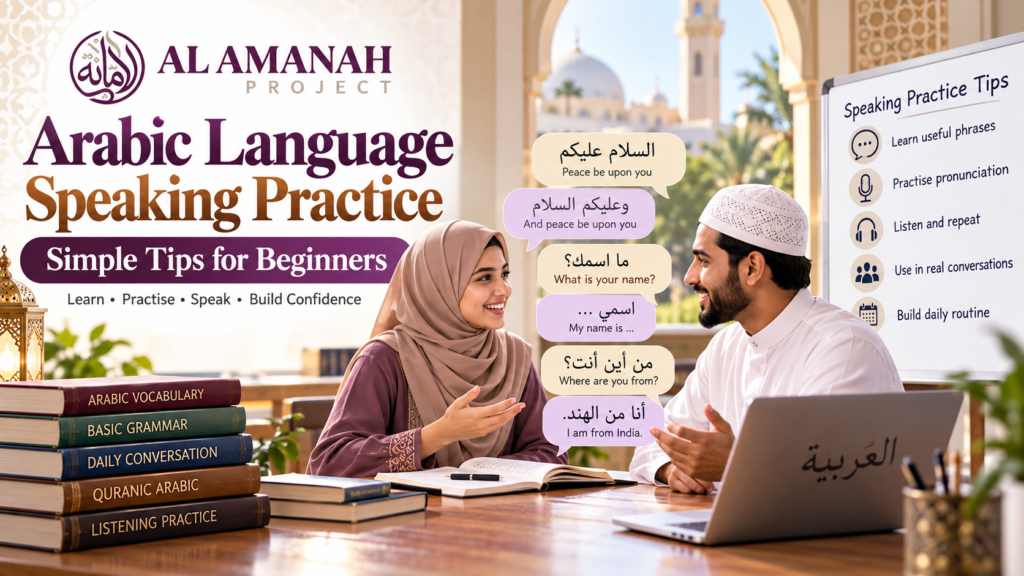
Arabic Language Speaking Practice: Simple Tips for Beginners
Introduction
Learning to recognize Arabic letters is one achievement. Understanding basic vocabulary is another. But speaking Arabic comfortably in a real conversation is where many beginners discover that their study routine needs to change.
A learner may know dozens of words but still hesitate when someone asks, كيف حالك؟ (Kayfa haluk?) — “How are you?” The problem is not always a lack of vocabulary. Often, the learner has spent more time memorising individual words than using those words in complete situations.
Effective Arabic Language speaking practice should therefore be practical, repetitive and connected to everyday communication.
Instead of trying to memorise hundreds of words before speaking, beginners can start with short conversations, useful sentence patterns, listening exercises and controlled repetition. A five-minute conversation practised every day can be more useful for speaking development than an hour spent silently reading vocabulary lists.
There is another important consideration: Arabic has both formal and spoken varieties. Modern Standard Arabic (MSA) is widely used in formal writing, education and media, while everyday conversations vary considerably across regions and dialects. Georgetown University’s Arabic programme notes this distinction as an important part of Arabic learning, while Cambridge describes MSA as the formal contemporary variety used in written communication and formal contexts.
For beginners, the goal is not to master every variety at once. The goal is to establish a reliable speaking foundation and then adapt it to the learner’s purpose.
Explore Al Amanah Project for Arabic Language courses
Why Arabic Speaking Feels Difficult for Beginners
Arabic can initially feel unfamiliar because learners are dealing with several new systems simultaneously:
- A different writing system
- New sounds
- New vocabulary
- Different sentence patterns
- Grammatical gender
- Word roots and patterns
- Formal and spoken varieties
- Different regional pronunciations
The difficulty becomes much smaller when these are separated into manageable skills.
A beginner does not need to understand advanced grammar before saying:
أنا من الهند.
Ana min al-Hind.
“I am from India.”
Or:
أريد أن أتعلم العربية.
Ureed an ata’allama al-Arabiyyah.
“I want to learn Arabic.”
Or:
أين المسجد؟
Ayna al-masjid?
“Where is the mosque?”
These are complete communication units. They can be practised immediately.
Explore Al Amanah Project for Arabic Language courses
First Decide What Kind of Arabic You Want to Speak
One of the most useful decisions a beginner can make is identifying the purpose behind learning Arabic.
Do you want Arabic for:
- Quranic understanding?
- Reading and writing?
- Travel?
- Work?
- Communication with Arabic-speaking family or friends?
- Study?
- Formal communication?
- A particular Arab country?
Your objective affects the vocabulary and variety of Arabic you should prioritise.
Modern Standard Arabic is useful for formal contexts, reading and broad written communication. Spoken dialects are essential for everyday conversation in particular communities.
SOAS, for example, offers separate learning pathways for Modern Standard Arabic, Levantine, Egyptian, Qur’anic Arabic and other varieties, illustrating how different learning goals can require different instructional paths.
Explore Al Amanah Project for Arabic Language courses
A practical beginner approach
If your primary goal is general Arabic literacy and Islamic learning, develop your Arabic reading, vocabulary and foundational grammar alongside speaking.
If your goal is conversation in a particular country, identify the dialect commonly used there and incorporate it early.
If you need both, you do not necessarily have to choose one permanently. You can build a foundation in MSA while gradually learning the spoken variety relevant to your environment.
Explore Al Amanah Project for Arabic Language courses
Start Speaking Before You Feel Ready
This is one of the most important principles for beginners.
Many students wait until they know enough vocabulary to begin speaking.
That moment rarely arrives.
Instead, use the vocabulary you already know.
Suppose you know:
- أنا — I
- طالب — student
- من — from
- الهند — India
- أدرس — I study
You can create:
أنا طالب.
Ana talib.
“I am a student.”
Then:
أنا طالب من الهند.
Ana talib min al-Hind.
“I am a student from India.”
Then expand:
أنا طالب من الهند وأدرس العربية.
Ana talib min al-Hind wa adrusu al-Arabiyyah.
“I am a student from India and I study Arabic.”
This technique is powerful because you are not learning three unrelated sentences. You are learning a sentence-building pattern.
Explore Al Amanah Project for Arabic Language courses
Learn Arabic in Sentence Patterns, Not Isolated Words
Vocabulary lists have their place, but speaking requires retrieval.
Knowing the word:
كتاب — kitaab — book
is useful.
But knowing how to use it is much more valuable:
هذا كتاب.
Haadha kitaab.
“This is a book.”
Then:
هذا كتاب جديد.
Haadha kitaab jadeed.
“This is a new book.”
Then:
هذا كتاب جديد ومفيد.
Haadha kitaab jadeed wa mufeed.
“This is a new and useful book.”
The learner is developing vocabulary and grammar together.
Useful beginner sentence frames
Practise patterns such as:
أنا أريد…
Ana ureed…
“I want…”
أنا أحب…
Ana uhibb…
“I like…”
أين…؟
Ayna…?
“Where is…?”
ما هذا؟
Ma haadha?
“What is this?”
هل لديك…؟
Hal ladayka…?
“Do you have…?”
أريد أن…
Ureed an…
“I want to…”
Take one pattern and substitute different vocabulary.
That gives you dozens of speaking opportunities without memorising dozens of completely separate sentences.
Explore Al Amanah Project for Arabic Language courses
Master a Small Set of High-Value Arabic Phrases
Beginners often make the mistake of collecting unusual vocabulary.
Instead, focus on language you can actually use.
Greetings
السلام عليكم
As-salaamu alaykum
“Peace be upon you.”
وعليكم السلام
Wa alaykum as-salaam
“And peace be upon you.”
مرحبا
Marhaban
“Hello.”
أهلا وسهلا
Ahlan wa sahlan
“Welcome / Hello.”
Introducing Yourself
ما اسمك؟
Ma ismuk?
“What is your name?”
اسمي…
Ismi…
“My name is…”
من أين أنت؟
Min ayna anta/anti?
“Where are you from?”
أنا من الهند.
Ana min al-Hind.
“I am from India.”
Everyday Questions
كيف حالك؟
Kayfa haluk?
“How are you?”
أين تذهب؟
Ayna tadhhab?
“Where are you going?”
ماذا تريد؟
Maadha tureed?
“What do you want?”
هل فهمت؟
Hal fahimta?
“Did you understand?”
ممكن أن تعيد؟
Mumkin an tu’eed?
“Can you repeat?”
The last phrase is particularly useful for learners. A conversation does not have to stop just because you missed something.
Explore Al Amanah Project for Arabic Language courses
Practise Pronunciation From the Beginning
Pronunciation should not be postponed until the end of your learning journey.
Arabic contains sounds that may be unfamiliar to speakers of Indian languages or English.
Examples include:
- ح
- خ
- ع
- غ
- ق
- ص
- ض
- ط
- ظ
The objective is not to develop a perfect accent immediately.
The objective is to make the sounds recognisable and consistent.
Cambridge’s reference material on Modern Standard Arabic identifies pronunciation and script as foundational areas, including Arabic’s right-to-left writing direction, connected letters and vowel representation.
Explore Al Amanah Project for Arabic Language courses
A simple pronunciation drill
Choose one difficult sound.
For example:
خ — kha
Practise:
خَ — kha
خُ — khu
خِ — khi
Then move to words containing the sound.
Explore Al Amanah Project for Arabic Language courses
Do this slowly.
Record yourself.
Listen back.
Compare your pronunciation with a reliable audio model.
This creates a feedback loop rather than relying entirely on your own perception.
Use the Listen–Repeat–Record Method
One of the most practical speaking exercises for beginners requires no complicated equipment.
Step 1: Listen
Choose a short Arabic sentence.
Step 2: Repeat
Say it immediately after hearing it.
Step 3: Record
Record your own version.
Step 4: Compare
Listen to the original and your recording.
Step 5: Repeat Again
Correct one or two noticeable problems rather than trying to fix everything at once.
Explore Al Amanah Project for Arabic Language courses
This method develops:
- Pronunciation
- Listening comprehension
- Speaking speed
- Sentence rhythm
- Confidence
King Saud University’s Interactive Arabic project similarly combines vocabulary, structures, listening, speaking, reading and writing with contemporary MSA and everyday communicative content.
Explore Al Amanah Project for Arabic Language courses
Build a 15-Minute Daily Arabic Speaking Routine
You do not need three hours every day.
Consistency matters more than occasional long study sessions.
Try this routine.
Minutes 1–3: Review
Review five phrases from yesterday.
Explore Al Amanah Project for Arabic Language courses
Say them aloud.
Minutes 4–7: Listen
Listen to a short Arabic dialogue or lesson.
Do not worry about understanding every word.
Minutes 8–11: Speak
Repeat the dialogue without looking at the translation.
Explore Al Amanah Project for Arabic Language courses
Minutes 12–15: Free Speaking
Talk about your own day.
For example:
أنا أستيقظ في الصباح.
“I wake up in the morning.”
أشرب الشاي.
“I drink tea.”
أذهب إلى العمل.
“I go to work.”
أعود إلى البيت مساءً.
“I return home in the evening.”
The sentences do not need to be sophisticated.
The objective is to make Arabic retrieval automatic.
Explore Al Amanah Project for Arabic Language courses
Talk About Your Real Life
This is an overlooked but extremely effective speaking technique.
Do not spend all your practice describing imaginary situations.
Describe your own environment.
Look around your room.
Name objects.
Explore Al Amanah Project for Arabic Language courses
Then form sentences.
هذا كتاب.
هذا هاتفي.
هذه نافذة.
الباب مفتوح.
الكتاب على الطاولة.
Now describe what you are doing.
Explore Al Amanah Project for Arabic Language courses
أنا أقرأ.
أنا أكتب.
أنا أتعلم العربية.
The advantage is simple: your brain has an immediate visual or physical reference for the sentence.
Practise Questions, Not Just Answers
Real conversations involve interaction.
Many beginners practise:
“My name is Ahmed.”
But they do not practise asking:
“What is your name?”
A better exercise is to build mini conversations.
Explore Al Amanah Project for Arabic Language courses
Example
A: السلام عليكم
B: وعليكم السلام
A: ما اسمك؟
B: اسمي أحمد. ما اسمك؟
A: اسمي محمد.
A: من أين أنت؟
B: أنا من الهند.
This creates a conversation loop.
Once you can handle one dialogue comfortably, change one element.
Replace:
الهند
with:
حيدر آباد
or another location.
Replace:
طالب
with:
معلم
or another occupation.
This technique makes your speaking flexible rather than memorised.
Explore Al Amanah Project for Arabic Language courses
Don’t Ignore Listening Practice
Speaking and listening are closely connected.
If your ear cannot distinguish Arabic sounds and word boundaries, producing them naturally becomes more difficult.
Al Jazeera Learning Arabic provides graded learning materials ranging from beginner to advanced levels and includes listening, reading, vocabulary and exercises. It also provides a placement test and vocalisation options.
A beginner should not listen only to advanced news broadcasts.
Choose material where you can understand at least part of what is being said.
Explore Al Amanah Project for Arabic Language courses
Start with:
- Short dialogues
- Beginner lessons
- Everyday conversations
- Slow audio
- Repeated phrases
Gradually increase the difficulty.
Explore Al Amanah Project for Arabic Language courses
Use Arabic Subtitles Strategically
When watching Arabic content, beginners often make one of two mistakes.
They either:
- Depend completely on translations, or
- Remove all support before they are ready.
A better method is progressive.
Explore Al Amanah Project for Arabic Language courses
Stage 1
Arabic audio + English translation.
Stage 2
Arabic audio + Arabic subtitles.
Stage 3
Arabic audio without subtitles.
Stage 4
Listen and summarise what you understood.
This develops the ability to connect sound directly with meaning.
Explore Al Amanah Project for Arabic Language courses
Learn the Difference Between MSA and Spoken Arabic
This deserves special attention because it prevents a common beginner frustration.
You may learn:
ماذا تريد؟
“What do you want?”
Then hear someone use a completely different conversational expression.
That does not necessarily mean your Arabic is wrong.
Arabic has substantial regional variation.
Explore Al Amanah Project for Arabic Language courses
The British Council explains that learners often need both formal Arabic and familiarity with local spoken varieties, particularly when their goal involves real-life conversation.
Comparison Table: Arabic Varieties for Beginners
| Learning Target | Best Starting Focus | Main Use | Speaking Consideration |
|---|---|---|---|
| Modern Standard Arabic | MSA | Formal communication, reading, education and media | Useful foundation but not identical to casual speech |
| Quranic Arabic | Classical/Quranic vocabulary and structures | Understanding Quranic text | Requires a specialised learning approach |
| Egyptian Arabic | Egyptian dialect | Everyday conversation in Egypt | Strong exposure through Egyptian media |
| Levantine Arabic | Levantine dialect | Everyday communication in Levantine communities | Pronunciation and vocabulary vary by country |
| Gulf Arabic | Gulf dialects | Everyday communication in Gulf countries | Local vocabulary and pronunciation matter |
| General beginner foundation | Basic MSA + conversational phrases | Broad foundation | Add a target dialect as your needs become clearer |
The distinction between formal and spoken varieties is well documented in university-level Arabic programmes and linguistic resources.
Explore Al Amanah Project for Arabic Language courses
How to Memorise Arabic Vocabulary for Speaking
Explore Al Amanah Project for Arabic Language courses
Do not simply write:
كتاب = book
Instead create a mini vocabulary network.
كتاب — book
كتب — books / wrote, depending on context and form
كاتب — writer
Then place the vocabulary into sentences.
هذا كتاب.
قرأت الكتاب.
الكتاب جديد.
The objective is to move vocabulary from recognition to active use.
Explore Al Amanah Project for Arabic Language courses
Use the 3-context rule
Whenever you learn a new word, use it in:
- A question
- An answer
- A personal sentence
For example:
ماء — water
أين الماء؟
Where is the water?
الماء هنا.
The water is here.
أنا أشرب الماء.
I am drinking water.
Now the word exists in a conversational context.
Practise Arabic With a Partner
A speaking partner can expose gaps that silent study hides.
You can practise:
- Introductions
- Shopping
- Directions
- Family
- Work
- School
- Food
- Travel
- Daily routines
- Hobbies
Do not make every session a grammar lesson..
Explore Al Amanah Project for Arabic Language courses
Try a simple rule:
First speak. Then correct.
If you stop after every sentence to analyse grammar, the conversation can become unnatural.
Instead, complete the conversation and note recurring errors.
Then review those errors afterwards.
Use Role-Play to Make Practice More Realistic
Role-play is particularly useful for beginners.
Explore Al Amanah Project for Arabic Language courses
Imagine that you are:
At a shop
كم هذا؟
“How much is this?”
At a restaurant
أريد ماءً، من فضلك.
“I would like water, please.”
Asking for directions
أين المسجد؟
“Where is the mosque?”
Meeting someone
من أين أنت؟
“Where are you from?”
At a classroom
لم أفهم.
“I did not understand.”
هل يمكنك أن تشرح مرة أخرى؟
“Can you explain again?”
Practise each situation until you can respond without translating every word mentally.
Explore Al Amanah Project for Arabic Language courses
Pros and Cons of Different Arabic Speaking Practice Methods
Self-Practice
Pros
- Flexible schedule
- Free or inexpensive
- Easy to repeat
- Comfortable for shy beginners
Cons
- Pronunciation mistakes can go unnoticed
- Limited spontaneous conversation
- Difficult to assess speaking level objectively.
Explore Al Amanah Project for Arabic Language courses
Speaking With a Teacher
Pros
- Immediate correction
- Structured progression
- Personalised feedback
- Real conversational practice
Cons
- Requires scheduled time
- Usually costs more than self-study
- Quality depends on teaching approach
Explore Al Amanah Project for Arabic Language courses
Speaking With a Language Partner
Pros
- Real conversation
- Natural expressions
- Cultural exposure
- Builds confidence
Explore Al Amanah Project for Arabic Language courses
Cons
- Conversation quality can vary
- Corrections may not always be accurate
- Scheduling can be difficult
The strongest approach for many beginners is not choosing only one method. A combination of structured lessons, independent practice and real conversation provides different types of feedback.
Explore Al Amanah Project for Arabic Language courses
Common Arabic Speaking Mistakes Beginners Should Avoid
Mistake 1: Waiting for Perfect Grammar
You will make mistakes.
That is part of speaking development.
Focus first on being understandable.
Mistake 2: Translating Every Sentence Word-for-Word
Arabic and English do not always organise information in exactly the same way.
Learn useful Arabic expressions as complete units rather than mechanically translating each word.
Mistake 3: Learning Too Much Vocabulary
Knowing 1,000 passive words is less useful if you cannot actively use 50 of them.
Prioritise high-frequency words connected to your life.
Mistake 4: Ignoring Pronunciation
A small pronunciation difference can change how easily listeners recognise a word.
Practise difficult sounds early.
Mistake 5: Learning Only Formal Arabic for a Conversation Goal
If you plan to communicate with people in a specific Arab country, eventually learn the local spoken variety.
Formal Arabic remains valuable, but everyday conversation may sound different.
Expert Recommendations From Al Amaanah Project
At Al Amaanah Project, our recommendation for beginners is to build Arabic gradually instead of treating language learning as a race.
The organisation’s Arabic Language Course is structured around reading, writing, vocabulary and basic grammar, with lessons, study material, assignments and teacher feedback available through its learning system.
For learners whose Arabic goals include understanding Quranic vocabulary, it is also useful to connect language learning with reading and comprehension. Al Amaanah Project’s educational material highlights the value of developing letter recognition, word formation, vocabulary and basic grammar as part of a gradual foundation for Quran learning.
Our practical recommendations are:
1. Speak from your first week
Do not wait until you finish a grammar book.
2. Learn phrases connected to your daily life
Your name, family, studies, work, food, travel and routine are excellent starting points.
3. Read aloud every day
Even five minutes helps connect Arabic script with pronunciation.
4. Record yourself
Your own recording provides feedback that silent study cannot.
5. Practise listening and speaking together
Do not make speaking an isolated activity.
6. Build gradually
Move from words to phrases, phrases to sentences and sentences to conversations.
7. Choose the right Arabic for your purpose
A learner preparing for Quranic study, academic reading and everyday conversation may need overlapping but different resources.
Al Amaanah Project’s broader learning approach emphasises structured pathways, teacher guidance and learner progress rather than disconnected lessons.
If you are looking for a structured starting point, you can explore the Al Amaanah Project Arabic Language Course.
Learners interested in the connection between Arabic study and Quran understanding can also read Benefits of Learning Arabic for Understanding the Quran.
To understand the organisation’s wider learning approach, visit About Al Amaanah Project.
For course enquiries or registration, you can use the Al Amaanah Project contact page.
A 7-Day Arabic Speaking Challenge for Beginners
If you want a practical starting point, try this simple seven-day plan.
Day 1 — Introductions
Practise your name, location, occupation and reason for learning Arabic.
Day 2 — Family
Describe three or four family members using simple sentences.
Day 3 — Daily Routine
Explain what you do from morning to night.
Day 4 — Food
Name your favourite foods and practise ordering something.
Day 5 — Places
Describe places around you and practise asking for directions.
Day 6 — Questions
Create ten questions and answer each one aloud.
Day 7 — Five-Minute Conversation
Speak continuously for five minutes.
Do not stop every time you make an error.
Record yourself.
Then identify three things to improve next week.
This last step is important. Improvement becomes much easier when you measure specific weaknesses rather than simply saying, “My Arabic is not good.”
Frequently Asked Questions About Arabic Language Speaking Practice
1. How can I practise Arabic speaking at home?
Start with 10–15 minutes every day. Read phrases aloud, listen to short Arabic conversations, repeat them, record yourself and describe your daily activities in simple sentences.
Consistency is more useful than occasional long study sessions.
Explore Al Amanah Project for Arabic Language courses
2. How long does it take to speak basic Arabic?
There is no fixed timeline because progress depends on your starting point, study frequency, learning method and target variety of Arabic.
A learner who practises speaking every day will generally get more opportunities for active language use than someone who studies vocabulary only occasionally.
Set functional goals such as:
- Introduce yourself
- Ask basic questions
- Order food
- Ask for directions
- Describe your routine
These are more useful milestones than simply counting months.
Explore Al Amanah Project for Arabic Language courses
3. Should beginners learn Modern Standard Arabic or a dialect?
It depends on the purpose.
MSA is valuable for formal communication, reading and educational contexts. A dialect becomes particularly important when your goal is everyday conversation with people from a specific region.
Arabic programmes at institutions such as SOAS explicitly distinguish MSA from spoken varieties and offer multiple dialect pathways.
4. What Arabic words should beginners learn first?
Start with vocabulary you can use repeatedly:
- Greetings
- Numbers
- Family
- Food
- Places
- Time
- Directions
- Common verbs
- Question words
- Everyday objects
Then immediately use those words in sentences.
Explore Al Amanah Project for Arabic Language courses
5. How can I improve my Arabic pronunciation?
Listen to reliable recordings, repeat short phrases, record yourself and compare your pronunciation.
Give particular attention to sounds that are unfamiliar in your first language. Do not attempt to perfect every sound simultaneously; focus on one or two pronunciation features at a time.
6. Can I learn Arabic speaking without learning Arabic grammar?
You can begin speaking without mastering grammar, but basic grammar eventually becomes useful for producing accurate and flexible sentences.
The best approach is usually to learn grammar through useful examples rather than studying rules in isolation.
Explore Al Amanah Project for Arabic Language courses
7. Why can I understand Arabic but struggle to speak it?
This is a common difference between passive and active language knowledge.
You may recognise a word when someone says it but fail to retrieve it quickly yourself.
Speaking practice solves this through repeated retrieval.
Instead of only reading:
أنا أحب القهوة
say it aloud, answer questions about it and create several new sentences using the same structure.
Explore Al Amanah Project for Arabic Language courses
8. Is Arabic difficult for Indian students to learn?
Arabic may contain unfamiliar sounds and structures for many Indian learners, but the difficulty varies considerably depending on the learner’s existing language experience.
Students who already have exposure to Arabic script, Islamic vocabulary or languages with related borrowed vocabulary may find certain aspects more familiar.
The key is to break the language into manageable skills.
9. How can I practise Arabic conversation if I have nobody to speak with?
Use self-talk and recorded role-play.
Pretend you are ordering food, introducing yourself, asking for directions or speaking with a teacher.
You can also listen to a short dialogue and play both sides of the conversation.
When possible, add teacher or partner practice for external feedback.
10. Is learning Arabic useful for understanding the Quran?
Arabic study can provide learners with greater direct access to Quranic vocabulary and linguistic structures, but Quranic Arabic is a specialised area and should not be reduced to ordinary conversational Arabic.
Al Amaanah Project specifically connects Arabic foundations with Quran learning and recommends gradual development of vocabulary, word formation, reading and basic grammar.
Useful Authoritative Resources for Arabic Learners
For additional study and reference, learners can use:
Council of Europe — CEFR
The CEFR provides structured proficiency descriptors covering listening, reading, speaking, writing, interaction and other language abilities. Explore the CEFR framework
Cambridge University Press — Modern Standard Arabic
Useful for understanding the role of formal Arabic compared with regional spoken varieties. Modern Standard Arabic reference
Quranic Arabic Corpus
A detailed resource for Quranic word morphology, syntax and grammatical analysis. Explore the Quranic Arabic Corpus
Unicode Standard — Arabic Script
A technical reference explaining Arabic script directionality, joining behaviour and character representation. Read the Unicode Arabic script specification
Contact Al Amaanah Project
If you are looking for structured guidance to develop your Arabic foundation, Al Amaanah Project provides learning programmes designed around progressive study and teacher-supported learning.
Al Amaanah Project
Location: Hyderabad, Telangana
Phone: +91 98492 87719
Website: alamanahproject.com
The organisation describes its mission as making Quranic and Arabic education clear, accessible and meaningful for learners from different backgrounds.
Conclusion
Speaking Arabic does not begin when you know enough Arabic.
It begins when you use the Arabic you already know.
For a beginner, ten useful sentences spoken confidently are more valuable than a vocabulary notebook filled with words that never enter conversation. Build from familiar situations, practise sentence patterns, listen carefully, repeat aloud and gradually introduce more complex vocabulary.
Most importantly, separate the idea of “learning Arabic” from the idea of memorising everything about Arabic.
You do not need to master every dialect, every grammar rule and every vocabulary category before having your first conversation.
Start with your name, your family, your routine, your surroundings and your daily needs. Turn those subjects into Arabic sentences. Ask questions. Answer them. Record yourself. Correct recurring mistakes. Repeat the process the next day.
That is how passive knowledge gradually becomes active speaking ability.
And when your goal includes Quranic learning, formal Arabic or everyday conversation, choose your learning pathway deliberately. Arabic is a broad language with different registers and spoken varieties, so the most effective study plan is the one that matches why you want to speak it and with whom you want to communicate.
For beginners, progress rarely comes from studying harder for a few days.
It comes from speaking a little, listening carefully and returning to Arabic every day.