
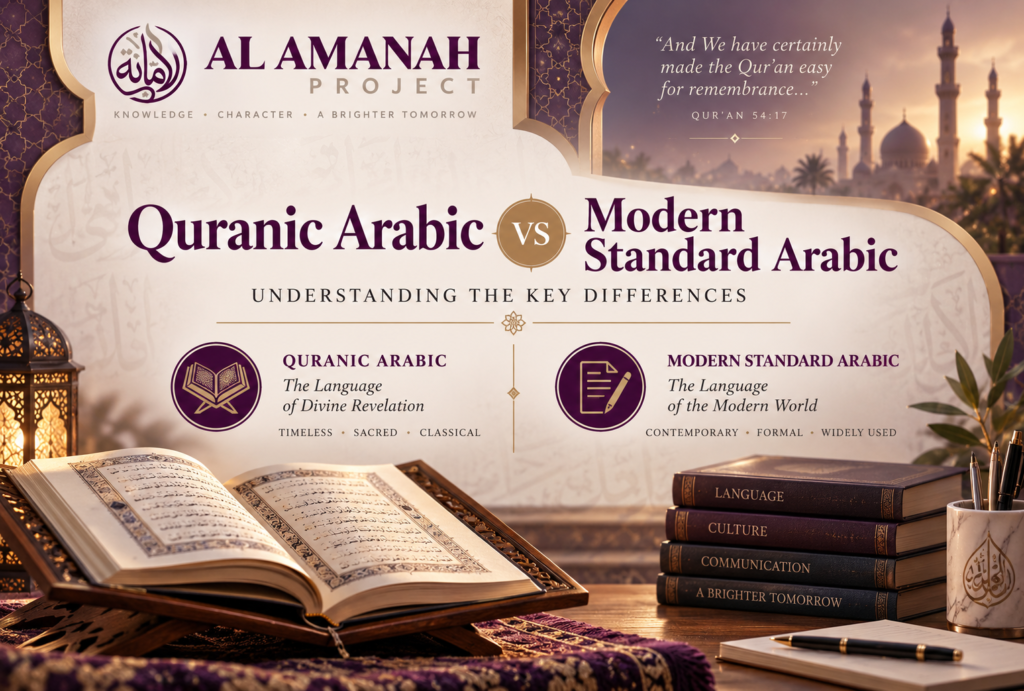
Difference Between Quranic Arabic and Modern Standard Arabic
A learner says, “I want to learn Arabic.” That sounds like a clear goal until the teacher asks a second question: Arabic for what?
Do you want to understand the Quran while reading and listening to recitation? Do you want to read contemporary Arabic books and newspapers? Do you need Arabic for university, work, travel, or communication? Or do you want a combination of these abilities?
The answer matters because Quranic Arabic and Modern Standard Arabic, commonly called MSA, are closely related but are not identical learning targets.
Quranic Arabic refers to the Arabic of the Quran and belongs to the classical literary tradition. Modern Standard Arabic is the contemporary formal variety used throughout the Arabic-speaking world in education, books, formal writing, news, speeches, and many professional settings. Cambridge describes MSA as a modern form based on the literary Arabic of the Quran and used broadly across the Arab world.
They share a great deal: script, root-based word formation, much of their grammatical framework, and a substantial amount of core vocabulary. Yet their vocabulary priorities, style, context, pronunciation practices, and learning objectives can be noticeably different.
For a student whose main goal is understanding revelation, learning Quranic Arabic directly is usually the more focused route. For someone who wants contemporary formal reading, writing, listening, and professional communication, MSA deserves greater emphasis.
The important point is not to treat them as two completely separate languages.
They are better understood as closely connected forms of Arabic serving different purposes.
What Is Quranic Arabic?
Quranic Arabic is the form of Classical Arabic encountered in the Quran. Students generally study it to understand Quranic vocabulary, grammatical structures, morphology, sentence relationships, rhetorical expression, and meaning.
Learning it involves far more than memorising translations.
A serious learner gradually develops the ability to recognise:
- Common Quranic vocabulary
- Arabic roots and derived forms
- Nouns, verbs, particles, and pronouns
- Nominal and verbal sentences
- Singular, dual, and plural forms
- Masculine and feminine structures
- Verb patterns
- Case and mood relationships
- Attached pronouns
- Prepositions
- Word order
- Context-dependent meanings
The Quranic Arabic Corpus demonstrates how detailed this linguistic structure can be. Its annotated resource identifies morphology, grammatical roles, verb forms, subjects, objects, cases, possessive constructions and other features word by word.
This explains why translating one Arabic word into one English word is often not enough to understand a verse properly.
Grammar and context matter.
A learner may recognise the basic meaning of a word yet miss who is performing an action, what is being described, whether a word is definite or indefinite, or how one phrase relates to another.
That is why structured study of Quranic Arabic can transform reading from word recognition into meaningful comprehension.
Students who need a broader foundation in reading, writing, vocabulary and basic grammar can also explore the Arabic Language Course from Al Amaanah Project. The course is structured around progressive Arabic-language skills.
What Is Modern Standard Arabic?
Modern Standard Arabic is the contemporary standard form of formal Arabic.
It is used in areas such as:
- Books
- Academic materials
- Newspapers
- Formal speeches
- Government and institutional communication
- News broadcasting
- Professional writing
- Educational content
- Formal websites and publications
It is important to distinguish MSA from everyday regional Arabic dialects.
A family in Egypt may use Egyptian Arabic at home. A family in Saudi Arabia may use a Gulf or regional variety. People in Lebanon, Morocco, Iraq and Sudan also have distinct spoken varieties.
MSA functions differently. It provides a broadly shared formal standard.
Cambridge University Press describes Modern Standard Arabic as the formal Arabic written and spoken in contemporary Arab societies and as a direct descendant of the Arabic of the Quran, classical literature and pre-Islamic poetry, with significant differences particularly in vocabulary and style.
That relationship is important.
A student who studies MSA is not learning something completely disconnected from Quranic Arabic. Much of the grammatical machinery will look familiar.
What changes most obviously is what learners need to talk and write about.
Modern life requires vocabulary for technology, transportation, medicine, business, administration, science, universities, computers, telecommunications and countless concepts that were not part of seventh-century discourse.
Quranic Arabic vs Modern Standard Arabic: Comparison Table
| Feature | Quranic Arabic | Modern Standard Arabic |
|---|---|---|
| Main purpose | Understanding the Quran and classical religious texts | Contemporary formal communication |
| Historical setting | Classical Arabic of the Quran | Modern continuation of formal literary Arabic |
| Writing system | Arabic script | Arabic script |
| Grammar | Classical grammatical structures | Largely shares the classical grammatical foundation |
| Vocabulary focus | Quranic concepts, faith, creation, morality, worship, stories and classical usage | Contemporary education, society, technology, media and professional life |
| Diacritics | Commonly shown extensively in printed Qurans | Often omitted from ordinary adult texts |
| Pronunciation goal | Closely connected with accurate Quran recitation | Formal standard pronunciation and communication |
| Tajweed | Essential for correct Quran recitation as a separate discipline | Not a general requirement of MSA communication |
| Main learners | Quran students, Islamic studies learners, researchers | Students, professionals, academics and general Arabic learners |
| Spoken use | Primarily recited and studied through classical texts | Used in formal speech as well as writing |
| Best choice for Quran comprehension | Highly relevant | Helpful, but not specifically Quran-focused |
| Best choice for modern news and formal communication | Limited modern vocabulary | Highly relevant |
The Biggest Difference Is the Learning Goal
Students sometimes spend months asking whether Quranic Arabic is harder than MSA.
A better question is:
What do I need Arabic to help me do?
Consider two learners.
Learner A Wants to Understand Salah and the Quran
This student wants to recognise phrases in Surah Al-Fatihah, understand frequently occurring words, follow Quran recitation more consciously and gradually analyse verses.
Teaching this person vocabulary about airports, journalism, modern administration and business meetings would not be the most efficient starting point.
Their course should prioritise Quranic Arabic, including common Quran words, roots, grammar and morphology.
Learner B Is Moving to an Arabic-Speaking Country for University
This learner may need to read academic notices, formal correspondence, websites, books and news.
MSA should therefore receive much more attention.
The student may later add a regional spoken dialect depending on where they live.
Learner C Wants Both
This is extremely common.
A learner wants to understand the Quran but also wants wider Arabic literacy.
In this situation, the paths do not have to compete. Begin with the learner’s highest priority and gradually expand.
Because the two varieties share substantial grammatical foundations, carefully learned concepts can transfer between them.
Difference in Vocabulary
Vocabulary is one of the clearest differences.
Quran-Focused Vocabulary
Students of Quranic Arabic repeatedly encounter vocabulary connected with concepts such as:
- Guidance
- Mercy
- Worship
- Belief
- Creation
- Knowledge
- Patience
- Gratitude
- Justice
- The Hereafter
- Prophets and communities
- Moral qualities
- Human actions and intentions
Many roots occur repeatedly in different grammatical forms.
Instead of memorising every form as an unrelated item, a learner can begin recognising families of meaning.
This is one of the strongest reasons to teach Arabic morphology—Sarf—alongside vocabulary.
MSA Vocabulary
An MSA learner needs words for modern subjects.
Examples might include terms related to:
- Digital technology
- Universities
- Transportation
- Companies
- Economics
- Scientific research
- Computers
- Hospitals
- Modern institutions
- International communication
Both learners study Arabic, but their first thousand useful words may look quite different.
Difference in Grammar
A common misconception is that MSA has one grammar and Quranic Arabic has an entirely different grammar.
That is misleading.
The foundational system has enormous continuity.
Both involve familiar Arabic concepts such as:
- Root-and-pattern morphology
- Verb conjugation
- Gender
- Number
- Pronouns
- Definite and indefinite nouns
- Nominal sentences
- Verbal sentences
- Adjective agreement
- Idafah constructions
- Prepositions
- Case relationships
Academic reference works on MSA still describe phonology, morphology and syntax within the broader Arabic grammatical tradition.
The practical difference is that Quranic study exposes the learner to classical constructions, rhetorical patterns and usages that may be less frequent in contemporary formal prose.
So an MSA learner opening the Quran may recognise the grammar but still need additional study to appreciate particular constructions and vocabulary.
Likewise, a student trained only in Quran-focused material may understand many Quranic structures but lack modern vocabulary needed to read a technology article.
Nahw and Sarf: Why Both Matter
Two terms quickly become important when learning Quranic Arabic:
Nahw
Nahw deals broadly with how words function within sentences and how grammatical relationships affect meaning.
A learner asks:
What is the subject?
What is the object?
What does this pronoun refer to?
Why does this word have this ending?
Which word is describing which noun?
Sarf
Sarf focuses on word formation and morphology.
Arabic frequently builds related words around roots and patterns. Recognising those relationships can dramatically improve vocabulary retention.
Instead of memorising isolated words, the student begins to recognise structure.
This is particularly valuable in Quranic Arabic, where repeated roots and derived forms give students opportunities to apply previous knowledge to new verses.
Difference in Diacritics
Anyone comparing a printed Quran with a modern Arabic website notices something immediately.
The Quran generally contains extensive vowel marks and recitation-related signs.
A typical contemporary MSA article usually contains far fewer.
Adult Arabic readers can often determine the correct reading of an unvowelled word from vocabulary, grammar and context.
For a beginner, however, removing vowel marks can make reading noticeably harder.
This creates an interesting learning experience: someone who has spent years reading a fully marked Quran may recognise Arabic letters confidently but still struggle when confronted with an unvowelled modern paragraph.
That does not mean the learner cannot read Arabic. It means a different reading skill now needs practice.
Is Tajweed the Same as Quranic Arabic?
No.
This distinction is extremely important.
Tajweed teaches the rules and practical application involved in correctly reciting the Quran, including matters of pronunciation and articulation.
Quranic Arabic language study focuses on understanding vocabulary, grammar, morphology and meaning.
You can therefore find four different learners:
- Someone who recites accurately but understands little Arabic.
- Someone who understands grammar but needs substantial recitation correction.
- Someone who can read Arabic text but has studied neither deeply.
- Someone developing both comprehension and correct recitation.
For well-rounded Quran learning, comprehension and recitation should support each other rather than being confused with each other.
Al Amaanah Project offers a Quran Tajweed Course focused on articulation, essential Tajweed rules and guided recitation practice.
What About Noorani Qaida?
For learners who cannot yet identify and join Arabic letters confidently, jumping immediately into grammar can be frustrating.
That student has an earlier problem to solve.
They first need decoding skills.
A foundation program such as Al Amaanah Project’s Noorani Qaida Course introduces Arabic letters, pronunciation, joining letters and progressive preparation for Quran reading.
A useful sequence can therefore be:
Letter recognition → accurate reading → basic Tajweed → vocabulary → grammar → morphology → verse analysis
Not every learner begins at the same stage.
Someone who already reads fluently should not spend months relearning letters. Someone unable to distinguish letters accurately should not be rushed into advanced grammatical terminology.
Practical Example: Reading Without Understanding
Imagine a learner who has recited a short Surah hundreds of times.
The sounds are familiar. Pronunciation may even be good.
Now the teacher asks:
“What is the verb in this verse?”
“Who is being addressed?”
“What does this attached pronoun refer to?”
“What root does this word come from?”
Suddenly the student realises that recitation and comprehension are different skills.
This is the point where Quranic Arabic study becomes especially meaningful.
The learner begins connecting familiar sounds with structure.
Over time, recitation stops feeling like a sequence of sounds whose meaning must always be looked up afterward.
Patterns start becoming recognisable while reading.
Al Amaanah Project also explains this progression in its resource on the benefits of learning Arabic for understanding the Quran, which emphasises vocabulary, structure, pronunciation and gradual guided study.
Can an MSA Student Understand the Quran?
An advanced MSA student has a significant advantage over someone with no Arabic.
They already know much of the grammar, script and root system.
However, understanding modern formal Arabic does not automatically provide complete Quran comprehension.
The learner may still encounter:
- Less familiar classical vocabulary
- Words with context-specific meanings
- Rhetorical structures
- Classical expressions
- Dense grammatical constructions
- Quran-specific usage
- Concepts requiring Tafsir rather than language knowledge alone
That final point is particularly important.
Language study is valuable, but language proficiency should not be treated as a replacement for Tafsir or qualified Islamic scholarship.
A word can be linguistically analysed without settling every interpretive question connected to a verse.
Can a Quranic Arabic Student Understand Modern Arabic?
Partially, depending on the student’s level.
A strong Quranic Arabic learner may recognise sentence structures, roots and many words in MSA.
But imagine opening an article about cybersecurity, aerospace engineering or contemporary medicine.
The grammar may look familiar while the vocabulary does not.
The student therefore needs to expand into modern lexical fields.
The same thing happens in English.
A person can be highly competent in English and still struggle with an advanced medical research paper because specialised vocabulary matters.
Arabic is no different.
Quranic Arabic vs Spoken Arabic Dialects
Another mistake is comparing only MSA with Quranic Arabic while assuming MSA is what everyone speaks at home.
Arabic-speaking communities use diverse regional varieties for everyday conversation.
MSA occupies the formal side of the language environment, while dialects serve many ordinary conversational settings. Cambridge’s academic overview explicitly distinguishes contemporary standard Arabic from regional colloquial varieties.
So a learner may eventually pursue three related goals:
Quranic Arabic for Quran comprehension.
MSA for formal modern Arabic.
A regional dialect for natural everyday conversation within a particular community.
Trying to master all three simultaneously from day one often produces unnecessary overload.
Prioritise.
Pros and Cons of Learning Quranic Arabic First
Pros
- Directly aligned with Quran comprehension
- Builds vocabulary that appears in Quran study
- Helps learners recognise recurring roots and structures
- Makes grammar immediately relevant to familiar verses
- Supports deeper engagement during recitation and study
- Provides a foundation for classical Islamic texts
Cons
- Does not automatically provide modern conversational ability
- Modern technical vocabulary requires separate expansion
- Classical structures can feel demanding to beginners
- Grammar-only courses can become difficult without practical application
- Quran comprehension still requires Tafsir and scholarly guidance beyond language analysis
Pros and Cons of Learning Modern Standard Arabic First
Pros
- Useful for contemporary formal reading and writing
- Provides access to modern Arabic publications
- Builds broad language skills
- Shares substantial grammar with Classical Arabic
- Helpful for academic and professional purposes
- Creates a strong base for expanding into other forms of Arabic
Cons
- The vocabulary syllabus may not prioritise Quran comprehension
- Quran-specific words and structures still need additional study
- MSA alone does not teach Tajweed
- It is not identical to everyday regional speech
- A student whose only objective is understanding the Quran may spend time on vocabulary unrelated to that immediate goal
Expert Recommendations from Al Amanah Project
Al Amanah Project recommends beginning with the learner’s actual level rather than forcing every student through the same syllabus.
1. Fix Reading Before Heavy Grammar
If Arabic letters still require guesswork, strengthen reading first.
Grammar becomes far easier when the student can comfortably recognise the words being analysed.
2. Learn High-Value Vocabulary in Context
Do not simply memorise hundreds of disconnected translations.
Study words as they appear in verses and revisit them repeatedly.
For Quranic Arabic, frequency and context are more valuable than random vocabulary lists.
3. Study Roots and Patterns Early
Once a learner understands basic word formation, unfamiliar forms stop looking completely unfamiliar.
Morphology turns vocabulary study into pattern recognition.
4. Connect Grammar to Real Quran Examples
A rule learned in isolation is easy to forget.
A rule recognised in Surah Al-Fatihah or another frequently recited passage becomes easier to remember.
5. Keep Recitation and Understanding as Separate Skills
Improve Tajweed with qualified correction while developing vocabulary and grammar through structured language lessons.
Do not assume success in one automatically guarantees success in the other.
6. Use Short, Consistent Study Sessions
Twenty to thirty focused minutes repeated throughout the week can be more productive than one irregular multi-hour session.
Consistency creates retrieval strength.
7. Add MSA According to Your Goals
If your priority is the Quran, establish your Quran-focused foundation first.
If you also want contemporary formal Arabic, gradually introduce MSA reading, listening and vocabulary.
This prevents the learner from thinking that choosing Quranic Arabic means permanently giving up modern Arabic.
A Practical 6-Stage Learning Roadmap
Stage 1: Arabic Reading Foundation
Master letter recognition, connected forms, basic vowels, sukoon, shaddah and common reading patterns.
Stage 2: Pronunciation and Recitation
Correct articulation with a teacher and begin applying essential Tajweed rules.
Stage 3: High-Frequency Quran Vocabulary
Learn frequently encountered words, particles, pronouns and common roots.
Stage 4: Basic Nahw
Understand word categories, nominal sentences, verbal sentences, adjective relationships, pronouns and common grammatical roles.
Stage 5: Sarf and Word Patterns
Learn how roots change into different verb and noun patterns.
Stage 6: Guided Verse Analysis
Take short passages and identify:
- Vocabulary
- Roots
- Verb forms
- Subjects
- Objects
- Pronouns
- Grammatical connections
- Translation possibilities
At this stage, Quranic Arabic becomes a working skill instead of a collection of memorised rules.
For learners who want to explore word-by-word morphology independently, the Quranic Arabic Corpus grammar resource provides extensive linguistic annotation.
For a scholarly reference on contemporary Arabic structure, Cambridge University Press’s A Reference Grammar of Modern Standard Arabic provides detailed coverage of MSA phonology, morphology and syntax.
Frequently Asked Questions
1. Is Quranic Arabic the same as Modern Standard Arabic?
No, although they are closely related. Quranic Arabic belongs to the Classical Arabic tradition of the Quran, while MSA is the contemporary formal standard. They share much of their grammatical foundation and vocabulary, but differ in historical usage, lexical priorities and style.
2. Should I learn Quranic Arabic or MSA first?
Choose according to your main objective. If understanding the Quran is your priority, begin with Quran-focused Arabic. If your primary goal is contemporary formal communication, academic reading or professional Arabic, MSA may be the better first emphasis.
3. Will learning Modern Standard Arabic help me understand the Quran?
Yes, substantially. MSA teaches grammar, vocabulary and structures closely related to classical literary Arabic. However, you will still need Quran-specific vocabulary, classical usage and contextual study.
4. Can I learn Quranic Arabic without learning spoken Arabic?
Yes. Understanding the Quran does not require mastering a regional dialect first. A learner can concentrate on reading, vocabulary, Nahw, Sarf and Quran analysis.
5. How long does it take to learn Quranic Arabic?
There is no universal timetable. A fluent Arabic reader studying consistently will progress differently from someone starting with the alphabet. A better approach is to measure milestones: reading accuracy, vocabulary recognition, grammar comprehension and the ability to analyse increasingly complex verses.
6. Is Quranic Arabic difficult for beginners?
It can feel demanding when grammar is introduced too quickly. A staged approach makes it more manageable: reading first, then vocabulary and simple structures, followed by morphology and deeper analysis.
7. Do I need Tajweed before learning Quranic Arabic?
You do not need to finish every Tajweed topic before beginning language study. They develop different skills and can be learned alongside each other. Tajweed improves recitation, while language study develops comprehension.
8. Is Classical Arabic exactly the same as Quranic Arabic?
The terms are often used loosely together, but Quranic Arabic specifically refers to the Arabic of the Quran, while Classical Arabic is a broader historical literary category that includes other early and classical texts.
9. Will Quranic Arabic help me speak with native Arabic speakers?
It provides vocabulary and grammar foundations, but it is not designed primarily for everyday conversation. For natural conversation, learners usually need exposure to a regional spoken dialect alongside or after formal Arabic study.
10. Can children and adults both learn Quranic Arabic?
Yes. The teaching method should differ. Children may benefit from more oral repetition, visual examples and short exercises, while adults can often handle explicit explanations of grammar and morphology earlier. In both cases, gradual progression and regular revision are important.
Conclusion
The difference between Quranic Arabic and Modern Standard Arabic is less about choosing the “correct” Arabic and more about choosing the right path for your objective.
Both belong to the same deep linguistic tradition.
MSA carries formal Arabic into contemporary education, writing, broadcasting, professional communication and modern literature. Quran-focused study takes the learner into the vocabulary, morphology, grammar and structures encountered in the Quran.
If your goal is Quran comprehension, build your study around Quranic Arabic rather than hoping that general Arabic exposure will eventually lead there by accident.
If your goal is modern formal fluency, MSA deserves systematic study.
And if you want both, you do not have to choose permanently. Build one foundation clearly, then expand.
The most productive learner is not the person trying to memorise the largest number of rules. It is the learner who can take a familiar verse, identify its important words, notice its grammatical relationships, recognise recurring roots and understand more today than they understood a month ago.
That gradual movement from recitation toward informed understanding is where Quranic Arabic study becomes genuinely meaningful.
Learn with Al Amanah Project
Al Amanah Project supports structured Quran and Arabic education for learners who want to strengthen reading, pronunciation and understanding.
Al Amanah Project
Hyderabad, Telangana
Phone: +91 98492 87719