
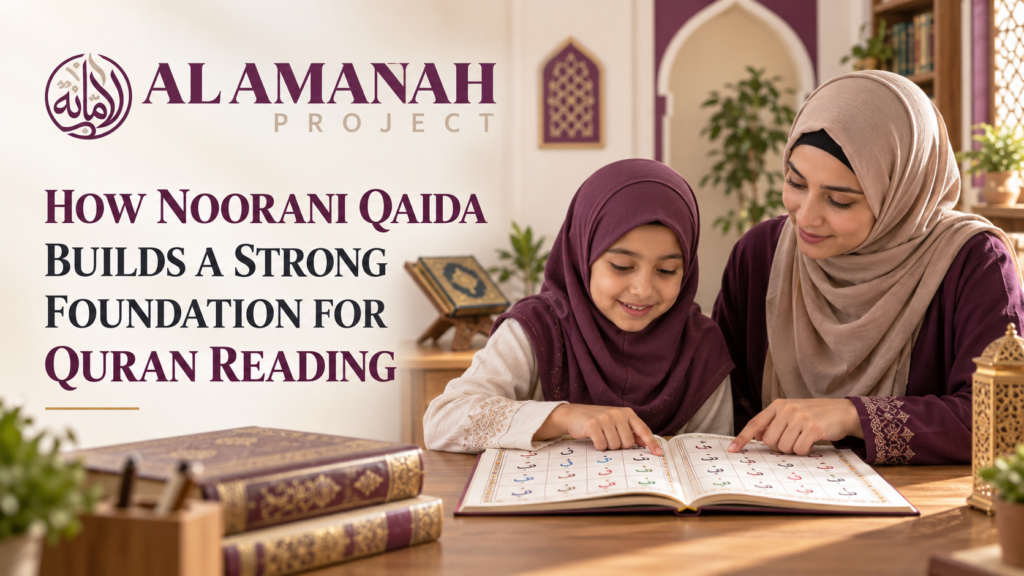
How Noorani Qaida Builds a Strong Foundation for Quran Reading
Learning to read the Quran is not simply a matter of memorising the Arabic alphabet. A student must recognise letters in different forms, pronounce each sound from its correct point of articulation, understand vowel marks, connect letters accurately and develop enough fluency to read without guessing. When these skills are introduced in the wrong order, beginners often feel overwhelmed. When they are taught systematically, Quran reading becomes far more manageable.
This is where Noorani Qaida plays an important role. It breaks Quran-reading skills into small, carefully sequenced lessons. Instead of placing a complete Quranic verse before a new learner, it begins with the smallest units of reading: individual letters and sounds. The student then progresses towards joined letters, short vowels, long vowels, sukoon, tanween, shaddah and other essential patterns.
The value of this approach lies in its structure. Each lesson prepares the learner for the next one. A student is not expected to read fluently before learning how Arabic letters change shape or how vowel marks affect pronunciation.
The Quran encourages careful, measured recitation: “Recite the Quran with measured recitation,” as conveyed in Surah Al-Muzzammil 73:4. Foundational study helps a learner move towards that goal with greater accuracy and confidence.
At Al Amanah Project, beginner Quran education is approached as a progressive learning journey. Learners can strengthen letter recognition and pronunciation before moving towards independent recitation and more detailed Tajweed study.
Contact Al Amanah Project to learn Noorani Qaida
What Is Noorani Qaida?
Noorani Qaida is a beginner-level instructional book and teaching method designed to introduce the Arabic reading system used in the Quran. It is commonly used with children, but its structure is equally useful for teenagers and adults who have never learned Arabic or who need to rebuild weak reading foundations.
The lessons usually begin with isolated Arabic letters. Learners study the name, written form and sound of each letter. They then encounter letters in joined combinations and practise reading them with different vowel signs.
A properly taught course may cover:
- Recognition of individual Arabic letters
- Differences between visually similar letters
- Correct pronunciation and articulation points
- Joined and changing letter forms
- Fathah, kasrah and dammah
- Tanween or double vowel sounds
- Madd or elongation
- Sukoon or the absence of a vowel
- Shaddah or letter emphasis
- Basic stopping and joining awareness
- Introductory recitation habits
The purpose is not to rush through a booklet. The real purpose is to develop reliable reading behaviour. A learner should gradually stop guessing and begin decoding every letter and mark that appears on the page.
Students interested in a structured learning pathway can explore the Noorani Qaida course at Al Amanah Project, which focuses on letter recognition, pronunciation practice, teacher feedback and Quran-reading preparation.
Contact Al Amanah Project to learn Noorani Qaida
Why Beginners Often Struggle with Quran Reading
Many reading difficulties do not begin with long verses or advanced Tajweed rules. They begin with small foundational gaps.
A student may recognise the letter ب when it appears alone but fail to identify it in the middle of a word. Another may know the names of Arabic letters without being able to produce their correct sounds. Some learners read from memory after hearing a phrase several times, which can hide the fact that they are not actually decoding the written text.
These problems may remain unnoticed while the material is easy. They become more visible when the learner encounters unfamiliar words.
Confusing similar-looking letters
Arabic includes several groups of letters that share a similar shape but differ through dots. Examples include:
- ب، ت and ث
- ج، ح and خ
- د and ذ
- ر and ز
- س and ش
- ص and ض
- ط and ظ
- ع and غ
A learner who relies only on the general shape may substitute one letter for another. Noorani Qaida trains the eyes to notice dots, position and letter identity before attempting to read complete words.
Producing familiar sounds instead of correct Arabic sounds
Beginners often replace unfamiliar Arabic sounds with the nearest sound from their first language. For example, ح may be read too much like ه, while ق may be softened into a different sound. This is understandable, but it must be corrected early because repeated errors can become habits.
Reading too quickly
Some learners believe that speed is proof of progress. They move through words quickly but omit vowel marks, shorten long vowels or merge sounds inaccurately. Slow, deliberate reading is usually more valuable during the foundation stage.
Depending entirely on transliteration
English or Roman transliteration can help someone remember a phrase, but it cannot reproduce every Arabic sound precisely. Long-term dependence on transliteration may delay direct engagement with Arabic script.
A sound beginner programme gradually removes these obstacles instead of allowing them to follow the learner into Quran recitation.
Contact Al Amanah Project to learn Noorani Qaida
How Noorani Qaida Develops Quran-Reading Skills
1. It establishes accurate letter recognition
The first skill is visual identification. Students learn to recognise each Arabic letter without relying on alphabetical order or neighbouring letters.
A useful teacher may show letters in a mixed sequence. If the student can identify ب only when it follows ا, the knowledge has not yet become independent. Mixed-letter practice reveals whether recognition is genuine.
Noorani Qaida also prepares students for the fact that many Arabic letters change appearance depending on whether they occur at the beginning, middle or end of a word.
For example, the letter ع can appear in multiple connected forms. A learner who knows only its isolated form may struggle when it appears inside a Quranic word. Progressive exercises train the student to recognise the underlying letter across these visual changes.
2. It connects each letter with its proper sound
Recognising a letter and pronouncing it are separate abilities. Effective instruction connects them from the beginning.
The teacher should model the sound, observe the learner’s mouth and tongue position, and provide a clear correction. The student then repeats the sound in short, focused attempts.
This introduces the learner to Makharij, the articulation points from which Arabic letters are produced. Detailed Makharij study may come later, but early awareness prevents avoidable habits.
A student may initially hear س and ص as similar. Guided comparison helps the student notice that they are produced with different qualities. The same principle applies to ت and ط, ذ and ظ, or ح and ه.
3. It teaches short vowels as functional sounds
Once letters are familiar, students learn how fathah, kasrah and dammah change the sound:
- بَ is read with an “a” sound.
- بِ is read with an “i” sound.
- بُ is read with a “u” sound.
This appears simple, but it is a major step. The learner is moving from naming letters to reading syllables.
A common beginner mistake is to pronounce the letter name instead of its sound. For example, the student may say “baa fathah” instead of reading بَ directly. Repeated practice helps the learner process the letter and vowel as one sound.
Contact Al Amanah Project to learn Noorani Qaida
4. It introduces joined letters gradually
Arabic is written primarily in a connected form, so isolated letter recognition is not enough. Noorani Qaida introduces combinations that teach students how letters interact.
At first, a learner may pause between every character. With guided repetition, the learner begins blending letters into a smooth unit without losing accuracy.
Consider a simple three-letter pattern. The beginner first identifies each letter, checks its vowel and reads each sound separately. The student then blends the sounds at a controlled pace. This method is more dependable than asking the learner to guess the complete word.
5. It develops awareness of long and short sounds
The difference between a short vowel and an elongated sound is significant in Quran recitation. Beginners may stretch every sound or fail to extend letters that require lengthening.
Structured Qaida lessons teach the difference through repeated contrast. The learner hears and practises a short sound beside a longer one. Rather than memorising an abstract rule, the student develops auditory awareness.
6. It prepares students for sukoon and shaddah
Sukoon shows that a letter does not carry a vowel. Shaddah indicates a doubled or strengthened consonant. Both features can be difficult for beginners because they require careful blending.
A student who ignores shaddah may remove part of a word’s sound. Another may insert an unnecessary vowel after a letter with sukoon. Targeted drills allow the learner to focus on one pattern before meeting it inside longer Quranic passages.
7. It creates readiness for Tajweed
Noorani Qaida and Tajweed are connected, but they are not identical. The Qaida builds decoding and pronunciation skills; Tajweed develops a more detailed understanding and application of recitation rules.
Students who can already recognise letters, vowel marks and basic patterns are in a better position to understand concepts such as ghunnah, qalqalah, rules of noon sakinah and meem sakinah, and different forms of madd.
Learners ready for this next stage can review the Tajweed course at Al Amanah Project, which includes Makharij practice, recitation correction and guided revision.
Contact Al Amanah Project to learn Noorani Qaida
Noorani Qaida Versus Beginning Directly with the Quran
| Learning area | Starting with Noorani Qaida | Beginning directly with Quran pages |
|---|---|---|
| Letter recognition | Letters are introduced and reinforced systematically | Learner meets many letter forms at once |
| Pronunciation | Individual sounds can be isolated and corrected | Errors may be harder to identify inside complete words |
| Vowel marks | Each mark is taught through focused exercises | Multiple signs appear together immediately |
| Learning pace | Moves from simple patterns to complex reading | Complexity may overwhelm a complete beginner |
| Confidence | Small achievements are visible | Difficulty reading verses may cause frustration |
| Teacher feedback | Correction can focus on one skill at a time | Several errors may occur within one line |
| Tajweed readiness | Provides a base for later rules | Student may memorise rules without decoding confidently |
| Best suited for | Beginners and learners rebuilding foundations | Learners who already recognise and blend Arabic letters |
Beginning directly with the Quran is not wrong for every learner. Someone who already reads Arabic may be ready to do so. However, a complete beginner often benefits from a staged method that reduces cognitive overload.
A Practical Example of Skill Progression
Imagine an adult learner who can recite several short surahs from memory but cannot read an unfamiliar Quranic word. The learner may feel embarrassed because memorised recitation has created the appearance of reading ability.
A responsible teacher does not begin by correcting an entire page. The teacher first checks whether the learner can:
- Identify Arabic letters in mixed order.
- Recognise their connected forms.
- Read letters with short vowels.
- Distinguish short and long sounds.
- Read sukoon and shaddah correctly.
- Blend three- or four-letter patterns.
- Apply those skills to an unfamiliar word.
Suppose the learner confuses ث and ت. The teacher creates a short contrast exercise and places both letters in several positions. After visual recognition improves, the teacher checks pronunciation. Only then does the learner return to word-level reading.
This “find the smallest missing skill” approach is more effective than repeatedly asking the student to reread the same difficult verse. Noorani Qaida makes this diagnostic process possible because its lessons separate foundational skills into observable stages.
Contact Al Amanah Project to learn Noorani Qaida
A 12-Minute Home Practice Method
Long study sessions are not always necessary for a beginner. Consistent, attentive practice is often more useful than irregular hour-long sessions.
A simple daily routine can look like this:
Minutes 1–2: Previous lesson review
Read a small set of material from the last completed lesson. Mark any repeated hesitation.
Minutes 3–5: Letter and sound contrast
Practise one easily confused pair, such as س and ص or ح and ه. Listen to a teacher’s model rather than inventing the sound independently.
Minutes 6–9: Current lesson
Read only a manageable number of lines. Accuracy should come before speed.
Minutes 10–11: Error correction
Return to two or three mistakes. Identify exactly what went wrong: letter recognition, vowel, elongation, articulation or blending.
Minute 12: Independent reading check
Attempt one short, unfamiliar line. This shows whether the skill can be transferred beyond memorised exercises.
Parents should avoid giving several corrections at the same time. If a child misidentifies a letter and also mispronounces it, correct the letter identity first and then work on the sound.
Contact Al Amanah Project to learn Noorani Qaida
Signs That a Learner Is Ready to Progress
Finishing a page does not necessarily mean mastering it. Before moving forward, a learner should demonstrate reasonable consistency.
Useful readiness checks include:
- Recognising letters in mixed order
- Reading without relying on the position of the exercise
- Distinguishing similar letter groups
- Applying short vowels accurately
- Identifying long vowels without unnecessary stretching
- Reading joined patterns without guessing
- Responding constructively to correction
- Reading a new example using the same rule
- Retaining the skill at the next lesson
A teacher may still allow minor mistakes while progressing, particularly with a very young learner. The important question is whether the error is occasional or whether it reveals a missing foundation.
Contact Al Amanah Project to learn Noorani Qaida
Benefits of Learning Through Noorani Qaida
A clear learning sequence
The learner knows what to practise and why. New material grows from previously acquired skills.
Early correction of pronunciation
It is easier to correct one letter during foundation study than to repair the same mistake after it has been repeated in many surahs.
Greater reading independence
The learner gradually becomes able to decode unfamiliar material rather than depending entirely on listening or memorisation.
Confidence based on real ability
A student gains confidence from recognising patterns and solving reading problems, not merely from completing pages.
Suitability for different age groups
Children, teenagers and adults can use the same basic sequence, while the teacher adjusts the pace, explanation and practice style.
Preparation for deeper study
Once the mechanics of reading become more stable, the learner can devote greater attention to Tajweed, memorisation and meaning. Those who want to develop broader reading, writing and vocabulary skills can also consider a structured Arabic-language course.
The Quran describes itself as facilitated for remembrance in Surah Al-Qamar 54:17. Learning still requires patience and practice, but a clear pathway can make that effort more focused.
Contact Al Amanah Project to learn Noorani Qaida
Pros and Cons of Noorani Qaida
Pros
- Introduces Quran reading in manageable stages
- Builds strong Arabic letter recognition
- Supports more accurate pronunciation
- Helps teachers identify specific learning gaps
- Reduces dependence on transliteration
- Creates a foundation for Tajweed
- Works for children and adult beginners
- Makes progress easier to observe
- Encourages disciplined, careful reading
Cons and limitations
- The book alone cannot listen to or correct a learner.
- Poor teaching may turn lessons into mechanical repetition.
- Students can lose motivation if they remain on the same exercise without explanation.
- Completing the Qaida does not automatically produce fluent Quran recitation.
- It does not replace continued practice with the Quran.
- It does not cover every advanced Tajweed rule in depth.
- Learners may develop errors when practising without a reliable model.
These limitations do not reduce the method’s usefulness. They show why teaching quality, feedback and regular application matter as much as the book itself.
Expert Recommendations from Al Amanah Project
Based on Al Amanah Project’s structured approach to beginner learning, the following practices can help students receive more value from their lessons.
Begin with a short assessment
Do not assume that an older student should skip foundational work. Age and reading level are different. A five-minute assessment of letters, vowels and blending can prevent months of frustration.
Correct one category of error at a time
If a learner makes several mistakes, classify them. Is the main problem visual recognition, Makharij, vowel awareness or blending? Correcting the highest-priority problem first produces clearer improvement.
Contact Al Amanah Project to learn Noorani Qaida
Keep a personal error list
Each learner has recurring difficulties. A small record might include:
- Confuses ت and ث
- Shortens madd
- Adds a vowel after sukoon
- Misses shaddah
- Reads too quickly at line endings
Reviewing this list for a few minutes before each session makes practice more personal and efficient.
Use the “three correct readings” rule
After correcting an error, ask the student to read the pattern correctly three times with attention. One successful repetition may be accidental; repeated accuracy gives stronger evidence of learning.
Combine listening with visual tracking
The learner should follow the printed letters while listening to the teacher. Listening without looking can become memorisation, while looking without a correct audio model may reinforce inaccurate pronunciation.
Contact Al Amanah Project to learn Noorani Qaida
Move forward without rushing
A student should not be held back until every sound is perfect, but repeated foundational errors should not be ignored. Good instruction balances progress with correction.
Review after a gap
A skill that appears secure today may weaken after several days. Brief delayed review shows whether learning has been retained.
Al Amanah Project provides guided learning options for different ages and levels. Families can learn more about its educational approach on the About Al Amanah Project page.
The Role of Parents in a Child’s Progress
Parents do not need to be Quran teachers to support learning. Their most important contribution is creating a calm and consistent practice environment.
A parent can:
- Set a regular practice time
- Keep sessions short enough for the child’s age
- Praise effort and careful correction
- Avoid comparing siblings or classmates
- Ask the teacher which sounds require practice
- Use the same terminology as the teacher
- Listen without interrupting every few seconds
- Inform the teacher when the child is struggling
Parents should be cautious about correcting pronunciation if they are uncertain. Conflicting models can confuse a beginner. It is better to ask the teacher for an audio example or a specific home exercise.
Why Teacher Guidance Matters
A printed page can show a letter, but it cannot determine whether the learner has produced the sound correctly. It cannot notice that a student is reading from memory or that the tongue position is producing the wrong sound.
Teacher guidance provides:
- Live pronunciation modelling
- Immediate correction
- Age-appropriate explanation
- Adjusted pacing
- Accountability
- Encouragement
- Progress assessment
- A bridge from exercises to Quranic text
This is especially important for sounds that do not exist in the learner’s first language. A qualified instructor can explain the articulation point and help the learner distinguish between sounds that initially appear identical.
Seeking beneficial knowledge is itself an important Islamic value. The supplication “My Lord, increase me in knowledge” appears in Surah Taha 20:114, reminding learners that progress should be accompanied by humility and sincere effort.
Frequently Asked Questions
1. What age should a child start Noorani Qaida?
There is no single compulsory starting age. Many children begin when they can listen for short periods, distinguish basic visual shapes and repeat sounds after a teacher. Readiness is more important than competition. For a young child, lessons may last only 10 to 15 minutes and use repetition, encouragement and visual activities. Older beginners can usually handle longer explanations and more independent practice.
2. Can adults learn Noorani Qaida?
Yes. Noorani Qaida is not restricted to children. Adults who cannot read Arabic, rely on transliteration or have persistent pronunciation problems may benefit greatly from returning to the foundations. Adult lessons should respect the learner’s maturity and existing knowledge. The instructor can move quickly through secure skills and spend more time on genuine gaps.
3. How long does it take to complete Noorani Qaida?
Completion time differs according to age, lesson frequency, home practice, previous exposure and pronunciation needs. Some learners progress within several months, while others need longer. Finishing quickly should not be the main objective. The more useful measure is whether the student can recognise, pronounce and blend unfamiliar patterns independently.
4. Can I learn Noorani Qaida without a teacher?
A learner can use a book or audio resource for additional practice, but independent study has limitations. Beginners may not hear their own pronunciation errors. They may also misunderstand a rule or memorise exercises without developing transferable reading ability. Teacher feedback is particularly valuable for Makharij, elongation, sukoon and shaddah.
5. Is Noorani Qaida the same as Tajweed?
No. Noorani Qaida teaches the fundamental mechanics required for reading Arabic Quranic text. Tajweed is the study and application of rules that govern correct Quran recitation. There is some overlap because a good beginner course introduces careful pronunciation and basic recitation habits. However, advanced Tajweed requires further guided study.
6. Can Noorani Qaida help someone who already reads the Quran slowly?
Yes. Slow reading may result from weak letter recognition, uncertain vowel processing or difficulty blending connected forms. A teacher can assess the learner and select only the relevant lessons instead of restarting every exercise. Rebuilding one missing skill may improve both speed and accuracy.
7. How much should a beginner practise each day?
For many beginners, 10 to 20 minutes of focused daily practice is more effective than one long weekly session. Young children may need even shorter sessions. Practice should include recent material, one correction target and a small independent-reading check. If accuracy declines through fatigue, the session has probably continued too long.
8. What should a student do after completing Noorani Qaida?
The learner should begin guided Quran reading while continuing to review difficult patterns. The transition should be gradual. Short surahs or selected passages may be used before longer pages. The next stage can include fluency development, correction of recurring errors, memorisation and structured Tajweed lessons.
9. Why can a student complete the Qaida but still struggle with the Quran?
Completing exercises and transferring them to authentic text are different skills. A learner may have memorised the sequence of a lesson, practised too little unfamiliar material or moved forward without retaining earlier rules. The solution is not always to repeat the entire book. A teacher should assess the learner, identify the precise weakness and provide targeted bridge practice using both Qaida patterns and Quranic words.
10. Are online Noorani Qaida classes effective?
Online classes can be effective when the teacher can hear the student clearly, observe participation and provide immediate feedback. A stable connection, suitable microphone, visible learning material and distraction-free space are important. Younger children may also require a parent nearby. The class format matters less than the quality of instruction, consistency and active correction.
Contact Al Amanah Project to learn Noorani Qaida
Conclusion
A strong Quran-reading foundation is built through careful progression, not speed. Learners must first see letters accurately, produce their sounds correctly, understand vowel signs and connect written patterns without guessing. Noorani Qaida offers a practical sequence for developing these abilities.
Its greatest value is not the number of pages a learner completes. Its value appears when the student can approach an unfamiliar Quranic word, examine its letters and marks, and read it with growing independence. That ability creates a dependable base for fluent recitation, Tajweed, memorisation and lifelong engagement with the Quran.
A good teacher, consistent practice and thoughtful review turn the Qaida from a simple booklet into a genuine reading pathway. Learners should proceed patiently, welcome correction and measure progress through retained skill rather than hurried completion.
For personal religious rulings or complex questions about recitation, learners should consult a qualified Islamic scholar or experienced Quran teacher..
Contact Al Amanah Project to learn Noorani Qaida
Contact Al Amanah Project
Al Amanah Project
Hyderabad, Telangana
Phone: +91 98492 87719
Website: https://alamanahproject.com/